



Antonio Ligabue
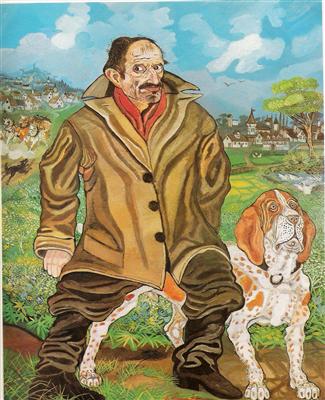
Antonio Ligabue was born in Switzerland, abandoned by his mother, expelled from school, deported to Italy at eighteen, and committed to psychiatric institutions repeatedly throughout his life. He produced paintings of wild animals, self-portraits, and rural landscapes with a ferocity that made him one of the most celebrated outsider artists in European art.
Biography
Born Antonio Laccabue in Zurich in 1899[1], he was raised by foster parents and showed behavioural difficulties from childhood. In 1919[1], Swiss authorities deported him to his biological father's village in Gualtieri, in the Po Valley, where he lived as a vagrant, sleeping in fields and producing paintings from whatever materials he could find.
His paintings of tigers, lions, and eagles in combat have a raw, confrontational energy that bypasses academic convention. The self-portraits, depicting himself with bulging eyes and exaggerated features, are among the most unsettling in twentieth-century art. He was championed by the sculptor Marino Mozzali.
Ligabue spent periods in the Reggio Emilia psychiatric hospital and continued painting between commitments. He received a solo exhibition in Rome in 1961[1]. He died in Gualtieri in 1965[1]. A museum dedicated to his work was established in the town.
Timeline
- 1899Born Antonio Laccabue in Zurich, Switzerland
- 1919Deported to Gualtieri, Italy
- 1961Solo exhibition in Rome
- 1965Died in Gualtieri, Italy
Notable Works
Tap to view larger.
Next stop
Browse the movements →
Every movement in the collection, from the Renaissance to Pop art.
Related Artists


Frequently Asked Questions
What is Antonio Ligabue known for?
Antonio Ligabue is known for his paintings of wild animals, self-portraits, and rural scenes. His paintings have a raw energy that sets them apart from academic art.What should I know about Antonio Ligabue's prints?
Antonio Ligabue (1899[1]-1965[1]) was an Italian[1] artist known for his paintings and sculptures of animals. Although he is less recognised for printmaking, reproductions of his works are widely available as prints. Ligabue's original works are characterised by intense colours and expressive brushstrokes. His subject matter primarily includes wild animals, such as tigers, lions, and horses, often depicted in dramatic or confrontational poses. These images reflect both his fascination with the animal world and his own internal struggles. He also created self-portraits that reveal a raw and vulnerable emotional state. Prints of Ligabue's work offer an accessible way to appreciate his unique artistic vision. When considering a Ligabue print, it is important to check the print quality and origin. Prints can vary widely in colour accuracy and detail, so comparing different versions is advisable. Collectors should also be aware of the distinction between original prints (made by the artist) and reproductions (copies of existing artworks). In Ligabue's case, most available prints are reproductions of his paintings.What style or movement did Antonio Ligabue belong to?
Antonio Ligabue (1899[1]-1965[1]) was an Italian[1] artist known for his intense and expressive paintings and sculptures of animals. He is often described as an outsider artist, or Art Brut, due to his isolation, mental health struggles, and lack of formal training. Ligabue's style is characterised by bold colours, distorted forms, and a raw, emotional quality. His work does not fit neatly into any established art movement. Some critics associate him with Expressionism because of the emotional intensity and subjective perspective found in his paintings. Others see a connection to Naive art, because of his simplified forms and direct, untrained approach. Ligabue spent much of his life in poverty and suffered from mental illness. He lived in the rural Po River region of Italy. His art reflects his personal experiences and his deep connection to the natural world, especially wild animals. While not formally part of any movement, his unique vision has earned him a place in the history of 20th-century Italian art.What techniques or materials did Antonio Ligabue use?
Antonio Ligabue employed diverse materials and techniques in his art. He favoured oil paint, often applying it to masonite or other inexpensive supports. This choice reflected his limited financial resources. Ligabue had an individual, expressive style. He used strong colours and vigorous brushstrokes to create dynamic compositions. His impasto technique, involving thick layers of paint, added texture and dimension to his works. Some scholars have noted the influence of German Expressionism on his artistic approach. Ligabue also worked with sculpture, using clay and bronze to create figures of animals and people. His sculptures share the same raw energy found in his paintings. Ligabue's graphic work, including drawings and etchings, further demonstrates his versatility. These pieces often served as studies for larger paintings. His subject matter included circus scenes and wild animals.What was Antonio Ligabue known for?
Antonio Ligabue (1899[1]-1965[1]) was an Italian[1] artist known for paintings and sculptures of animals. Ligabue's work is often categorised as naive art (or art brut), because he was a self-taught artist who was not part of the art establishment. He spent much of his life in psychiatric hospitals, and his art was not widely recognised until late in his life. Ligabue's subject matter included wild animals (tigers, lions, leopards and eagles), farmyard animals, and self-portraits. He worked in a variety of media, including oil paint, sculpture, and drawings. His paintings are characterised by intense colour and expressive brushwork. Although he did a few landscapes, he is best known for his animal paintings. Ligabue's art is now held in several Italian museums.When did Antonio Ligabue live and work?
Antonio Ligabue (1899[1]-1965[1]) was an Italian[1] artist known for his paintings and sculptures of animals. He was born in Zurich, Switzerland, on 18 December 1899[1]. His birth mother was Maria Elisabetta Costa; he was given to an adoptive Swiss family with the surname Ligabue. Ligabue was institutionalised several times for psychiatric problems. He was expelled from Switzerland in 1919 and moved to Italy, to the town of Gualtieri, in the province of Reggio Emilia. He lived there in poverty, making art from humble materials. His artistic career began to gain recognition in the 1950s. Several critics and collectors started to notice his unique style and the emotional power of his work. Despite facing personal difficulties throughout his life, Ligabue produced a substantial body of work, including paintings, drawings and sculptures. He died on 27 May 1965 in Gualtieri, leaving behind a complicated and compelling artistic output. His art continues to be exhibited and studied, and it maintains its appeal due to its raw expression and unique perspective.Where can I see Antonio Ligabue's work?
Antonio Ligabue's paintings and sculptures are primarily held in Italian[1] collections, especially in locations connected to his life and career. The Museo Ligabue, located in Gualtieri, Italy, holds a collection of his works. Gualtieri was Ligabue's hometown; the museum provides context for his artistic development. Another significant collection is found at the Antonio Ligabue Foundation in Gualtieri. This foundation promotes the study and appreciation of his art. The Galleria Parmeggiani in Reggio Emilia also possesses pieces by Ligabue. Reggio Emilia was another important location in the artist's life; he spent considerable time there. These museums offer the most comprehensive access to Ligabue's oeuvre. Smaller selections of his work may appear in temporary exhibitions at other galleries and museums throughout Italy. However, the collections in Gualtieri and Reggio Emilia remain the central locations for viewing his art. Catalogues of past exhibitions can also provide information, even when the shows are closed.Where was Antonio Ligabue from?
Antonio Ligabue (1899[1]-1965[1]) was born in Zurich, Switzerland, on 18 December 1899[1]. His birth name was Antonio Costa. He was the out-of-wedlock child of Elisabetta Costa, who was originally from Belluno, Italy. Ligabue's early life was difficult. Shortly after his birth, he was given to a Swiss-German family named Göbel. He remained with them until 1919. He developed behavioural problems and was eventually expelled from school. In 1919, Elisabetta Costa and her husband were murdered. After this, the Swiss authorities declared Ligabue to be Italian[1] and deported him to Italy. Ligabue was sent to Gualtieri, in the province of Reggio Emilia, because his father was supposedly from there. Ligabue had never lived in Italy and knew no one in Gualtieri. He did not speak Italian well, only a dialect of German and some French. He lived a marginal existence in Gualtieri for the rest of his life, making a living through his art. He died in Gualtieri on 27 May 1965.Who did Antonio Ligabue influence?
While a direct line of influence is difficult to establish, some artists working later in the 20th century have been compared to Ligabue. Nicola Vitale's book *Sunniness in Paintings* suggests a connection between Ligabue's style and that of several contemporary artists. Vitale notes that certain artists, without necessarily following a specific model, arrived at similar expressive forms. Among these, he mentions David Hockney, known for his Pop Art swimming pool paintings, who later shifted to woods and fields. Gianantonio Abate, associated with the Nuovi Futuristi, also developed a style with similarities to Ligabue. David Bowes, recognised for his figurative painting, moved towards a sunny radiance of image. The critic Diane Waldman observed that Italian[1] art contains a continuum of old and new. She identified artists such as Giorgio de Chirico, Filippo de Pisis, and Carlo Carra as forerunners of the trans-avantgarde movement. While not directly linked to Ligabue, these artists shared certain preoccupations, such as allegorical subjects and deliberate clumsiness in technique. This suggests a broader trend in Italian art that resonates with some aspects of Ligabue's work.Who influenced Antonio Ligabue?
It is difficult to identify specific influences on Antonio Ligabue, who was largely self-taught and worked in relative isolation. However, some connections can be drawn between his art and the work of earlier artists. Ligabue's intense, expressive style and focus on animal subjects have been compared to those of Henri Rousseau. Like Rousseau, Ligabue had no formal training and developed a unique, individual approach to painting. His raw, emotional approach to his subjects also has some parallels with German Expressionism. Ligabue's paintings share the Expressionists' interest in conveying strong feelings and subjective experiences. While it is not certain that Ligabue was directly influenced by these movements, his work shares some aesthetic similarities. Ultimately, Ligabue's art is highly personal and reflects his own unique vision and experiences.Who was Antonio Ligabue?
Antonio Ligabue (1899[1]-1968) was an Italian[1] artist. Born in Switzerland, he spent much of his life in Italy. His artistic career was marked by personal struggles and a unique style. Ligabue's early life was difficult, and he faced mental health challenges throughout his life. These struggles often influenced his art, which is characterised by intense emotion and raw expression. Ligabue's art often depicted animals, particularly wild ones, and self-portraits. His paintings and sculptures are known for their bold colours and expressive brushwork. Although he did not achieve widespread recognition during his lifetime, Ligabue's work gained attention posthumously. Today, he is recognised as an important figure in 20th-century Italian art, celebrated for his distinctive vision and powerful artistic voice.Why are Antonio Ligabue's works important today?
Antonio Ligabue (1899[1]-1965[1]) is remembered for his distinctive style and his outsider status. He spent much of his life in poverty and suffered from mental illness. Despite these hardships, he produced a substantial body of work, mainly paintings and sculptures of animals. Ligabue's art is characterised by its raw energy and emotional intensity. His paintings often depict wild animals in dramatic poses, reflecting both his fascination with nature and his own inner turmoil. The expressive use of colour and distorted forms contribute to the unique visual impact of his pieces. Interest in Ligabue's work has grown since his death. His art appeals to those interested in outsider art, or art brut, which is made by self-taught or marginalised artists. His biography has also been the subject of films and plays, which has further increased his public profile. He is now recognised as a significant figure in 20th-century Italian[1] art, whose work offers a powerful expression of human experience.
Sources
Editorial draws on the following primary and tertiary references for Antonio Ligabue.
- [1] wikipedia Wikipedia: Antonio Ligabue Used for: biography, birth dates, death dates, identifiers, movement attribution, nationality.
- [2] book guggenheim-futurismmodernfo00solo Used for: biography.
- [3] book guggenheim-italianartnowame00wald Used for: biography.
- [4] book Braun, Emily, 1957-; Asor Rosa, Alberto; Royal Academy of Arts (Great Britain), Italian art in the 20th century : painting and sculpture, 1900-1988 Used for: biography.
Editorial overseen by Solis Prints. Sources verified 2026-10-14. Click a source for details, or hover over [N] in the page above to preview.
Editorial standardsMethodologyCorrectionsAI disclosureAbout the editorial team