



António de Carvalho da Silva Porto
When António de Carvalho da Silva Porto returned to Portugal from Paris in 1879[1], he brought the Barbizon School with him. Alongside his fellow student João Marques de Oliveira, he introduced the direct observation of nature that French painters such as Corot and Daubigny had pioneered, redirecting Portuguese painting away from academic historicism. The two are jointly regarded as the founders of Portuguese Naturalism.
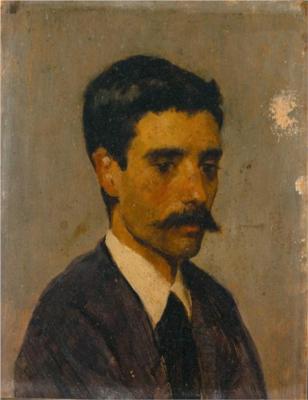
Biography
Born in Porto in 1850[1], he trained first under João António Correia and Tadeu de Almeida Furtado before a state pension took him to Paris, where he studied under Adolphe Yvon and Alexandre Cabanel. He also spent time in Rome. He exhibited at the Paris Salon and at the 1878[1] Exposition Universelle before returning home the following year.
Back in Portugal, Silva Porto focused on rural scenes: beach settings, village markets, quiet corners of the Portuguese countryside, all approached with the tonalist sensitivity he had absorbed in France. Secondary influence from Impressionism is visible in his handling of light, though he stayed within the Naturalist tradition throughout. Works such as Going to Market (1886[1]) and A Quiet Place on the Beach typify his mature approach. His canvases are held at the Chiado Museum in Lisbon and the National Museum Soares dos Reis in Porto.
He died in Lisbon in July 1893[1] at forty-two, cutting short a career that had already changed how Portuguese painters looked at their own landscape.
Timeline
- 1850Born in Porto, Portugal.
- 1878Exhibited at the Exposition Universelle in Paris.
- 1879Returned to Portugal from Paris, bringing the Barbizon School style with him.
- 1879Along with João Marques de Oliveira, introduced direct observation of nature to Portuguese painting.
- 1879Redirected Portuguese painting away from academic historicism.
- 1879Returned home after spending time in Rome.
- 1886Painted "Going to Market", a typical example of his mature style.
- 1893Died in Lisbon at 42. His career had changed how Portuguese painters viewed their own country.
Notable Works
Tap to view larger.
Next stop
Browse the movements →
Every movement in the collection, from the Renaissance to Pop art.
Frequently Asked Questions
What is António de Carvalho da Silva Porto known for?
António de Carvalho da Silva Porto is known for introducing the Barbizon School style to Portugal. With João Marques de Oliveira, he is regarded as a founder of Portuguese Naturalism, shifting the focus of Portuguese painting. He is known for his rural scenes, such as beach settings and village markets.Who was António de Carvalho da Silva Porto?
António de Carvalho da Silva Porto was a Portuguese painter who, along with João Marques de Oliveira, is credited with introducing Naturalism to Portuguese painting. He brought the Barbizon School aesthetic, with its emphasis on direct observation of nature, back from France after studying there. He redirected Portuguese painting away from academic historicism.What was António de Carvalho da Silva Porto's art style?
Silva Porto's art style was primarily Naturalism, influenced by the Barbizon School. He adopted the practice of direct observation of nature, focusing on tonalist sensitivity in his works. Secondary influence from Impressionism is visible in his handling of light.How did António de Carvalho da Silva Porto die?
António de Carvalho da Silva Porto died in 1893[1] at the age of 43.
Sources
Editorial draws on the following primary and tertiary references for António de Carvalho da Silva Porto.
- [1] wikipedia Wikipedia: António de Carvalho da Silva Porto Used for: biography, birth dates, death dates, identifiers, movement attribution, nationality.
- [2] book Jennifer D. Milam, Historical Dictionary of Rococo Art Used for: biography.
Editorial overseen by Solis Prints. Sources verified 2026-10-07. Click a source for details, or hover over [N] in the page above to preview.
Editorial standardsMethodologyCorrectionsAI disclosureAbout the editorial team