

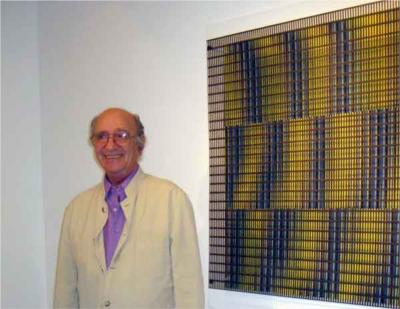
Antonio Asis
When Antonio Asis arrived in Paris in 1956[1] after training at the Escuela Nacional de Bellas Artes in Buenos Aires, he walked into the most concentrated gathering of kinetic and optical art anywhere in the world. The Denise René gallery was the hub; there he encountered Jesús Rafael Soto, Pol Bury, and Yaacov Agam, artists already developing the visual languages of movement, interference, and perceptual instability that would define Op Art.
Biography
Born in Argentina in 1932[1], Asis made Paris his permanent home and spent the following decades systematically investigating what happens when the eye meets patterns calibrated to produce the sensation of movement in static objects. His signature works, the Interférences concentriques series, built fields of concentric geometric forms that appeared to pulse and vibrate as the viewer moved in relation to them. A parallel line of sculptures, the Vibrations pieces, used layered metal grilles to create moiré interference patterns in three dimensions.
These were not purely decorative experiments. The Op Art and kinetic movements of the 1960s carried a particular conviction: that art could engage the nervous system directly, bypassing cultural literacy and reaching any viewer regardless of education or background. For a generation of Latin American artists in Paris, this democratic aspiration had additional weight, coming as it did from outside the European tradition they were simultaneously absorbing.
Asis exhibited at the Paris Biennale in 1967[1] and at the Casa de Cultura in Grenoble in 1968, during Op Art's peak institutional moment. He continued working in Paris until his death in 2019[1] at the age of 87.
Timeline
- 1932Born in Argentina.
- 1956Moved to Paris after training at the Escuela Nacional de Bellas Artes in Buenos Aires.
- 1960Began systematically investigating the effects of patterns on the eye to produce the sensation of movement in static objects.
- 1967Exhibited at the Paris Biennale.
- 1968Exhibited at the Casa de Cultura in Grenoble.
- 2019Died in Paris at the age of 87.
Next stop
Browse the movements →
Every movement in the collection, from the Renaissance to Pop art.
Related Artists


Frequently Asked Questions
What is Antonio Asis known for?
Antonio Asis is known for his systematic investigation into the effects of patterns on the eye, creating the sensation of movement in static objects. His signature works include the Interférences concentriques series, which used concentric geometric forms to create a pulsing, vibrating effect, and the Vibrations pieces, which used layered metal grilles to create moiré interference patterns in three dimensions.Who was Antonio Asis?
Antonio Asis was an Argentinian artist born in 1932[1] who made Paris his permanent home. He trained at the Escuela Nacional de Bellas Artes in Buenos Aires before moving to Paris in 1956[1], where he spent decades investigating the effects of patterns on the eye to produce the sensation of movement in static objects; he died in 2019[1] at the age of 87.What was Antonio Asis's art style?
Asis worked in the Op Art and kinetic art styles. His works explored movement, interference, and perceptual instability.When was Antonio Asis born?
Antonio Asis was born in 1932[1].
Sources
Editorial draws on the following primary and tertiary references for Antonio Asis.
- [1] wikipedia Wikipedia: Antonio Asis Used for: biography, birth dates, death dates, identifiers, movement attribution, nationality.
- [2] book Art, the ape of nature : studies in honor of H. W. Janson Used for: biography, stylistic analysis.
- [3] book guggenheim-beforepicassoaft00swee Used for: biography.
- [4] book guggenheim-berriarei00bilb Used for: biography.
- [5] book Patrick Frank, Readings in Latin American Modern Art Used for: biography.
- [6] book 1892-1968, Panofsky, Erwin,, Tomb sculpture: four lectures on its changing aspects from ancient Egypt to Bernini Used for: biography, stylistic analysis.
Editorial overseen by Solis Prints. Sources verified 2026-08-31. Click a source for details, or hover over [N] in the page above to preview.
Editorial standardsMethodologyCorrectionsAI disclosureAbout the editorial team