



Antoine Blanchard
- School of Paris
Paris in the rain, seen from vintage postcards, reproduced until the brushstrokes memorised the city's reflection on wet cobblestones: this was Antoine Blanchard's world, and he never left it. Born Marcel Masson in 1910[1] near the Loire, he trained at the École des Beaux-Arts in Paris from 1932[1] but kept his real name out of the galleries, adopting the pseudonym under which his work would eventually attract both collectors and forgers in equal measure.
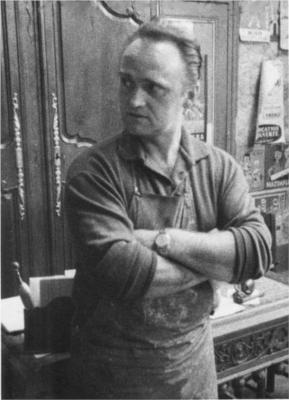
Biography
He began his Parisian street scene series in the late 1950s, painting the grands boulevards, the Arc de Triomphe, the Opéra Garnier, and the Champs-Élysées in conditions that other painters would avoid: overcast skies, wet pavements, the amber smear of gas lamps across rain-slicked stone. His immediate forebears were Édouard Cortès and Eugène Galien-Laloue, both of whom had made similar careers from similar subjects, though Blanchard's palette runs warmer and his touch carries a commercial clarity that speaks to international taste rather than Parisian connoisseurship.
His method was documentary in its way: he worked extensively from period postcards, reconstructing a Paris that had long since been demolished, modernised, or simply changed. The nostalgia was deliberate and served a ready market. By 1979[1] he had won the Grand Prix du Public, and his canvases were regularly selling through galleries in the United States, including those on the New Orleans French[1] Quarter circuit where a taste for atmospheric European nostalgia ran deep. He died in Paris in 1988[1]. The demand for his work has since produced a counterfeiting problem serious enough that authentication requires specialist knowledge of his signature variations.
Timeline
- 1910Born Marcel Masson near the Loire, France.
- 1932Began training at the École des Beaux-Arts in Paris.
- 1950Began his Parisian street scene series, depicting boulevards and landmarks in overcast or wet conditions.
- 1950Adopted the pseudonym Antoine Blanchard to distance himself from his birth name in galleries.
- 1979Won the Grand Prix du Public.
- 1988Died in Paris at 78.
Notable Works
Tap to view larger.
Next stop
Browse the movements →
Every movement in the collection, from the Renaissance to Pop art.
Related Artists



Frequently Asked Questions
What is Antoine Blanchard known for?
Antoine Blanchard was born Marcel Masson. He is known for his Parisian street scenes, often depicting the city in the rain, based on vintage postcards.What is Antoine Blanchard's most famous work?
It is difficult to identify one single work as Antoine Blanchard's most famous. He was a 20th-century artist who painted cityscapes of Paris, often featuring recognisable landmarks. These paintings were not innovative, but they proved commercially popular. Blanchard's paintings recall an earlier era, stylistically similar to the Rococo style popularised by artists such as Antoine Watteau (1684-1721[1]). Watteau's most famous work is *The Embarkation for Cythera*. Painted in 1718, it depicts a group of amorous couples in a verdant, idyllic setting. The painting is characterised by its graceful gallantry and sensuousness, although it also contains an undercurrent of melancholy. Watteau's work greatly influenced artists such as François Boucher and Nicolas Lancret. He brought the Rococo style to a height never reached before.What should I know about Antoine Blanchard's prints?
Antoine Blanchard (1910[1]-1988[1]) is known for his paintings and prints of Paris street scenes. Although he is often described as painting Paris as it was during the Belle Époque, this is not quite correct. Blanchard was born Marcel Masson in a small village near the Loire. He studied at the Beaux-Arts in Tours. His artistic career was interrupted by the Second World War; he was captured and held as a prisoner of war until 1945[1]. After the war, he moved to Paris. He began painting cityscapes in the late 1950s. These paintings usually featured recognisable Parisian landmarks, such as the Arc de Triomphe and Notre Dame. However, the cars and buses in his paintings are from the 1950s and 1960s, not the horse-drawn carriages of the early 20th century. Blanchard's work, therefore, presents a slightly idealised, timeless vision of Paris. He used the pseudonym "Antoine Blanchard" from the 1960s onwards.What style or movement did Antoine Blanchard belong to?
Antoine Blanchard (born Marcel Masson) painted cityscapes of Paris. He was active in the mid-20th century. Blanchard is often called a Post-Impressionist; however, this is more of a marketing term than an art-historical classification. He painted in a representational style, similar to that of the Impressionists, but several decades later. Impressionism, as a coherent movement, had faded by the early 20th century. Blanchard's paintings are similar in subject and style to those of Jean Béraud (1849-1935[1]) and Eugène Galien-Laloue (1854-1941[1]), who painted similar scenes of Paris. These artists are sometimes called Post-Impressionists because they worked after the main Impressionist period, but they did not share the aims of the original Impressionist painters such as Monet and Renoir. They continued the representational style of the Impressionists, but without the same focus on light and colour.What was Antoine Blanchard known for?
Antoine Blanchard (1910[1]-1988[1]) was a French[1] artist best known for his paintings of Paris street scenes. These works often depicted the city during the Belle Époque, a period from the late 19th century to the start of World War One. Blanchard did not live or paint in the Belle Époque, however. He created his paintings later in life, looking back to an earlier time. His paintings usually feature bustling streets, famous landmarks, and people in period clothing. Blanchard's work captured a nostalgic view of Paris. His paintings are not always historically accurate, but evoke a sense of Parisian charm. He is sometimes grouped with other artists who painted similar Parisian scenes, such as Édouard Cortès and Eugène Galien-Laloue.Where can I see Antoine Blanchard's work?
It is difficult to point to a specific permanent collection of Antoine Blanchard's work. However, numerous museums hold collections of related art from the same periods or movements. These include the Musée d’Art et d’Industrie (Roubaix, France) and Musée des Arts Décoratifs (Paris). Others are the Musée des Beaux-Arts (Nancy, France), Musée de l’Ecole de Nancy (Nancy, France), and Brangwyn Museum (Brugge, Belgium). Also worth visiting are the Clockarium Museum (Brussels, Belgium), Musée du Louvre (Paris), and Musée d’Orsay (Paris). Outside France and Belgium, relevant collections are held at the Manchester Art Gallery (UK), the Victoria & Albert Museum (London), and the National Museums of Scotland (Edinburgh). In the United States, see the Metropolitan Museum of Art (New York City), the Los Angeles County Museum of Art, and the Minneapolis Institute of Arts. Other options are the Charles Hosmer Morse Museum of American Art (Winter Park, Florida) and the Wolfsonian at Florida International University (Miami Beach).Who did Antoine Blanchard influence?
It is difficult to identify specific artists who were directly influenced by Antoine Blanchard (1910[1]-1988[1]). Blanchard painted Parisian street scenes in a style reminiscent of earlier artists; this makes it hard to separate general influence from direct artistic borrowing. Blanchard's work belongs to a tradition of French[1] cityscape painting that includes Jean Béraud (1849-1935[1]) and Eugène Galien-Laloue (1854-1941[1]). These artists depicted similar subjects: the boulevards, monuments, and daily life of Paris. Blanchard's paintings are similar to those of Galien-Laloue in particular, with shared subject matter and stylistic qualities. Both artists captured the atmosphere of Paris during different periods; Galien-Laloue focused on the late 19th and early 20th centuries, while Blanchard depicted the mid-20th century. Any assessment of Blanchard's influence would need to consider this broader context of French cityscape painting. His paintings are part of a popular genre; he was not a figure who established a new movement or school of art.Who was Antoine Blanchard?
Antoine Blanchard is a pseudonym of a 20th-century artist who created paintings of Parisian street scenes. Blanchard was born in France, and little is known about him. It is difficult to determine who he was, but his paintings are collected internationally. He is known for his Post-Impressionist paintings of Paris, often featuring landmarks such as the Eiffel Tower and the Arc de Triomphe. Blanchard's works evoke a nostalgic view of Paris during the Belle Époque. His paintings capture the city's atmosphere with detailed architectural depictions and bustling street life. Blanchard's use of light and colour creates a romantic impression of Paris. He is regarded for continuing the tradition of French[1] cityscapes.Why are Antoine Blanchard's works important today?
Antoine Blanchard (1910[1]-1988[1]) is remembered for his paintings of Paris. He often depicted street scenes, especially those of the Belle Époque. His paintings provide a nostalgic view of the city during a bygone era. Blanchard was not an innovator. Instead, he produced works in a representational style that appealed to a broad audience. His paintings are appreciated for their charm and accessibility. They offer a glimpse into the past. While not considered part of the avant-garde, Blanchard's art has found a place in popular culture. His paintings are collected by those who appreciate traditional artistic styles and historical subject matter. They provide a sense of connection to a romanticised version of Paris. His works continue to be sought after by collectors interested in scenes from Parisian life.What was Antoine Blanchard's art style?
His style is similar to Édouard Cortès and Eugène Galien-Laloue, though his palette is warmer. Blanchard's work has a commercial clarity that appealed to international tastes.How did Antoine Blanchard die?
Antoine Blanchard died in 1988[1] at the age of 78.
Sources
Editorial draws on the following primary and tertiary references for Antoine Blanchard.
- [1] wikipedia Wikipedia: Antoine Blanchard Used for: biography, birth dates, death dates, identifiers, movement attribution, nationality.
- [2] book guggenheim-europeandrawings00allo Used for: biography.
- [3] book guggenheim-onehundredpainti00thom Used for: biography.
- [4] book guggenheim-twopri00weis Used for: biography, stylistic analysis.
- [5] book 1892-1968, Panofsky, Erwin,, Tomb sculpture: four lectures on its changing aspects from ancient Egypt to Bernini Used for: stylistic analysis.
Editorial overseen by Solis Prints. Sources verified 2026-09-30. Click a source for details, or hover over [N] in the page above to preview.
Editorial standardsMethodologyCorrectionsAI disclosureAbout the editorial team