

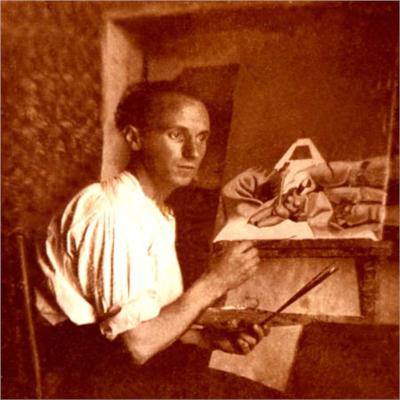
Angel Planells
Ángel Planells spent the Franco years painting landscapes for public consumption and Surrealist works in secret. The compartmentalisation was necessary: his real artistic allegiances, formed in Cadaqués alongside Salvador Dalí and extended through the international Surrealist network, were incompatible with the cultural politics of the dictatorship. After Franco's death in 1975[1], he finally painted openly again.
Biography
Born in Cadaqués in 1901[1], Planells studied painting, lithography, and engraving in Barcelona from 1918[1], though financial pressures pulled him back to the Costa Brava. His proximity to Dalí's circle in Cadaqués was formative: it placed him at the edge of Spanish avant-garde activity at a moment when Surrealism was expanding outward from Paris. He met René Magritte in the same milieu.
By 1928[1] he was writing Surrealist poetry and art criticism. His first solo exhibition followed in 1930 at Galeries Dalmau in Barcelona. In 1936 he joined the Logicofobista group alongside Remedios Varo and Maruja Mallo, and the same year three of his canvases appeared at the London International Surrealist Exhibition, placing him in genuinely international company. He had been teaching at the School of Arts in Blanes since 1929 and remained there, settled, through the long compromise of the Franco period.
When he could paint openly again after 1975[1], Planells produced work that recovered ground rather than started fresh. In 2025 his painting "Napoleon's Harp" sold at auction for 50,000 euros, a modest sign that his reputation continues to be reassessed. He died in 1989[1].
Timeline
- 1901Born in Cadaqués.
- 1918Began studying painting, lithography, and engraving in Barcelona.
- 1928Started writing Surrealist poetry and art criticism.
- 1929Began teaching at the School of Arts in Blanes.
- 1930Held his first solo exhibition at Galeries Dalmau in Barcelona.
- 1936Joined the Logicofobista group, along with Remedios Varo and Maruja Mallo.
- 1936Three of his paintings were displayed at the London International Surrealist Exhibition.
- 1975Resumed painting openly after Franco's death.
- 1989Died in 1989.
Notable Works
Tap to view larger.
Next stop
Browse the movements →
Every movement in the collection, from the Renaissance to Pop art.
Frequently Asked Questions
What is Angel Planells known for?
Ángel Planells is known for his Surrealist paintings and poetry, as well as his association with Salvador Dalí and other Surrealist artists. He gained international recognition when three of his canvases were displayed at the London International Surrealist Exhibition in 1936[1].What is Angel Planells's most famous work?
It is difficult to name Angel Planells's single most famous work. He is not mentioned in standard art-history resources that survey Spanish painting. For example, Nina Mallory's *El Greco to Murillo* includes entries for artists from the 16th through 18th centuries, but does not mention Planells. Similarly, general art-history surveys, such as Susie Hodge's *Art: Everything You Need to Know About the Greatest Artists and Their Work*, do not include him. A comprehensive listing of works by Peter Paul Rubens also fails to mention Planells. This absence from standard reference books suggests that Planells, while perhaps significant in certain circles, has not achieved widespread recognition in the broader art world.What should I know about Angel Planells's prints?
When considering a print by Angel Planells, bear in mind some basic principles. An original print is conceived as a print, and executed solely as a print. Each one is made individually, whether it is a woodcut, etching, linocut, or serigraph. The artist creates the artwork directly on the plate, stone, or screen. The number of prints in an edition is decided by the artist. Numbering accounts for the number of prints; for example, 12/25 means it is number 12 of an edition of 25. The edition claim is usually written as a pair of numbers on the left bottom margin of the print. The title of the print is written in the middle of the bottom margin, and the signature is on the right. These descriptions are always signed in pencil. Some artists create artist's proofs, and number them separately with AP after the number; for example, 5/100 AP. Remember that printmaking is an unregulated activity, so these conventions are not legal requirements.What style or movement did Angel Planells belong to?
Angel Planells was a Catalan artist associated with Surrealism. This movement, which gained momentum in the early 20th century, explored the realm of dreams and the subconscious, often juxtaposing unexpected imagery and challenging conventional artistic norms. Planells's association with Surrealism places him among artists who sought to liberate the imagination and create works that defied rational interpretation. The movement itself was influenced by Freudian psychoanalysis and a desire to tap into the hidden depths of the human psyche. Surrealist artists often employed techniques such as automatism and collage to unlock creative potential and produce art that reflected the inner world of emotions and desires. Planells contributed to this artistic current through his own unique vision and style.What techniques or materials did Angel Planells use?
Angel Planells employed a range of materials and techniques in his art. He used resin panels, designed as interior wall treatments, as supports for his two-dimensional works. He also worked with metal panels, such as copper, aluminium, and stainless steel. Planells combined these with synthetic paper and fabrics. Traditional materials like paper and canvas were also part of his practice, alongside metals like bronze and copper, which he used in sculpture. Planells explored diverse techniques, integrating them to transcend typical visuals. These included edging, screen-printing, oil painting, image transfers, stitching, and ceramics. In his two-dimensional work, he manipulated panels by sanding and preparing them to receive transfer images and paint, adding layers of silk and other fabrics. He sought new ways of visual deciphering through this assemblage of multidisciplinary techniques.Where can I see Angel Planells's work?
Angel Planells's work can be viewed in several museums that feature art deco and related styles. These museums have collections of decorative arts from the period. In the United States, notable museums include the Charles Hosmer Morse Museum of American Art (Winter Park, Florida), the Los Angeles County Museum of Art (LACMA), the Metropolitan Museum of Art (New York), the Minneapolis Institute of Arts, the Museum of Modern Art (New York), the Virginia Museum of Fine Arts (Richmond), and the Wolfsonian at Florida International University (Miami Beach). In the United Kingdom, museums with relevant holdings are the Bakelite Museum (Williton), the Brighton Museum & Art Gallery, the Geffrye Museum (London), the Manchester Art Gallery, the National Museums of Scotland (Edinburgh), and the Victoria & Albert Museum (London). In continental Europe, see the Museo Art Nouveau y Art Deco (Salamanca, Spain), the Museu Calouste Gulbenkian (Lisbon, Portugal), the Museu d’Art Modern (Barcelona, Spain), the Brangwyn Museum (Brugge, Belgium), the Clockarium Museum (Brussels), the Musée d’Art et d’Industrie (Roubaix, France), the Musée de l’Ecole de Nancy (France), the Musée des Arts Décoratifs (Paris), and the Musée des Beaux-Arts (Nancy, France).Where was Angel Planells from?
Angel Planells was born in Barcelona. Passage one of a Guggenheim exhibition catalogue mentions a 'Carlos Planeel' born in Barcelona. The listed dates (1927[1]-) suggest this is the same person as Angel Planells (1901[1]-1989[1]). The catalogue entry notes that Carlos Planeel was a member of the Cercle Maillol and the group Silex. He also founded the Asociacion de Artistas Actuates group and was a founding member of the Salon de Mayo. From 1953 onwards, he participated in many exhibitions, including the III Spanish-American Biennial in 1955. His work was shown in New York at the Petite Gallery in 1956. Paintings by him are owned by private collectors and the Museo de Arte Contempordneo in Madrid.Who did Angel Planells influence?
It is difficult to identify specific artists directly influenced by Angel Planells (1901[1]-1989[1]). Planells worked in relative isolation for much of his career. He did not have students or a formal school. Planells's surrealist style, developed in the Catalan region of Spain, shares characteristics with other Spanish surrealists, such as Salvador Dalí and Joan Miró. All three explored dreamlike imagery and unexpected juxtapositions. However, direct lines of influence are hard to trace. Planells's mature style emerged in the 1930s, concurrent with the rise of surrealism internationally. He synthesised elements of surrealism with his own personal vision. Planells's work gained wider recognition later in his life, particularly after the death of Francisco Franco in 1975[1]. This led to increased interest in Catalan art and culture. Any influence he may have had on younger artists is more likely to have occurred in the late 20th century, after his own work became more visible. Further research is needed to establish these connections definitively.Why are Angel Planells's works important today?
Ángel Planells (1901[1]-1989[1]) was a Catalan painter associated with the Surrealist movement. Although he remained in Spain during the Spanish Civil War and the Franco regime, his work retained a distinctive character that connects with broader artistic and intellectual concerns. Planells's art can be seen as part of a larger European movement exploring the nature of representation and reality. The Parisian Tel Quel group, active in the 1960s, included figures who viewed language as a lens through which to view the world. Writers and artists used disguise and simulation to suggest an ontology of the surface. Planells's dreamlike imagery and unexpected juxtapositions align with this interest in the constructed nature of reality. Planells's continued relevance lies in his contribution to a visual language that questions fixed meanings. His work prompts viewers to consider how images shape our understanding of identity and experience. Like the writers and artists mentioned, Planells sends signals, inviting viewers to decipher the figures and find new meaning.What was Angel Planells's art style?
Ángel Planells's art style was Surrealist, though he also painted more conventional pieces, such as landscapes, during the Franco dictatorship.How did Angel Planells die?
Angel Planells died in 1989[1] at the age of 88.
Sources
Editorial draws on the following primary and tertiary references for Angel Planells.
- [1] wikipedia Wikipedia: Angel Planells Used for: biography, birth dates, death dates, identifiers, movement attribution, nationality.
- [2] book guggenheim-beforepicassoaft00swee Used for: biography.
- [3] book guggenheim-newimagesfromspa00ro Used for: biography.
- [4] book guggenheim-twopri00weis Used for: biography.
Editorial overseen by Solis Prints. Sources verified 2026-10-15. Click a source for details, or hover over [N] in the page above to preview.
Editorial standardsMethodologyCorrectionsAI disclosureAbout the editorial team