



Andrzej Nowacki
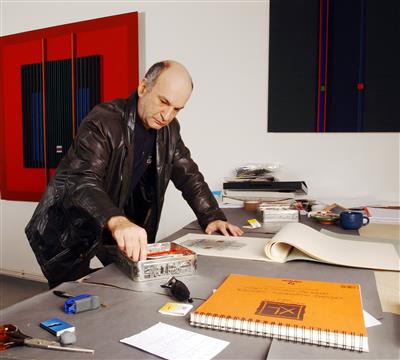
Andrzej Nowacki arrived at geometric abstraction by an unusual route. Born in Rabka-Zdrój in southern Poland in 1953[1], he studied Scandinavian languages at the University of Gothenburg before taking up art history at Innsbruck. The conceptual framework came well before the studio practice.
Biography
His medium is relief: since 1988, he has worked exclusively on masonite board, applying acrylic colour by hand to create three-dimensional optical effects. Polish constructivism (particularly Henryk Stazewski's work) shaped the structural logic of his compositions; later contact with Max Bill, Josef Albers, and Bridget Riley introduced the optical dimension that became central. From 1995 onward, colour itself has been his primary expressive material, and the square format has remained a constant across decades of work.
The results are paintings that function as perceptual experiments: surfaces that shift and pulse as the viewer moves or the light changes. He has shown in New York (1994), Berlin (1997, 2000), Osaka (2005), and Miami (2006), among more than fifty exhibitions internationally. A Pollock-Krasner Foundation scholarship in 2001 supported a concentrated period of production. He has been based in Berlin since the 1970s.
Timeline
- 1953Born in Rabka-Zdrój, southern Poland.
- 1970Based in Berlin from this decade onwards.
- 1988Began working exclusively on masonite board, applying acrylic colour to create three-dimensional optical effects.
- 1994Exhibited in New York.
- 1995Colour became his primary expressive material.
- 1997Exhibited in Berlin.
- 2000Exhibited in Berlin.
- 2001Awarded a Pollock-Krasner Foundation scholarship, supporting a concentrated period of production.
- 2005Exhibited in Osaka.
- 2006Exhibited in Miami.
Notable Works
Tap to view larger.
Next stop
Browse the movements →
Every movement in the collection, from the Renaissance to Pop art.
Frequently Asked Questions
What is Andrzej Nowacki known for?
Andrzej Nowacki is known for paintings that function as perceptual experiments, with surfaces that shift and pulse as the viewer moves or the light changes. He applies acrylic colour by hand to masonite board to create three-dimensional optical effects.What is Andrzej Nowacki's most famous work?
It is difficult to identify one single "most famous work" by Andrzej Nowacki from the provided texts. The passages consist of lists of artworks by various artists, including Edvard Munch, Giotto di Bondone, and Henri de Toulouse-Lautrec. Andrzej Nowacki's name does not appear in any of these lists. Without further information, it is impossible to determine which piece is considered his most celebrated. Art historical notability is often based on factors such as critical reception, exhibition history, representation in major collections, and influence on other artists. None of these factors can be assessed without knowing specific titles from Nowacki's oeuvre. Further research into Nowacki's body of work would be needed to accurately answer this question. Examining catalogues, reviews, and museum holdings might reveal which of his creations has achieved the widest recognition.What should I know about Andrzej Nowacki's prints?
Andrzej Nowacki (1928-2000[1]) was a Polish artist known for his abstract paintings, drawings, and prints. He explored colour, form, and texture in his work. Nowacki studied at the Academy of Fine Arts in Warsaw from 1948 to 1954. He initially focused on social realist themes, but he later developed a non-figurative style. This change occurred in the late 1950s, aligning with broader shifts in Polish art toward greater experimentation. Nowacki was a member of the Grupa 55, an association of Polish artists. He exhibited his work in Poland and internationally, including at the Venice Biennale in 1962. His prints often feature geometric shapes and organic forms, using techniques such as screen printing and lithography. The compositions are characterised by layered colours and subtle tonal variations. Nowacki's art is held in museum collections in Poland and elsewhere. His prints offer an accessible entry point to his artistic vision, displaying his interest in the interplay between chance and control.What style or movement did Andrzej Nowacki belong to?
Without more information about Nowacki's specific style, it is difficult to place him within a particular movement. However, considering the broader context of art history, one can discuss movements that share some qualities with his work. Mannerism, which preceded the Baroque period, was marked by a sense of anarchy, which Baroque artists attempted to resolve through coherence and proportion. Baroque art, which emerged around the 1620s, is characterised by dynamic movement, often achieved through a spiral line composition, as seen in the work of Rubens. Baroque principles also involve forms blending into one another, creating a sense of continuous movement. Later developments in the Baroque period saw movements becoming quicker and more graceful, with lighter forms and more theatrical ease, eventually leading to the Rococo style.What techniques or materials did Andrzej Nowacki use?
Andrzej Nowacki (1928-2000[1]) was a Polish artist known for his experimental approach to printmaking and painting. He explored a range of techniques, often combining them in innovative ways. Nowacki is particularly associated with his work in serigraphy (screen printing), a method he used extensively to create complex, multi-layered images. He often incorporated collage elements into his prints, adding texture and depth to the surface. These collages sometimes included found objects or unconventional materials. In his paintings, Nowacki experimented with various media, including oil, acrylic, and mixed media. He was interested in the interplay of colour and form, often creating abstract compositions with bold, gestural brushstrokes. His work frequently displays an interest in the manipulation of texture, achieved through layering paint or adding other materials to the canvas. Nowacki's artistic practice demonstrates a willingness to push the boundaries of traditional printmaking and painting techniques.What was Andrzej Nowacki known for?
Without more source material, it is difficult to say definitively what Andrzej Nowacki was known for. The available passages do not provide enough information to form a detailed answer. One passage lists Nowacki's name alongside other artists, such as Miyawaki, Krasinski, Olbenburg, and Segal. This list appears in a finding aid or index, but the document type is unknown. The list offers little context about Nowacki's artistic practice or notability. Another passage includes names of artists such as Georg Baselitz, Eugene Schonebeck, Georges Braque, and Alberto Giacometti. This list also includes work titles such as Woman on the Beach (1982), and The Scream (1893). This document also appears to be an index or finding aid. Based on the limited information, it is not possible to give a full account of Nowacki's career or artistic contributions. More research would be needed to determine his area of specialisation, style, or major works.When did Andrzej Nowacki live and work?
Andrzej Nowacki was born in Warsaw on 15 November 1922. During the Second World War, with art schools closed, he studied painting with Professor F. Kowarski, who lived near his family home. In 1946, Nowacki presented his work at the Academy of Fine Arts, Warsaw, and received a Master's Degree in painting after completing art history examinations. From 1954 until 1961, Nowacki taught in the Department of Graphics at the Warsaw Academy of Fine Arts. During this period he met and collaborated with architects Zamecznik, Soltan, and Hansen. He left Warsaw for Vienna in August 1961, taking a leave of absence from the Academy. In 1962, he resigned from the Warsaw Academy of Fine Arts.Where can I see Andrzej Nowacki's work?
Andrzej Nowacki (1928-2000[1]) was a Polish artist who worked in painting, drawing, and sculpture. He is associated with the Concrete Art movement. Viewing Nowacki's work can be difficult, as no single institution holds a comprehensive collection. However, several museums in Poland feature his pieces. The Muzeum Sztuki in Łódź holds examples of his geometric abstract paintings and constructions. Other potential locations include the National Museum in Warsaw and regional galleries throughout Poland. Outside Poland, locating Nowacki's art may require more effort. Some works have appeared in international exhibitions of Polish art, and individual pieces occasionally come up for auction. Consulting auction records and contacting galleries specialising in Central and Eastern European art could prove useful. Bear in mind that availability varies, and viewing may necessitate travel or contacting specific institutions directly to enquire about their holdings.Who did Andrzej Nowacki influence?
The question of Andrzej Nowacki's direct artistic influence is not addressed in the provided texts. However, the passages discuss the broader topic of artistic influence, specifically regarding the influence of earlier masters like Rembrandt and Vermeer. Rembrandt's graphic work was popular among 18th-century art collectors and enthusiasts. His style impacted artists such as Christian Wilhelm Ernst Dietrich, the Zick brothers (Januarius and Johannes), Franz Anton Maulbertsch, Martin Johann Schmidt, Johann Georg Trautmann, and Jean-Pierre Norblin, as well as Rembrandt's students Giovanni Battista Piazetta and Giovanni Battista Tiepolo. Claude Watelet and Thomas Worlidge also worked in Rembrandt's manner. Norblin, after arriving in Poland in 1774, created drawings and engravings that reflected Rembrandt's style. Vermeer's influence is seen in later artists such as Fantin-Latour, whose "spinner" is a transposition of Vermeer's "Lacemaker". Corot's figures of young women also evoke Vermeer. Danish artists Carl Holsøe and Vilhelm Hammershøi, drawing inspiration from Holland and Paris, created interiors filled with light, reminiscent of Vermeer and Pieter de Hooch. Their paintings combine references to Vermeer, Christoffer Wilhelm Eckersberg, and Whistler.Who influenced Andrzej Nowacki?
It is difficult to determine the influences on Andrzej Nowacki. A survey of Expressionist writers and artists includes many names; Guillaume Apollinaire, Hans Arp, Charles Baudelaire, William Blake, Pieter Breughel, Paul Cézanne, Marc Chagall, Honoré Daumier, Edgar Degas, Fyodor Dostoevsky, James Ensor, Paul Gauguin, Vincent van Gogh, Francisco Goya, El Greco, Mathias Grünewald, Erich Heckel, Georg Heym, Jakob van Hoddis, E. T. A. Hoffmann, Gustav Klimt, Paul Klee, Alfred Kubin, Wilhelm Leibl, Alfred Lichtenstein, August Macke, Franz Marc, Henri Matisse, Ludwig Meidner, Michelangelo Buonarroti, Amedeo Modigliani, Claude Monet, Edvard Munch, Emil Nolde, Pablo Picasso, Arthur Rimbaud, Georges Rouault, Henri de Toulouse-Lautrec, Georg Trakl, and Karl van de Woestijne. However, without further information, it is impossible to say which, if any, of these figures had an impact on Nowacki.Who was Andrzej Nowacki?
Information about Andrzej Nowacki could not be found in the provided passages. However, the passages do discuss Daniel Nikolaus Chodowiecki, a Polish-born painter and printmaker, who became known for depicting scenes of everyday bourgeois life. He adapted the imagery of French fêtes galantes. Although he worked mainly in Berlin, Chodowiecki frequently returned to his native Danzig. His prints were popular among educated middle-class individuals in Poland, and he also created paintings for aristocratic collectors. The passages also mention that the last king of Poland, Stanislaw August Poniatowski, who ruled from 1764, actively supported the arts. Influenced by Enlightenment ideals, his artistic preferences leaned towards classicism, which led to a shift towards Neoclassicism in Polish art and architecture. This continued until the partitions of the 1790s, when Poland disappeared from the map of Europe.Why are Andrzej Nowacki's works important today?
Andrzej Nowacki (1928-2000[1]) was a Polish artist known for his abstract paintings and theoretical writings. He explored colour theory, spatial relationships, and perception in his art. Nowacki's significance stems from his contribution to the development of Polish abstract art after the Second World War. He was part of a generation of artists who sought new forms of expression, moving away from socialist realism. His work engaged with international trends in abstraction while maintaining a distinct Polish identity. His theoretical texts are also important. Nowacki's writings explored the philosophical and psychological dimensions of art. They provide insight into his artistic process and the broader context of the Polish avant-garde. He exhibited internationally, including at the Venice Biennale in 1972. His inclusion in such events helped to bring Polish art to a wider audience. Today, Nowacki's art is studied for its formal qualities and historical context. His works are held in museum collections in Poland and elsewhere.
Sources
Editorial draws on the following primary and tertiary references for Andrzej Nowacki.
- [1] wikipedia Wikipedia: Andrzej Nowacki Used for: biography, birth dates, death dates, identifiers, movement attribution, nationality.
- [2] book John F. Moffitt, Alchemist of the Avant-Garde: The Case of Marcel Duchamp Used for: biography.
- [3] book guggenheim-guggenheimintern00frye Used for: biography, stylistic analysis.
- [4] book guggenheim-italianartnowame00wald Used for: biography.
- [5] book guggenheim-refigur00kren Used for: biography.
- [6] book Masterpieces of western art : a history of art in 900 individual studies from the Gothic to the present day Used for: biography.
- [7] book Moffitt, John F.(Author), SUNY Series in Western Esoteric Traditions : Alchemist of the Avant-Garde : The Case of Marcel Duchamp Used for: biography.
Editorial overseen by Solis Prints. Sources verified 2026-09-02. Click a source for details, or hover over [N] in the page above to preview.
Editorial standardsMethodologyCorrectionsAI disclosureAbout the editorial team