



Andrea Benetti
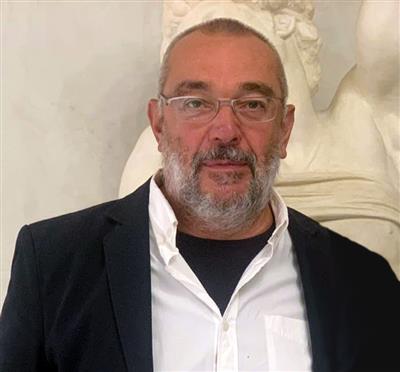
Andrea Benetti's paintings look like they were made before writing existed. Working in a style he calls Neo Cave Art, the Bologna-born painter draws directly on the aesthetic of prehistoric cave paintings, using vegetable pigments, henna, karkade (hibiscus), and in some cases actual paleolithic sediment to produce stylised zoomorphic and anthropomorphic forms that sit between Lascaux and the contemporary gallery.
Biography
Born 15 January 1964[1], Benetti trained at the Artistic High School and Academy of Fine Arts in Bologna before developing his singular approach. The technique involves layering plant-derived pigments alongside graffiti-like mark-making and occasional bas-relief, creating surfaces that read as geological rather than painted. "Grotta dei Cervi" (2015, 50x50 cm, paleolithic sediment and oxides) is among the clearest examples of this methodology.
His institutional profile is unusual for a living painter working in such an archaic register: works are held by the United Nations, the Vatican, the Quirinal Palace (the official residence of the Italian[1] president), and the Italian Parliament. A solo exhibition at Rome's Chamber of Deputies in 2015 brought the work squarely into public life. Earlier, a 2013 show at Bologna's Palazzo D'Accursio and a 2017 exhibition at the Gallipoli Civic Museum expanded his reach across Italy.
Among his awards: the LXI Michetti Prize (2010), the International Excellence Prize (2014), and the 49th Nettuno d'Oro (2020).
Timeline
- 1964Born in Bologna, Italy, on 15 January.
- 1980Studied at the Artistic High School in Bologna, Italy, at 16.
- 1984Studied at the Academy of Fine Arts in Bologna, Italy, at 20.
- 2010Received the LXI Michetti Prize.
- 2013Solo exhibition at Palazzo D'Accursio in Bologna, Italy.
- 2014Received the International Excellence Prize.
- 2015Created "Grotta dei Cervi" (50x50 cm, paleolithic sediment and oxides).
- 2015Solo exhibition at the Chamber of Deputies in Rome, Italy.
- 2017Exhibition at the Gallipoli Civic Museum in Italy.
- 2020Received the 49th Nettuno d'Oro.
Notable Works
Tap to view larger.
Next stop
Browse the movements →
Every movement in the collection, from the Renaissance to Pop art.
Related Artists


Frequently Asked Questions
What is Andrea Benetti known for?
Andrea Benetti is known for his Neo Cave Art style, which uses vegetable pigments, henna, karkade (hibiscus), and sometimes paleolithic sediment. His paintings feature stylised zoomorphic and anthropomorphic forms that evoke prehistoric cave art.What is Andrea Benetti's most famous work?
It is difficult to name Andrea Benetti's single 'most famous work' with certainty. Without specific references to his notability, or critical and commercial reception, it is hard to gauge which piece has brought him the most attention. It is possible to examine his wider artistic output and the themes he engages with. Benetti is known for his theoretical writing around the concept of 'Neo Cave Art', and his practice of using primordial signs and glyphs in his paintings. He has been involved with public art projects, such as the 2012 creation of a large painting for the University of Bari, Italy. Without more information, a definitive 'most famous work' cannot be identified.What should I know about Andrea Benetti's prints?
Andrea Benetti is an Italian[1] contemporary artist known for his theoretical work on the "Manifesto of Neo Cave Art". His art makes reference to the signs and shapes of prehistoric art. Prints of artworks have a long history as a way for collectors to advertise their treasures. Illustrated books devoted to a single collection date back to the 1620s. Cardinal Federico Borromeo produced a guide to the archbishop's collection in Milan, called Museum Bibliothecae Ambrosianae (1625), though it lacked illustrations. Later, illustrated books on collections appeared, such as David Teniers' Theatrum Pictorium (1660). This communicated messages about painting and the glory of the collector. Prints have also served as records of artworks and as educational tools. The Galleria Giustiniana, a collection of prints made from engraved plates after statues, was published to allow those familiar with ancient sculpture to see what had been done to satisfy those who had requested it. The publication extended the walls of this free academy far beyond Rome.What style or movement did Andrea Benetti belong to?
Without more context, it is difficult to assign Andrea Benetti to a specific art movement. The provided texts discuss Renaissance art, costume history, and Aby Warburg's methods of analysis; they do not mention Benetti or his work. However, the passages do discuss general art historical concepts that might be relevant if more information about Benetti's art was available. For example, they touch on the shift from Gothic to Renaissance styles, noting a change from straight lines to curves and an increased emphasis on volume. They also discuss the classical influence on Renaissance art, particularly the representation of movement and emotion. To accurately place Benetti within a movement, one would need to analyse his specific techniques, themes, and artistic intentions, comparing them to established art historical categories. Without this information, any classification would be speculative.What techniques or materials did Andrea Benetti use?
Andrea Benetti employs a variety of techniques and materials in his artistic practice. When restoring paintings, conservators have used traditional methods, such as applying gesso, a white coating of plaster and animal glue, to create a smooth surface. For retouching, watercolours, tempera gouaches, and varnish colours are used. The retouching process involves applying a lighter tempera gouache, then defining it with watercolour hatching. Varnish colours complete the process, providing final glazings. In sculpture, artists often begin by wedging clay to compact it and remove air pockets. Bernini, for example, used a method that yielded a cylindrical column of clay. Sculptors add clay to build a form, using fingers and tools to shape the material. Oval-tip and toothed tools are common for modelling, while cloths and brushes are used for smoothing. These tools, made of wood or metal, help create the desired textures and details.What was Andrea Benetti known for?
Andrea Vendramin, who died in 1478, was a Venetian nobleman. He was a merchant and a military leader. In 1476, he became the doge, the elected chief of state of Venice. Vendramin's dogeship lasted less than two years. He died in May 1478 and was given an elaborate tomb. The tomb was constructed in the church of Santa Maria dei Servi. When the church was torn down in the 19th century, the tomb was moved to the Basilica di San Giovanni e Paolo, Venice. The monument was made by Tullio Lombardo and assistants. Lombardo was a sculptor and architect from a family of artists. The Vendramin monument is an early example of Renaissance art in Venice. It set a style for wall tombs in Venice for many years after its completion.Where can I see Andrea Benetti's work?
It is difficult to provide a comprehensive list of locations for Andrea Benetti's work based solely on the passages. However, the excerpts do reference several museums and collections where artworks may be viewed. Florence is mentioned as a city with significant art collections. Specifically, the "National Museum, Florence" is named, although without reference to Benetti. Similarly, the "S. Mini Florence" is referenced in relation to the tomb of the Cardinal of Portugal; it is unclear if this is a museum or a church. Rome is also mentioned, with reference to the "Vatican Museum, Rome" and the "Palazzo Giustiniani, Rome". The "Brera" in Milan and the "Brit. Mus." (British Museum) in London are also listed. It is important to note that these passages do not confirm the presence of Benetti's specific works in these locations; they merely indicate places where artworks are held. Further research into the collections of these museums and galleries would be needed to ascertain where to view Benetti's art.Where was Andrea Benetti from?
Without more specific information, it is difficult to determine Andrea Benetti's precise origins. However, some historical records provide clues about individuals with similar names or locations that may be relevant. For instance, a record mentions an "A’ndrea di Michele del Verocchio, maestro della palla" from 1470. The document indicates a payment related to "palla e della crocie", and places him in relation to a ledger and book. Another document mentions individuals identified as "Venetus Creatus" and "Romanus", which might indicate origins in Venice or Rome for people with similar names during the Baroque period. Additionally, the tomb of Lello Il Camponeschi is located in Aquila, while John Hawkwood's memorial is in the Cathedral in Florence; these places could be connected to people named Andrea in some way.Who did Andrea Benetti influence?
Andrea Mantegna (c. 1430-1506[1]) influenced several artists of the Venetian school. Mantegna's early independent works, dating from the late 1440s, had an impact on the older Jacopo Bellini, influencing both his style and motifs. In turn, the art of both Mantegna and Jacopo Bellini inspired Giovanni Bellini (born around 1430). Giovanni trained in his father's workshop alongside his brother Gentile, who also became a well-known Venetian painter. One of Giovanni's early major works, an altarpiece depicting the Transfiguration painted around 1450, shows the influence of Andrea Mantegna's style. The painting was even attributed to Mantegna until the last century. Giovanni Bellini's later style became an inspiration for a generation of Venetian painters, some of whom were his students. Other important artists, such as Gentile Bellini and Carpaccio, contributed to the development of the Venetian style. By the beginning of the sixteenth century, a distinct manner of painting had developed in Venice.Who influenced Andrea Benetti?
It is difficult to isolate specific influences on Andrea Benetti. The available texts do not directly address his inspirations. However, they do offer a wide view of the artistic and intellectual milieu of 20th-century Italian[1] art. Many artists, writers, and philosophers active in Italy and elsewhere are named. Futurists such as Umberto Boccioni, Carlo Carrà, and Giacomo Balla are listed, as are non-Italian figures like Picasso. Other possible influences from the period include Giorgio de Chirico, Henri Matisse, and Medardo Rosso; also the writers Giovanni Papini and Ardengo Soffici. The index listings include composers Igor Stravinsky and Arnold Schoenberg. Philosophers include Friedrich Nietzsche, Arthur Schopenhauer, and Benedetto Croce. These figures, among many others, represent the broad artistic and intellectual context in which Benetti developed.Who was Andrea Benetti?
Several artists named Andrea were active in Italy during the 15th and 16th centuries. Andrea di Lazzaro Cavalcanti, also known as Andrea Cavalcanti or Andrea Il Buggiano (1412-1462[1]), was a sculptor from Florence. He is known for his work on the sarcophagus of Giovanni and Piccarda de' Medici in the Old Sacristy of S. Lorenzo, Florence. Andrea del Verrocchio (1435-1488) was another Florentine sculptor, goldsmith, and painter. He created the sarcophagus of Giovanni and Piero de' Medici, also located in the Old Sacristy of S. Lorenzo, Florence. Documents from 1470 record payments to Andrea di Michele del Verrocchio for work on a "palla" (orb) and cross. Andrea Vendramin's tomb is located in SS. Giovanni e Paolo, Venice; the sculptors were Tullio Lombardo and assistants.Why are Andrea Benetti's works important today?
Andrea Benetti's work is important for its connection to prehistoric art and its exploration of human origins. His paintings often incorporate signs and symbols inspired by cave paintings, creating a dialogue between the ancient past and the present. Benetti developed the "Neo-Cave Art" manifesto in 2006, which advocates for a renewed interest in the art of early humans. This movement seeks to re-evaluate the roots of visual communication. His work has been exhibited in museums and galleries internationally, bringing attention to this unique artistic approach. His art invites viewers to consider the common origins of humanity and the development of symbolic thought. By referencing cave paintings, Benetti explores themes of communication, spirituality, and the relationship between humans and their environment. The use of these ancient symbols in a contemporary context prompts reflection on the continuities and changes in human culture over millennia. His theoretical framework provides a lens through which to view the history of art and the ongoing human need for expression.
Sources
Editorial draws on the following primary and tertiary references for Andrea Benetti.
- [1] wikipedia Wikipedia: Andrea Benetti Used for: biography, birth dates, death dates, identifiers, movement attribution, nationality.
- [2] book Art, the ape of nature : studies in honor of H. W. Janson Used for: biography.
- [3] book Gianlorenzo Bernini: new aspects of his art and thought : a commemorative volume Used for: biography, stylistic analysis.
- [4] book guggenheim-refigur00kren Used for: biography.
- [5] book Beckett, Wendy, Sister Wendy's odyssey : a journey of artistic discovery Used for: biography.
- [6] book Nicola Vitale;, Sunniness in Paintings Used for: biography.
Editorial overseen by Solis Prints. Sources verified 2026-08-30. Click a source for details, or hover over [N] in the page above to preview.
Editorial standardsMethodologyCorrectionsAI disclosureAbout the editorial team