



Alvar Aalto
- Neues Bauen
Alvar Aalto's Villa Mairea (1937[1]-38), built in Noormarkku for a Finnish art collector, reads at first glance as a riposte to Le Corbusier's Villa Savoye of a decade earlier. Where Le Corbusier stripped away warmth, Aalto brought back wood, brick, and stone, layering Scandinavian materials over an International Style framework. Scholars have described it as both a rejection of modernism and its most productive regional variation, and as a direct forerunner of Post-Modern architecture.
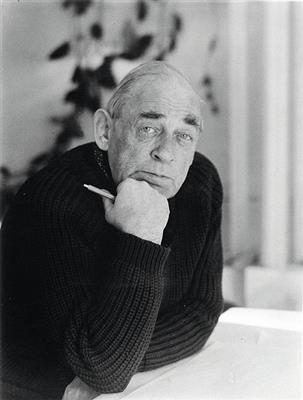
Biography
Born Hugo Alvar Henrik Aalto in Finland in 1898[1], he graduated from the Helsinki University of Technology in 1921[1]. His early furniture used tubular steel, following Bauhaus principles, but by the early 1930s he had moved decisively to laminated birch, bent through a steaming process to produce the cantilevered chairs and stools that became his signature. In 1930 he co-founded Artek in Helsinki to manufacture and distribute the furniture; British distribution followed through Finmar Ltd from 1934. His wife and collaborator Aino Marsio, whom he married in 1924, contributed substantially to the furniture programme.
Aalto spent much of the 1940s in the United States, where his furniture found a receptive institutional market: schools, hospitals, and public buildings adopted the clean lines of his stacking stools and tables. Many pre-war designs remain in production through Artek and through Herman Miller, which began reproducing them in 2002. Major pieces sell in the £3,000-6,000 range at auction; rarer desk and chest sets reach £4,000-6,000.
He died in Helsinki in 1976[1]. His place in 20th-century architecture remains, as Janson noted, genuinely unclear: nationalist and modernist, regional and universal at the same time.
Timeline
- 1898Born Hugo Alvar Henrik Aalto in Finland.
- 1921Graduated from the Helsinki University of Technology.
- 1924Married Aino Marsio; she became a collaborator on furniture designs.
- 1930Co-founded Artek in Helsinki to manufacture and distribute furniture.
- 1934Began British distribution of his furniture through Finmar Ltd.
- 1937Designed Villa Mairea in Noormarkku.
- 1976Died in Helsinki.
Notable Works
Tap to view larger.
Next stop
Browse the movements →
Every movement in the collection, from the Renaissance to Pop art.
Related Artists




Frequently Asked Questions
What is Alvar Aalto known for?
Hugo Alvar Henrik Aalto is known for his architectural work and furniture design. His furniture was marketed in Britain by Finmar Ltd.What is Alvar Aalto's most famous work?
Alvar Aalto was a Finnish architect and designer. While he created many significant works, one of his most celebrated is Villa Mairea, constructed in Noormarkku, Finland, in 1939[1]. It synthesises many of Aalto's recurring themes. The house blends modernism with a sensitivity to the surrounding natural environment. He and his wife Aino both designed the villa for their friends Maire and Harry Gullichsen. It served as a summer residence and a space for entertaining. The design incorporates a free-flowing floor plan, natural materials (such as wood and stone), and large windows that blur the line between indoors and outdoors. The building's architecture and furnishings were conceived as a unified and site-specific whole. Villa Mairea is considered an important example of Aalto's humanistic approach to modern architecture.What should I know about Alvar Aalto's prints?
Alvar Aalto was not primarily a printmaker, but it is important to understand some basics about fine art prints. Since the late nineteenth century, prints have been viewed as a major artistic medium, and the quality of each impression has gained importance. Artists began signing prints to differentiate original graphics, which have aesthetic value, from reproductions. A signature also confirms the print's authenticity and the artist's approval of a particular proof. Artists control quality by limiting the size of print editions and numbering them. By inscribing the impression number and the edition number, they influence the price relative to the number of works available and prevent prints from being pulled after the plate or stone degrades from overuse. Around this time, artists also began using handmade or specially manufactured paper, which contributed to the prints' aesthetic value. An original print is conceived by the artist as a print and executed solely as a print, usually in a numbered edition, and signed. Each print in the edition is an original, printed from a plate, stone, screen, block, or other matrix created for that purpose. Each print is inked and pulled individually; it is a multi-original medium. The artist decides the number of prints in the edition, and sequential numbering accounts for the number of prints.What style or movement did Alvar Aalto belong to?
Alvar Aalto (1898[1]-1976[1]) was a Finnish architect and designer whose work is linked to several styles. He graduated from Helsinki University of Technology in 1921[1] and founded Artek in 1930. Aalto adapted the International Style to Finnish architecture, materials, and lifestyle. His work harmonised human needs with functionalism. His style also has romantic elements; he employed wood, brick, and stone, which added warmth, and free forms that broke up cubic geometry. His designs have been interpreted as both a rejection of modernism and a regional variation of the International Style. Some consider him a forerunner of Post-Modern architecture. An "organic Modernist" style applies to much of Aalto's furniture from the late 1930s and after the Second World War. His early designs used tubular steel, and his Art Deco furniture was admired for its clean lines and practical economy.What techniques or materials did Alvar Aalto use?
Alvar Aalto's architectural designs and furniture often incorporated wood, especially bent birch, exploiting its flexibility and natural beauty. He also used glass extensively, sometimes in innovative ways. Aalto experimented with glass manipulation techniques. One method involved sandblasting layers of opaque glass that had been fused together. This process began with a sheet of milk glass coated with a thin layer of coloured glass (red, yellow, black, blue, or grey). A stencil was applied, and sandblasting removed the exposed areas. This allowed for sharper lines than acid etching. He would sometimes add another colour with paint, then bake the piece in a kiln. Intense sandblasting could expose the milk glass, while a shorter blast would create a dark grey. Aalto's work demonstrated a considered approach to materials, combining industrial processes with natural elements.When did Alvar Aalto live and work?
Alvar Aalto (1898[1]-1976[1]) was a Finnish architect and designer. He was a major figure in 20th-century architecture. Aalto was born in Kuortane, Finland. He studied architecture at the Helsinki University of Technology, graduating in 1921[1]. He established his architectural practice in Jyväskylä in 1923. His early work followed the Nordic Classicism style. However, he soon adopted a more functionalist approach. In the late 1920s, Aalto began to gain international recognition. His Turun Sanomat newspaper building (1928-1930[1]) and Paimio Sanatorium (1929-1933) are prime examples of his move towards modernism. These projects displayed his interest in human-centred design and use of natural materials. During the 1930s, Aalto's style matured further. He incorporated organic forms and a sensitivity to the surrounding environment. His Villa Mairea (1938-1939), a private residence, is considered one of his masterpieces. After World War II, Aalto was involved in reconstruction projects and urban planning. He also designed furniture, glassware, and other objects. His designs are known for their simplicity, functionality, and beauty. Aalto remained active until his death in Helsinki in 1976, leaving behind a significant body of work.Where was Alvar Aalto from?
Alvar Aalto was Finnish. He was born in Kuortane, Finland, on 3 February 1898[1]. His family soon relocated to Alajärvi, where he spent his childhood. Aalto is best known as an architect and designer. His career spanned from the 1920s to the 1970s. He worked in several media, including furniture, textiles, and glassware. His designs are examples of modernism. They often incorporated natural materials and organic forms. Aalto's architectural designs include the Paimio Sanatorium (1933[1]), Villa Mairea (1939), and Säynätsalo Town Hall (1952). These buildings are located in Finland. His furniture designs, such as the Stool 60 (1933), are still in production. They are recognised for their simple, functional aesthetic. Aalto died in Helsinki on 11 May 1976[1].Who did Alvar Aalto influence?
Alvar Aalto (1898[1]-1976[1]) adapted the International Style to the traditional architecture, materials, lifestyle, and environment of Finland. His main concern was human needs, both physical and psychological, which he harmonised with functionalism. Aalto's modernist heritage is clear in his vocabulary of forms and massing of elements; yet everywhere there are romantic touches, such as the use of wood, brick, and stone, that add warmth absent from Le Corbusier's pristine classicism. Free forms break up the cubic geometry and smooth surfaces favoured by the International Style. His Villa Mairea (1937[1]-38) has been interpreted as both a rejection of modernism and as a fruitful regional variation on the International Style. His work can be seen as a direct forerunner of Post-Modern architecture. Aalto studied under Armas Lindgren in Helsinki, who was a partner of Eliel Saarinen.Who influenced Alvar Aalto?
The Bauhaus school, particularly the work of Walter Gropius and Mies van der Rohe, influenced Alvar Aalto. Both Gropius and van der Rohe aimed for a synthesis of the arts within building design. Their premise was oriented towards fulfilling "the needs of the masses" while refining quality and taste. This approach involved collaboration with industry, using workshops to develop models. Mies van der Rohe considered the contributions of visual artists essential. He valued the instruction of artists such as Kandinsky, Peterhans, and Albers, even insisting that Albers teach drawing from nature. The Bauhaus focus on combining art, craft, and technology to serve social needs likely resonated with Aalto's own architectural and design philosophy.Who was Alvar Aalto?
Hugo Alvar Henrik Aalto graduated from the Helsinki University of Technology in 1921[1]. He practised as an architect, and in 1930, he founded Artek in Helsinki.Why are Alvar Aalto's works important today?
Alvar Aalto (1898[1]-1976[1]) was a Finnish architect whose work remains important due to its synthesis of modernism with regional and humanistic elements. He graduated from Helsinki University of Technology in 1921[1] and established Artek in 1930. Aalto adapted the International Style to Finnish architecture, materials, and lifestyle. His designs prioritised human needs, both physical and psychological, harmonising them with functionalism. While his work displays a modernist vocabulary, he incorporated wood, brick, and stone, adding warmth often absent from the pure classicism of architects such as Le Corbusier. Aalto broke up cubic geometry with free forms. His Villa Mairea (1937-38) can be interpreted as either a rejection of modernism or a regional variation of the International Style. Some consider Aalto a direct forerunner of Post-Modern architecture. His furniture designs, marketed in Britain by Finmar Ltd, gained international recognition at the 1937 Paris Exposition and the 1939 New York World’s Fair. Aalto's designs were influential; his furniture was known for clean lines and practical economy, leading to its use as institutional furniture.What was Alvar Aalto's art style?
An “organic Modernist” style applies to most of Alvar Aalto's furniture made during the late 1930s and after World War II.
Sources
Editorial draws on the following primary and tertiary references for Alvar Aalto.
- [1] wikipedia Wikipedia: Alvar Aalto Used for: biography, birth dates, death dates, identifiers, movement attribution, nationality.
- [2] book Miller, Judith, 1951-, Art deco Used for: biography, stylistic analysis.
- [3] book Judith Miller, Art Deco (Collector's Guides) Used for: biography, stylistic analysis.
- [4] book Judith Miller, DK Collector's Guides: Art Deco Used for: biography, stylistic analysis.
- [5] book guggenheim-berriarei00bilb Used for: biography.
- [6] book guggenheim-glascoli00albe Used for: biography.
- [7] book guggenheim-mest00aten Used for: biography.
Editorial overseen by Solis Prints. Sources verified 2026-10-15. Click a source for details, or hover over [N] in the page above to preview.
Editorial standardsMethodologyCorrectionsAI disclosureAbout the editorial team