

Alighiero Boetti
- Arte Povera
Between 1971[1] and his death in 1994[1], Alighiero Boetti produced around 150 embroidered world maps in a series called Mappa. Each was unique in scale and made by teams of up to 500 artisans in Afghanistan and Pakistan, who stitched national flags into the borders of each country they covered. The project was as much about logistics, collaboration, and geopolitical time as it was about image-making.
Biography
Born in Turin in 1940[1] to a lawyer father and a violinist mother, Boetti abandoned business school at the University of Turin to pursue art. He moved to Paris to study engraving and returned to Italy to become one of the founding figures of Arte Povera[1], exhibiting his first solo show in Turin in 1967[1]. Two years later he participated in the landmark "When Attitudes Become Form" exhibition. In 1971 he co-founded the One Hotel in Kabul as a kind of artistic commune, which ran until the Soviet invasion ended it in 1979.
His work consistently staged problems of order and disorder, self and other. In 1973[1] he adopted the dual persona "Alighiero e Boetti," separating his name into two to reflect the opposing forces at work in his practice. "Lampada annuale" (Yearly Lamp, 1966) is a light bulb in a wooden box programmed to illuminate for just eleven seconds each year. "Classificazione dei mille fiumi più lunghi del mondo" (1977) is an embroidered classification of the world's thousand longest rivers.
Boetti died of a brain tumour in Rome in 1994[1], at 53. The Venice Biennale dedicated its entire Italian[1] Pavilion to him in 2001; the Tate Modern held a retrospective in 2012.
Timeline
- 1940Born in Turin, Italy.
- 1967First solo show in Turin.
- 1969Participated in "When Attitudes Become Form" exhibition.
- 1971Co-founded the One Hotel in Kabul.
- 1971Began producing embroidered world maps (Mappa).
- 1973Adopted the dual persona "Alighiero e Boetti".
- 1977"Classificazione dei mille fiumi più lunghi del mondo" created.
- 1979Soviet invasion ended the One Hotel project.
- 1994Died of a brain tumour in Rome.
Next stop
Browse the movements →
Every movement in the collection, from the Renaissance to Pop art.
Related Artists




Frequently Asked Questions
What is Alighiero Boetti's most famous work?
Alighiero Boetti worked in a number of media, and pinpointing a single "most famous work" is difficult. However, his series of embroidered world maps, titled *Mappa*, are among his best-known and most significant pieces. Begun in 1971[1], these works were created in collaboration with Afghan artisans. Boetti conceived the initial design, which depicted the world with each country rendered in the colours and patterns of its flag. Afghan women in Kabul and later Pakistani refugees in Peshawar then produced the embroidery. The project continued for many years, adapting to political changes such as the Soviet invasion of Afghanistan. Boetti inserted an 'e', meaning 'and', between his first and last names in 1973. This symbolised a dichotomy between creativity and the individual, society, order, and chaos. He was associated with the Arte Povera[1] movement, using mundane materials, but later moved towards collaborative works interested in classification systems.What should I know about Alighiero Boetti's prints?
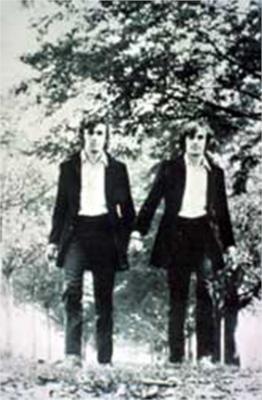
Alighiero Boetti, born in Turin in 1940[1], worked in a variety of media, including printmaking. He is associated with the Arte Povera[1] movement, although he distanced himself from it in 1972[1]. His prints often reflect his interest in systems of classification, order, and disorder. In 1973, Boetti inserted an "e" (Italian[1] for "and") between his first and last names. This symbolised a dichotomy; the space between individual identity and formal societal identification. A 1968 self-portrait, "Twins", embodies this concept. The work depicts two figures walking hand-in-hand. They are similar, but not mirror images; instead, they represent two equal but separate entities. Boetti's prints often incorporate mundane materials, which aligns with the Arte Povera ethos. His works include charcoal, spray paint, and pasted paper on transparent paper. Examples include his series "Drawing (Disegno)", produced between 1970 and 1979.What style or movement did Alighiero Boetti belong to?
Alighiero Boetti is most closely associated with the Arte Povera[1] movement. This artistic tendency emerged in Italy during the latter half of the 1960s. The term "Arte Povera" was first used by curator Germano Celant in 1967[1], to describe the work of a number of Italian[1] artists, including Boetti, Luciano Fabro, Jannis Kounellis, and others. Arte Povera, meaning "poor art", involved the use of simple, everyday, and often unconventional materials. These could be "poor" in the sense of being inexpensive, or "poor" in the sense of being unprocessed or unrefined. The artists aimed to challenge the values of the commercialised art world, and to create a direct connection between art and life. Boetti's practice also extended beyond Arte Povera. He explored systems of language, classification, and order, often undermining these through chance and collaboration. He engaged artisans in Afghanistan to create his embroidered works, introducing an element of unpredictability into the production process. Boetti's openness to different approaches demonstrates an artistic vision that moved beyond the limitations of any single movement.What techniques or materials did Alighiero Boetti use?
Alighiero Boetti worked with a range of media and techniques throughout his career. He is known for employing systematic and conceptual approaches in his art. Boetti's practice included the use of diverse materials, such as pen on paper, often in grid-like arrangements. He explored the concept of chance and collaboration in his work; for example, he commissioned Afghan craftspeople to create embroidered works based on his designs. These pieces frequently featured maps, mathematical sequences, or colourful arrangements of words. Boetti also experimented with postal art, sending postcards and letters as a means of artistic expression. His interest in systems and order led him to create works that explored classification, language, and cultural codes. These investigations extended to photography, sculpture, and installation, often incorporating found objects and unconventional materials.What was Alighiero Boetti known for?
Alighiero Boetti (born in Turin, 1940[1]; died in Rome, 1994[1]) is associated with the Arte Povera[1] movement. This term, "poor art", was first used by Germano Celant in 1967[1] to identify art using rough or base materials; these were often contrasted with industrial materials and related to the human body. Boetti disassociated himself from the group in 1972, but retained the Arte Povera ethos. Boetti's work often involved collaboration and an interest in classification systems. He looked for order within disorder and pattern within randomness. In 1973, he inserted an 'e' (Italian[1] for 'and') between his first and last names; this symbolised the dichotomy between creativity and the individual, society, order, and chaos. It also represented the distinction between his private self and his public, professional identity. His 1968 *Twins* double self-portrait functions in the same way. The two figures walking hand-in-hand are not mirror images; instead, they reflect the relationship between two equal but separate things.When did Alighiero Boetti live and work?
Alighiero Boetti was born in Turin, Italy, in 1940[1]. He died in Rome in 1994[1], after being diagnosed with cancer. Boetti began exhibiting work in the late 1960s. He was associated with the Arte Povera[1] movement; this term, coined by Germano Celant, was first used in connection with an exhibition in Genoa in September 1967[1] that included Boetti's work. Arte Povera explored the relationship between art and life through the use of simple materials, often in contrast to industrial ones. In 1972, Boetti met Clemente in Rome. In 1973, Clemente made his first trip to India; in 1974, he travelled with Boetti to Afghanistan, staying in a hostel Boetti ran in Kabul. Boetti collaborated with local artisans, such as weavers and embroiderers, to produce his art. He was interested in languages and systems of classification, such as maps, numbers, and alphabets.Where can I see Alighiero Boetti's work?
Alighiero Boetti's artworks have been displayed in numerous locations. A number of drawings from 1970[1] to 1979 are held in private collections in Turin. Other works are held by the Stein Gladstone Gallery in New York. Also, Painting is Long and Fast (1980) is courtesy of Galleria Salvatore Ala, Milan and New York. Boetti's pieces have been included in group exhibitions. These include: the Padiglione d'Arte Contemporanea, Milan (1986-1987[1]); Anthony d'Offay Gallery, London (1987); Barbara Gladstone Gallery, New York (1987); and Galleria Eva Menzio, Turin (1987). His art was also part of the Musée National d'Art Moderne, Centre Georges Pompidou, Paris (1987) exhibition, L'epoque, la mode, la morale, la passion: Aspects de l'art d'aujourd hui 1977-1987. Notably, Boetti was associated with the Arte Povera[1] movement; though he disassociated himself from the group in 1972, he retained their ethos. He died in Rome in 1994[1].Where was Alighiero Boetti from?
Alighiero Boetti was born in Turin, Italy, in 1940[1]. He spent much of his career in Italy, but his travels, particularly to Afghanistan, influenced his art. Boetti was associated with the Arte Povera[1] movement, which used everyday materials. Although he distanced himself from the group in 1972[1], he retained their ethos. His work often involved collaboration, such as employing Afghan artisans to create pieces like embroideries and mosaics. In 1972, Boetti met Clemente in Rome, and they formed a close bond, sharing an interest in Eastern culture. The two artists travelled to Afghanistan in 1974, where Boetti ran a hostel and cafe in Kabul. Boetti saw his art as open to chance encounters. By removing the artist's direct hand, he explored the unpredictable nature of collaboration. He died in Rome in 1994[1].Who did Alighiero Boetti influence?
Alighiero Boetti had an impact on a number of artists. Francesco Clemente met Boetti in Rome in 1972[1]. They formed a spiritual connection based on their shared interest in the East. In 1974, Clemente travelled with Boetti to Afghanistan. For both, this voluntary exile influenced their lives and work. Clemente shaped some of his own interactions around Boetti's personal and professional relationships. Boetti's field of ideas was much bigger than his roots in Arte Povera[1] suggested. He opened the door to a wider world through his art. He was interested in languages and systems of classification, such as maps, numbers, and alphabets. He then set out to undermine these systems through an intuitive approach. Boetti gave Clemente the sense that the artist's hand could be removed from the procedures of art, opening it to chance. Boetti retained the Arte Povera ethos in his use of mundane materials; cardboard, fabric, and cement blocks. His later work, often collaborative, is characterised by an interest in classification systems; finding order within disorder and pattern within randomness.Who influenced Alighiero Boetti?
Alighiero Boetti (1940[1]-1994[1]) was part of the Arte Povera[1] (Poor Art) movement, but he disassociated himself from the group in 1972[1]. Even after this, he retained the Arte Povera ethos in his use of mundane materials, such as cardboard and fabric. His later work, often collaborative, is characterised broadly by an interest in classification systems, and in finding order within disorder. Boetti inserted an 'e' (meaning 'and') between his names in 1973, symbolising the dichotomy between creativity, the individual, society, order, and chaos. Figures such as Lucio Fontana, Piero Manzoni, and Yves Klein influenced Luciano Fabro, who was associated with Arte Povera from its beginnings in 1967. Fabro sought to divest the viewer of preconceived ideas of form or taste. His reduction of art to a set of phenomenological experiences aligned him with the Arte Povera movement. His work is also related to the larger, international phenomenon of Post-Minimalism and to the 'anti-form' installations of Eva Hesse and Robert Morris.Who was Alighiero Boetti?
Alighiero Boetti (1940[1]-1994[1]) was an Italian[1] conceptual artist associated with the Arte Povera[1] movement. Born in Turin, Boetti's practice explored dualities: order and disorder, individual and society, reason and creativity. In 1973[1], he symbolically inserted an "e" (Italian for "and") between his first and last names. This gesture reflected his interest in dichotomies, and the relationship between the private individual and their public identity. Boetti's early work used mundane materials, aligning with Arte Povera's ethos. He later moved away from the group, but retained their interest in everyday materials. His practice shifted towards classification systems, seeking patterns within randomness. He often worked collaboratively. His work questions the uniqueness of the self. A double self-portrait, *Twins* (1968), embodies this, presenting two figures walking hand-in-hand, not as mirror images, but as distinct yet equal entities. Boetti's art examines systems of knowledge, language, and cultural production.
Sources
Editorial draws on the following primary and tertiary references for Alighiero Boetti.
- [1] wikipedia Wikipedia: Alighiero Boetti Used for: biography, birth dates, death dates, identifiers, movement attribution, nationality.
- [2] book Beard, Lee, 1973- author, Butler, Adam, author; Van Cleave, Claire, author; Fortenberry, Diane, author; Stirling, Susan, author, Beard, Lee, 1973- author, Butler, Adam, author; Van Cleave, Claire, author; Fortenberry, Diane, author; Stirling, Susan, author - The Art Book_ New Edition, Mini Format Used for: biography.
- [3] book guggenheim-mariomerz00cela Used for: biography.
- [4] book Braun, Emily, 1957-; Asor Rosa, Alberto; Royal Academy of Arts (Great Britain), Italian art in the 20th century : painting and sculpture, 1900-1988 Used for: biography.
Editorial overseen by Solis Prints. Sources verified 2026-10-07. Click a source for details, or hover over [N] in the page above to preview.
Editorial standardsMethodologyCorrectionsAI disclosureAbout the editorial team