

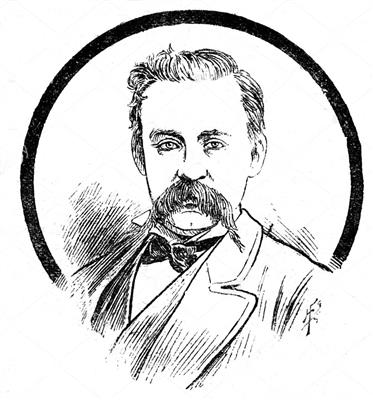
Alfred Concanen
When Victorian Londoners bought a song to sing at home, the cover was almost certainly drawn by Alfred Concanen. The leading lithographer of sheet music covers from his debut in 1860[1] until his death 26 years later, Concanen produced thousands of designs during the height of the music hall era, charging between two and twenty guineas per image depending on complexity.
Biography
Born around 1835[1] in Nottingham to an artistic family with Irish roots, his father Edward John Concanen was a portrait painter. Alfred succeeded John Brandard as the defining name in the field, creating character portraits of performers and comic scenes drawn directly from their songs. His subjects included some of the most famous names of the period: George Leybourne (whose "Champagne Charlie" cover is among the most recognised), Jenny Hill, Nellie Farren, and Alfred Vance.
Beyond sheet music, he illustrated books including "The Wilds of London" (1874[1]) and "Low Life Depths" (1876) and designed theatre posters, among them one for the comic opera "Cox and Box." The critic Sacheverell Sitwell singled out his draughtsmanship for particular praise, noting qualities that set him apart from the commercial run of the trade.
Concanen died in Marylebone on 10 December 1886[1]. Major holdings of his work are preserved at the Victoria and Albert Museum and the British Library, where his output now functions as a uniquely detailed visual record of popular entertainment in Victorian Britain.
Timeline
- 1835Born in Nottingham, England.
- 1860Began career as a lithographer of sheet music covers.
- 1874Illustrated the book "The Wilds of London".
- 1876Illustrated the book "Low Life Depths".
- 1886Died in Marylebone, London.
Notable Works
Tap to view larger.
Next stop
Browse the movements →
Every movement in the collection, from the Renaissance to Pop art.
Frequently Asked Questions
What is Alfred Concanen known for?
Alfred Concanen is known for his character portraits of performers and comic scenes drawn directly from their songs. He created sheet music covers for some of the most famous names of the period, including George Leybourne, Jenny Hill, Nellie Farren, and Alfred Vance. His work now functions as a uniquely detailed visual record of popular entertainment in Victorian Britain.What is Alfred Concanen's most famous work?
It is difficult to name Alfred Concanen's single most famous work. He was a prolific lithographer of sheet music in the Victorian period, and his work is not well represented in modern art-historical sources. He is best known for his contributions to popular entertainment, especially the music hall. Concanen designed many colourful covers for songs popular in London theatres. These covers often featured performers of the day. He worked with several composers and publishers, producing a large number of designs. His work helped to promote both the songs and the artists who performed them. While it is hard to isolate one piece, his collective output had a significant effect on the visual culture of Victorian music. He died in 1886[1].What should I know about Alfred Concanen's prints?
Alfred Concanen was a lithographic artist, many of whose works were produced as prints. When considering Concanen's prints, there are a few things to keep in mind. Firstly, the number of prints in an edition is determined by the artist. The edition claim is usually written as a pair of numbers on the bottom left margin of the print; it consists of a print number and an edition number. The title of the print is written in the middle of the bottom margin, and the signature is on the right. Secondly, early prints were not always numbered or signed. In some cases, the artist might have signed the plate or stone itself, with no pencilled signature on each print. Finally, it is important to distinguish between an original print and a reproduction. An original print is an image that has been conceived by the artist as a print and executed solely as a print, usually in a numbered edition, and signed by the artist. A reproduction is a copy of a work of art conceived by the artist in another medium, such as painting or watercolour, and has usually been made by photomechanical means.What style or movement did Alfred Concanen belong to?
Alfred Concanen (1835[1]-1886[1]) was a lithographer and illustrator, best known for his work in the field of popular music cover art. During his career, he created a large number of designs for sheet music covers, popular songs, and theatrical posters. Concanen's work can be seen as part of the broader development of commercial art in the 19th century. His designs often incorporated elements from various contemporary styles, including realism, romanticism, and the decorative arts. The covers frequently featured portraits of performers or scenes from the songs themselves. They reflect the tastes and interests of the Victorian public. His images were not high art, but rather were aimed at a mass audience. As such, Concanen's work is a valuable record of popular culture and entertainment during his lifetime. His designs helped to promote songs and performers, and they also provide insights into the visual culture of the period.What techniques or materials did Alfred Concanen use?
Alfred Concanen was a lithographic artist, creating images for a mass audience. Art historians note that an understanding of artistic techniques is essential; this allows one to appreciate the choices made by the artist. Technique can be defined as the manual and mechanical operations that act upon raw material; these shape and mould it according to artistic intentions. Some artists begin with craft and move towards ideas, while others move from ideas to the mundanities of craft. The materials and methods used by an artist are intimately connected with the notion of the "craftsman". The intention of the artist may be remembered, but the order in which each area was painted, and each brushmark made, is likely to have been forgotten. As Pierre Auguste Renoir observed, there is not a single process that can be made into a formula.What was Alfred Concanen known for?
Alfred Concanen (1835[1]-1886[1]) was an artist known primarily for his work in the field of popular music publishing. He created many of the now-iconic chromolithographic images on sheet music covers from the 1860s to the 1880s. His designs often featured performers of the day, from comic singers to ballet dancers. Concanen's work helped to visually market songs and artists to a wide audience. His images are recognised for their style and their reflection of Victorian popular culture. The covers provide a record of the music and stars that were successful at the time. Concanen collaborated with several lithographic printing firms, including Stannard & Son, and H.G. Banks. His output was prolific, and his designs are still collected today as examples of Victorian commercial art.When did Alfred Concanen live and work?
Alfred Concanen was active during the 19th century. He is known to have been working as an artist as early as 1847[1]. During this period, the Cameron family, including Julia Margaret Cameron, moved several times. In 1848, they relocated from India to Tunbridge Wells, Kent, and by 1850, they had settled in East Sheen, London. Later, between 1857 and 1859, the Camerons resided at Ashburton Cottage, Putney Heath, London. Julia Margaret Cameron was associated with artistic figures such as George Frederic Watts, who began a painting of her around 1850. She also spent time at Little Holland House, a prominent artistic salon run by her sister, Sarah Prinsep. Figures such as Alfred Tennyson were among Cameron's subjects in the 1860s.Where can I see Alfred Concanen's work?
It is difficult to say with certainty where you can view work by Alfred Concanen, as his pieces are not always on permanent display. However, many major museums and galleries hold collections of Art Deco and Arts and Crafts works, and these movements were contemporary to Concanen. These may be good places to start your search. In the UK, consider the Victoria & Albert Museum in London, the National Museums of Scotland in Edinburgh, Manchester Art Gallery, and Brighton Museum & Art Gallery. Other possibilities include the Cheltenham Art Gallery & Museum, and the William Morris Gallery in London. In the United States, you could try the Metropolitan Museum of Art in New York, the Los Angeles County Museum of Art (LACMA), the Minneapolis Institute of Arts, the Museum of Modern Art in New York, the Wolfsonian in Miami Beach, or the Charles Hosmer Morse Museum of American Art in Winter Park, Florida. The Royal Ontario Museum in Toronto also has relevant holdings.Where was Alfred Concanen from?
Alfred Concanen was born in Ireland around 1835[1]. Some sources suggest Dublin as his specific place of birth, although this is not definitively confirmed. During Concanen's lifetime, Ireland was undergoing significant political and social change. Daniel O'Connell's campaigns for Catholic Emancipation had created a sense of Irish democracy, although tensions remained high between Protestants and Catholics, particularly in Ulster. Concanen's family background is not well documented, but it is likely that he would have been aware of these prevailing social and political tensions. The fraught relationship between Irish nationalism and Ulster Protestantism would have been a feature of life. Concanen later moved to London, where he became a prominent lithographer and illustrator. He is best known for his work creating theatrical posters and sheet music covers.Who influenced Alfred Concanen?
The question of influences on Alfred Concanen is complex. The Pre-Raphaelite movement, with its emphasis on clarity of form and colour, and clean handling, certainly had an impact on artists of the period. The Pre-Raphaelites admired early Italian artists such as Francia and Ludovico Mazzolini, as well as Jan van Eyck. They saw these artists as examples of painting profitable for youthful emulation. The Pre-Raphaelites also rejected the fashion for idealising immoral figures, a trend they associated with Byron, Schiller, Goethe, and Shelley. Instead, they promoted the "manliness and heroism of simple goodness", as found in the work of Keats, Wordsworth, and Coleridge. The Dulwich Gallery was a place where artists could study early portraits by Rubens and Holbein, examples of care and humility.Who was Alfred Concanen?
Alfred Concanen was the leading lithographer of sheet music covers during the height of the music hall era. From his debut in 1860[1] until his death 26 years later, Concanen produced thousands of designs. He also illustrated books and designed theatre posters.Why are Alfred Concanen's works important today?
Alfred Concanen (1835[1]-1886[1]) was a lithographic artist and illustrator, best known for his work in the field of popular music cover design during the Victorian era. His images helped to promote the songs and performers of the time, and they offer a glimpse into the popular culture and entertainment of that period. Concanen's designs often featured performers from music halls and theatres. These covers provide information about the artists themselves, the songs they sang, and the venues in which they performed. As such, Concanen's work is a valuable resource for researchers studying the history of popular entertainment. His images also reflect the social attitudes and fashions of the time. By studying these, we can learn about the representation of gender, class, and race in Victorian society. Concanen's work is a reminder of the close relationship between art, commerce, and entertainment in the 19th century.
Sources
Editorial draws on the following primary and tertiary references for Alfred Concanen.
- [1] wikipedia Wikipedia: Alfred Concanen Used for: biography, birth dates, death dates, identifiers, movement attribution, nationality.
- [2] book Getty, Getty - Julia Margaret Cameron Complete Photographs Used for: biography.
- [3] book Post-impressionism : cross-currents in European painting Used for: biography.
- [4] book Post-impressionism : cross-currents in European painting Used for: biography.
Editorial overseen by Solis Prints. Sources verified 2026-10-14. Click a source for details, or hover over [N] in the page above to preview.
Editorial standardsMethodologyCorrectionsAI disclosureAbout the editorial team