



Aleksey Morgunov
The coincidence of birth: Aleksey Morgunov, one of the most combative figures of the Russian avant-garde, was allegedly the illegitimate son of Aleksei Savrasov, the founding father of Russian lyrical landscape painting. Whether or not that parentage is true, Morgunov thoroughly rejected his putative father's melancholy naturalism, aligning himself with the noisiest radicals in early 20th-century Moscow.
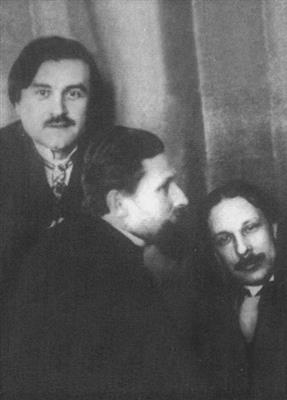
Biography
After studying at the Stroganov Academy from 1899[1] and receiving private instruction from Konstantin Korovin and Sergey Ivanov, Morgunov joined the Moscow Association of Artists in 1904. He fell quickly into the orbit of Mikhail Larionov and appeared at the April 1907 exhibition that art historians now identify as the first definitive showing of Neoprimitivist tendencies, alongside Malevich, Goncharova, and Shevchenko. He also exhibited with the provocateurs of the Donkey's Tail group in 1912.
Travel through Western Europe in 1909[1]-1910[1] absorbed Impressionist technique, but Morgunov remained committed to the formal experiments of the Moscow avant-garde circle. Around 1914 he co-founded a short-lived movement called Februaryism with Malevich and Ivan Kliun, whose members announced themselves by wearing spoons in their buttonholes. He also contributed to the anarchist journal Anarkhiia alongside Rodchenko, Rozanova, and Gan.
After 1917[1], he taught at the Stroganov Academy (then renamed the First Free State Art Workshops) but struggled with alcoholism through his later years. His style shifted through Neo-Classicism before settling into Socialist Realism. A body of his work survives in the George Costakis collection at the Museum of Modern Art in Thessaloniki. He died in Moscow on 15 February 1935[1].
Timeline
- 1884Born, allegedly the illegitimate son of Aleksei Savrasov
- 1899Began studies at the Stroganov Academy
- 1904Joined the Moscow Association of Artists
- 1907Exhibited at the first Neoprimitivist exhibition
- 1909Travelled through Western Europe until 1910
- 1912Exhibited with the Donkey's Tail group
- 1914Co-founded Februaryism with Malevich and Ivan Kliun
- 1917Taught at the Stroganov Academy
- 1935Died in Moscow
Notable Works
Tap to view larger.
Next stop
Browse the movements →
Every movement in the collection, from the Renaissance to Pop art.
Frequently Asked Questions
What is Aleksey Morgunov known for?
Aleksey Morgunov is known for his involvement in the Russian avant-garde movement and his association with various radical art groups. He exhibited with the Neoprimitivist group and the Donkey's Tail group, and he co-founded the short-lived Februaryism movement with Malevich and Ivan Kliun. His work, such as "Aviator's Workroom", was displayed in significant exhibitions like the Union of Youth exhibition and Tramway V.Who was Aleksey Morgunov?
Aleksey Morgunov was a combative figure in the Russian avant-garde art movement. He studied at the Stroganov Academy and joined the Moscow Association of Artists in 1904[1], later aligning himself with radical artists in Moscow. Morgunov also taught at the Stroganov Academy after 1917, but his later years were marked by struggles with alcoholism, and his style shifted to Neo-Classicism and then Socialist Realism.What was Aleksey Morgunov's art style?
Aleksey Morgunov's style evolved throughout his career, beginning with Impressionist techniques absorbed during travels in Western Europe. He remained committed to formal experiments within the Moscow avant-garde circle. His style shifted through Neo-Classicism before settling into Socialist Realism later in his life.How did Aleksey Morgunov die?
Aleksey Morgunov died in 1935[1] at the age of 51.
Sources
Editorial draws on the following primary and tertiary references for Aleksey Morgunov.
- [1] wikipedia Wikipedia: Aleksey Morgunov Used for: biography, birth dates, death dates, identifiers, movement attribution, nationality.
- [2] book guggenheim-artofavantgardei00rowe Used for: biography.
- [3] book guggenheim-grerussi00schi Used for: biography.
- [4] book Russian art of the avant-garde : theory and criticism, 1902-1934, with 105 illustrations Used for: biography.
Editorial overseen by Solis Prints. Sources verified 2026-09-01. Click a source for details, or hover over [N] in the page above to preview.
Editorial standardsMethodologyCorrectionsAI disclosureAbout the editorial team