

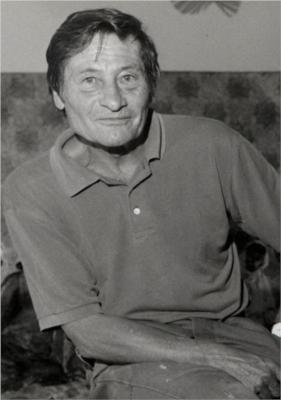
Aldo Mondino
Aldo Mondino made mosaics out of chocolate, coffee, seeds, and legumes. Born in Turin in 1938[1], he approached art-making with a systematic irreverence: the materials themselves were the subject, not merely the medium, and traditional craft techniques were fair game so long as their logic could be subverted.
Biography
Mondino trained in Turin and later worked in Paris during the 1970s, moving between painting, sculpture, and mosaic throughout a career that resisted stable categorisation. His work drew heavily on Islamic and North African visual culture, and where conventional mosaic artists use glass or stone, Mondino built elaborate pictorial surfaces from food and organic materials. 'Qui c'est moi' (1999[1]), a chocolate mosaic measuring 100 by 82 centimetres, is characteristic: recognisably portrait-like, formally accomplished, and made from something that will eventually decay.
He also painted on linoleum, exploiting the material's flat sheen and industrial associations to produce images that sit awkwardly between the domestic and the monumental. The irony was consistent throughout his practice: a deliberate deflation of high-art seriousness that never tipped into mere novelty.
Mondino died in Turin in March 2005[1], aged 66. His use of perishable materials remains one of the more unusual and sustained experiments in Italian[1] post-war art.
Timeline
- 1938Born in Turin, Italy
- 1970Worked in Paris
- 1999Created 'Qui c'est moi', a chocolate mosaic
- 2005Died in Turin, Italy
Notable Works
Tap to view larger.
Next stop
Browse the movements →
Every movement in the collection, from the Renaissance to Pop art.
Related Artists



Frequently Asked Questions
What is Aldo Mondino known for?
Aldo Mondino is known for making mosaics out of materials such as chocolate, coffee, seeds, and legumes. He also painted on linoleum, exploiting its flat sheen and industrial associations.What is Aldo Mondino's most famous work?
It is difficult to name one single work as Aldo Mondino's 'most famous'. Mondino worked in an eclectic style, and his body of work includes painting, sculpture, and mosaic. However, one series of works that is well recognised is his use of unusual materials, such as chocolate, coffee, and sugar, as a medium for creating art. Mondino explored themes of cultural identity, history, and consumerism throughout his career. His art often incorporates humour and irony, challenging conventional notions of taste and value. He is known for his playful approach to art-making, which blends different styles and techniques. Mondino's diverse output resists easy categorisation, but his innovative use of materials and his engagement with contemporary issues have earned him international recognition.What should I know about Aldo Mondino's prints?
Aldo Mondino, an Italian[1] artist, produced prints as part of his wider body of work. To understand the context of his prints, it is helpful to know some basic print terminology. A 'vintage print' is one made around the same time the negative was taken. A 'period print' is one made within roughly ten to fifteen years of the original shooting. If the printing date is unknown, or more than fifteen years later, it is simply called an 'old print'. A 'modern print' is a recent print made from the original negative. An 'original print' is one made by the artist or under their direct supervision. A 'facsimile' is a print made by re-photographing a print, or using the original negative, with the base and processing as close as possible to the original. The Professional Art Dealers Association of Canada defines an original print as an image conceived by the artist as a print, executed solely as a print, usually in a numbered edition, and signed. Each print in the edition is an original, printed from a plate, stone, screen, block or other matrix created for that purpose.What style or movement did Aldo Mondino belong to?
Aldo Mondino (1938[1]-2005[1]) was an Italian[1] artist whose practice resisted easy categorisation. He is often associated with the Arte Povera movement, although his relationship to it was complex. Arte Povera, which emerged in Italy during the late 1960s, was characterised by its use of humble, everyday materials, and a rejection of traditional artistic conventions. Mondino shared some of these concerns, particularly in his early work. However, his art also incorporated humour, irony, and a fascination with different cultures, elements not always central to Arte Povera. Mondino's diverse output included painting, sculpture, and mosaic. He drew inspiration from sources as varied as Byzantine art, Islamic culture, and popular imagery. His work frequently employed unusual materials such as chocolate, sugar, and linoleum. While some critics see him as an independent figure, others place him within a broader context of postmodern art, given his playful approach to art history and his rejection of a singular style. His diverse approach makes definitive classification difficult.What was Aldo Mondino known for?
Aldo Mondino (1938[1]-2005[1]) was an Italian[1] artist and sculptor, known for his eclectic approach and playful subversion of artistic conventions. He worked across a range of media, including painting, sculpture, and ceramics. Mondino often incorporated unusual materials into his art. Examples include chocolate, linoleum, and sugar. These unconventional choices challenged traditional notions of artistic value and material hierarchies. His subject matter was equally diverse, drawing inspiration from art history, literature, and popular culture. Mondino frequently referenced historical styles and motifs, reinterpreting them with a contemporary and often ironic twist. He engaged with themes of cultural identity, consumerism, and the art world itself. Mondino's art is characterised by its humour, wit, and intellectual engagement. He aimed to provoke thought and challenge viewers' expectations, while maintaining a sense of lightness and playfulness. He exhibited widely throughout Europe and beyond, securing his place as a significant figure in late 20th-century Italian art.When did Aldo Mondino live and work?
Aldo Mondino (1938[1]-2005[1]) was an Italian[1] artist, painter, and sculptor. He was born in Turin, Italy, on 4 October 1938[1]. Mondino's artistic career began in the 1960s. He became known for his diverse range of styles and materials. These included chocolate, linoleum, and sugar. His work often incorporated humour and irony, and he explored themes related to culture, history, and identity. Throughout his career, Mondino exhibited extensively both in Italy and internationally. He participated in major exhibitions such as the Venice Biennale and the Paris Biennale. His work can be found in numerous public and private collections. Mondino died in Turin on 10 March 2005. His art continues to be exhibited and studied. He is remembered for his experimental approach and his contribution to contemporary Italian art.Where can I see Aldo Mondino's work?
Aldo Mondino's artwork can be viewed in various public and private collections. In Italy, his pieces are held by the Galleria Civica d'Arte Moderna e Contemporanea (GAM) in Turin; the Museo del Novecento in Milan; and the MART, Museo di arte moderna e contemporanea di Trento e Rovereto. Internationally, Mondino's output has been collected by institutions such as the Musée d'Art Moderne et Contemporain in Geneva; the Neue Galerie in Kassel, Germany; and the Museum Junge Kunst in Frankfurt an der Oder. His work has also been included in exhibitions at the Jewish Museum in New York. Mondino's estate maintains an archive that facilitates the study and appreciation of his artistic output. Catalogues raisonnés and other scholarly resources are available for researchers and enthusiasts. Checking museum websites or contacting their curatorial departments is advisable for information on specific holdings and exhibition schedules.Where was Aldo Mondino from?
Aldo Mondino was an Italian[1] artist, born in Turin on 4 October 1938[1]. He is associated with the Arte Povera movement, a form of Italian Conceptual art. Mondino studied at the Accademia Albertina di Belle Arti in Turin. He later moved to Paris, where he attended William Hayter's Atelier 17, a printmaking studio, and also studied mosaic techniques. His work often incorporated unconventional materials, such as chocolate, linoleum, and sugar. Mondino’s subject matter ranged widely, from historical figures to personal experiences. He had a playful, ironic style. Some of his pieces include "Cioccolatini" (1969[1]), made from chocolate, and his series of "Turqueries" paintings. Mondino exhibited extensively throughout Europe and the United States. He represented Italy at the Venice Biennale in 1993. He died in Turin on 10 March 2005[1], his birthplace.Who did Aldo Mondino influence?
Aldo Mondino's artistic approach, which combined humour, irony, and a diverse range of materials, has had an impact on subsequent generations of artists. His playful deconstruction of artistic conventions and his exploration of cultural stereotypes have been noted as influential. Mondino's influence is seen in the work of artists who embrace unconventional materials and techniques. His use of chocolate, linoleum, and other unexpected substances encouraged others to experiment beyond traditional media. His art also paved the way for artists who address themes of cultural identity and globalisation with a critical eye. While it is difficult to pinpoint specific individuals who directly credit Mondino as an influence, his impact can be observed in the broader artistic landscape. Many contemporary artists share his interest in challenging established norms and engaging with popular culture. Mondino's legacy lies in his contribution to a more open and inclusive art world, where experimentation and critical thinking are valued.Who influenced Aldo Mondino?
Mondino de’ Liuzzi, a professor of medicine at the University of Bologna, produced a dissection manual and anatomy treatise, Anathomia, in 1316. The text had immense influence, remaining in publication and in use for university teaching for two centuries. Mondino's manual was part of a larger movement, as the University of Bologna was one of the first places to utilise human dissection within medical education. This was intended as a practical addition to studying Galen's anatomical writings. Animal dissections had already been practiced at Salerno. Although Mondino’s are the first recorded dissections for teaching purposes, it seems likely that the practice was introduced by his predecessor Taddeo Alderotti in the late thirteenth century; this is when we begin to find the earliest recorded instances in Italy of autopsies carried out for public health and forensic reasons. From these Bolognese beginnings, the practices of autopsy and pedagogical dissection spread to other centres in Italy across the course of the fourteenth century.Who was Aldo Mondino?
Aldo Mondino (1938[1]-2005[1]) was an Italian[1] artist and painter, known for his eclectic style and playful approach to art history. He was born in Turin and his artistic career spanned several decades. Mondino's work often incorporated diverse materials such as chocolate, linoleum, and sugar. He blended different cultural references and artistic traditions. His art frequently featured irony and humour, challenging conventional notions of taste and artistic value. Mondino moved between various artistic movements, including Nouveau Réalisme and Arte Povera, but maintained a distinct artistic identity. He explored themes of cultural identity, consumerism, and the art world itself. His paintings, sculptures, and installations have been exhibited internationally. Major exhibitions of his work have been held in museums and galleries across Europe and beyond. Mondino's contribution to Italian art is marked by his experimental approach and his witty commentary on contemporary society. He died in his home city in 2005[1].Why are Aldo Mondino's works important today?
Aldo Mondino dei Liuzzi, a fourteenth-century professor of medicine at the University of Bologna, produced Anathomia, an immensely influential text. Completed circa 1316, it was used in university teaching for the next two hundred years. Mondino's work is important because it documents the introduction of human dissection as a regular part of medical training in Italian[1] universities. Before this innovation, there were no authoritative texts suitable for teaching this field, as human dissection had not been practised in ancient or medieval Islamic culture. Mondino's treatise was intended to accompany the dissection of a cadaver in the classroom. However, rather than using the dissected cadaver to correct errors, he treated it as a visual aid. This was intended to help students remember anatomical information contained in older texts. Mondino drew most of his information from Greek and Arabic medical writers, most notably Galen and Ibn Sina. Many of his descriptions reflect earlier textual tradition, supplemented and shaped by the dissection of animals.
Sources
Editorial draws on the following primary and tertiary references for Aldo Mondino.
- [1] wikipedia Wikipedia: Aldo Mondino Used for: biography, birth dates, death dates, identifiers, movement attribution, nationality.
- [2] book guggenheim-mariomerz00cela Used for: biography.
- [3] book guggenheim-refigur00kren Used for: biography.
- [4] book Braun, Emily, 1957-; Asor Rosa, Alberto; Royal Academy of Arts (Great Britain), Italian art in the 20th century : painting and sculpture, 1900-1988 Used for: biography.
Editorial overseen by Solis Prints. Sources verified 2026-08-24. Click a source for details, or hover over [N] in the page above to preview.
Editorial standardsMethodologyCorrectionsAI disclosureAbout the editorial team