



Aldo Locatelli
Aldo Locatelli arrived in Brazil in 1948[1] at the invitation of a bishop, commissioned to paint the Cathedral of São Francisco de Paula in Pelotas, and never went home. He died in Porto Alegre in 1962, leaving behind an extensive body of monumental religious fresco work that has become central to the cultural heritage of Rio Grande do Sul.
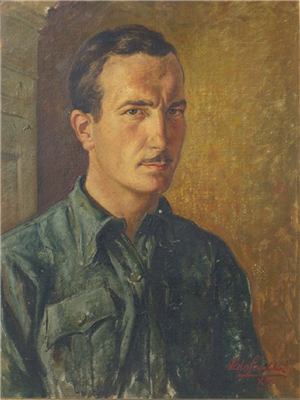
Biography
Born in Bergamo in 1915[1], Locatelli trained in Italy during the 1930s and 1940s, working on frescoes at Genoa's cathedral before his Brazilian chapter began. The Pelotas commission was the first of many: over the following decade he undertook fresco and panel projects in churches and public buildings across the state, including a ten-year cycle of the Stations of the Cross in the Church of San Pelegrini in Caxias do Sul.
His style drew on the northern Italian[1] tradition of monumental sacred painting, translated into a Brazilian context. Working at large scale and in fresco, a technique demanding both speed and preparation, Locatelli brought an ambition to his compositions that was unusual for church commissions of the period. His final project, 'Sacred Heart of Jesus', remained unfinished at his death.
The Cathedral frescoes in Pelotas and the Caxias do Sul cycle are generally considered his finest works. Locatelli died aged 47, before he could complete his final commission.
Timeline
- 1915Born in Bergamo, Italy
- 1930Trained in Italy during the 1930s and 1940s
- 1940Worked on frescoes at Genoa's cathedral
- 1948Arrived in Brazil, commissioned to paint Cathedral of São Francisco de Paula
- 1948Commissioned to paint the Cathedral of São Francisco de Paula in Pelotas
- 1948Undertook fresco and panel projects in churches and public buildings
- 1948Began ten-year cycle of Stations of the Cross in Caxias do Sul
- 1962Died in Porto Alegre
- 1962Final project, 'Sacred Heart of Jesus', remained unfinished
Notable Works
Tap to view larger.
Next stop
Browse the movements →
Every movement in the collection, from the Renaissance to Pop art.
Related Artists


Frequently Asked Questions
What is Aldo Locatelli known for?
Aldo Locatelli is known for his monumental religious fresco work, which is central to the cultural heritage of Rio Grande do Sul. His finest works are generally considered to be the Cathedral frescoes in Pelotas and the Stations of the Cross cycle in the Church of San Pelegrini in Caxias do Sul.What is Aldo Locatelli's most famous work?
Aldo Locatelli is best known for his religious paintings in churches across the Brazilian state of Rio Grande do Sul. Born in Italy, Locatelli emigrated to Brazil in 1948[1], where he received commissions to decorate many churches. His most famous work is considered to be the cycle of paintings in the Igreja Matriz São Pelegrino (Parish Church of Saint Pellegrino) in Caxias do Sul. These paintings, executed between 1951 and 1954, depict scenes from the life of Saint Pellegrino Laziosi, as well as other religious subjects. The murals cover the internal surfaces of the church, creating a cohesive decorative scheme. They combine elements of Renaissance and Baroque styles with a modern sensibility. Locatelli also completed significant works in the Catedral de Pedra (Stone Cathedral) in Canela and the Igreja Matriz in Veranópolis. Although he died relatively young, at the age of 57, Locatelli left behind a substantial body of religious art that continues to be admired in Brazil.What should I know about Aldo Locatelli's prints?
Aldo Locatelli (1915[1]-1962[1]) was an Italian[1]-Brazilian painter and printmaker. Although details about his printmaking techniques are scarce, understanding the context of print production in Italy during similar periods can offer insights. In the late Renaissance, printmaking was closely tied to book production. Illustrated books often included woodcuts and engravings, with copperplates requiring a separate printing press. The cost of paper, the engraver's fees, and the printer's labour all contributed to the final price of a print or illustrated book. The monetary system in Italy at the time was complex, with each region minting its own coinage, and values fluctuating due to inflation. This complexity affected the economics of printmaking, from the cost of materials to the sale price of the finished work.What style or movement did Aldo Locatelli belong to?
Aldo Locatelli's artistic style is generally categorised as a blend of realism and religious art, often with influences from the Italian[1] Renaissance. Born in Italy in 1915[1], Locatelli developed his skills through formal training, which instilled in him a respect for traditional techniques. His work frequently features religious subjects, reflecting his deep faith and the commissions he received from churches and religious institutions. These pieces often incorporate realistic depictions of figures and settings, combined with a sense of drama and emotion. Locatelli's approach is characterised by careful attention to detail, particularly in his portrayal of human anatomy and facial expressions. While his style is rooted in tradition, Locatelli also incorporated some modern elements into his work. This is evident in his use of colour and composition, which sometimes departs from strict academic conventions. Although not associated with a specific avant-garde movement, Locatelli's art represents a continuation of classical ideals within a contemporary context. He died relatively young, in 1962[1].What techniques or materials did Aldo Locatelli use?
Aldo Locatelli was a versatile artist who employed a range of techniques and materials in his work. He is known to have worked with stucco, using it in abundant quantities. Locatelli combined stucco with other contrasting materials such as glass and dry wood, creating a sense of space between them. He also framed panes of dusty glass with stucco, contrasting the heavy material with the idea of light and transparent glass. In addition to stucco and glass, Locatelli also used materials such as wax, plaster, and crude iron in his sculptures. He poured wax into boxes and suspended it from structures, creating intriguing and incomprehensible forms. He also made a well of glass panes and stucco, pouring plaster into it and propping it against an iron structure. Locatelli also incorporated mud, earth, leaves, chestnuts, and pinecones into his canvases, revitalising the images with these natural elements.When did Aldo Locatelli live and work?
Aldo Locatelli was born in Bergamo, Italy, on 18 August 1915[1]. He died relatively young, on 22 January 1962[1], in Porto Alegre, Brazil. Locatelli's career was impacted by the Second World War. He was drafted in 1940 and served until 1943. After the war, he dedicated himself to painting, initially producing religious works in the Bergamo area. In 1951, Locatelli travelled to Brazil to decorate the Igreja Matriz de Nossa Senhora das Dores in Porto Alegre. He executed other commissions in Brazil, including work in the Catedral de Pelotas and the Palácio Piratini (the state government building). He remained in Brazil for the rest of his life, becoming a naturalised citizen in 1956.Where can I see Aldo Locatelli's work?
While specific locations for viewing Aldo Locatelli's artwork are not widely publicised, several museums and galleries in Italy feature collections that may include his pieces. These include the Galleria Civica d'Arte Moderna e Contemporanea in Turin, and the Galleria Nazionale d'Arte Moderna e Contemporanea in Rome. The Civico Museo d'Arte Contemporanea in Milan and the Civico Museo Revoltella in Trieste are also possibilities. Other museums such as the Museo Fortuny in Venice, and the Museo Marino Marini in Florence, may hold works relevant to the periods and styles Locatelli worked in. It is advisable to check the museums' websites or contact them directly to enquire about specific works by Locatelli in their collections and whether they are currently on display.Who did Aldo Locatelli influence?
It is difficult to identify specific artists who were directly influenced by Aldo Locatelli. His work in sacred art and large-scale decorative projects, such as the frescoes at Caxias do Sul Cathedral (Brazil), do not fit neatly into the major movements of 20th-century Italian[1] art. However, Locatelli's career coincided with a period of significant debate about the relationship between art and craft. Artists such as Lucio Fontana, Fausto Melotti, and Leoncillo Leonardi grappled with these issues, as did the journal *Valori Primordiali*, which included work by artists of different tendencies. While not a direct stylistic influence, Locatelli's work might be considered within this broader context of Italian artists working in diverse media and negotiating the boundaries between fine art, design, and religious or civic functions. His focus on public art aligns with the aims of some of these artists, even if their aesthetic approaches differed greatly.Who influenced Aldo Locatelli?
Aldo Locatelli's influences are difficult to pin down precisely. He lived through a period of rapid change in Italian[1] art and architecture, and was exposed to a range of ideas. In Milan, where Locatelli spent time, there was a strong interest in Modern architecture and design. Architects looked to both neoclassicism and international Modernism. Figures such as Luigi Caccia Dominioni sought a connection between the Novecento movement and international trends. There was also an aspiration to social-democratic models from northern Europe, and the beginnings of a consumer society. Locatelli would have been aware of artists such as Lucio Fontana and sculptors such as Arturo Martini. The Futurists also had a presence in Italian art during Locatelli's formative years. Figures such as Umberto Boccioni, Carlo Carra, and Giacomo Balla explored themes of modernity and dynamism. Their ideas might have resonated with Locatelli, although his mature style is distinct.Why are Aldo Locatelli's works important today?
Aldo Locatelli (1895-1962[1]) was an Italian[1] artist whose career took him to Brazil, where he produced many works in churches and public buildings. His commissions in Brazil are significant for several reasons. He created many large-scale religious works, mainly murals and frescoes, that can still be viewed today. These works are accessible to the public. They provide insight into the artistic and religious climate of Brazil in the mid-20th century. His style represents a blend of European academic traditions with some influence from the developing modern art movements. Locatelli's art offers a case study of cultural exchange between Europe and South America, as well as the adaptation of European artistic styles to a new cultural context. His works remain important examples of 20th-century religious art and contribute to the understanding of the development of art in Brazil.What was Aldo Locatelli's art style?
Aldo Locatelli's style drew on the northern Italian[1] tradition of monumental sacred painting, translated into a Brazilian context. He worked at a large scale and in fresco, bringing ambition to his compositions for church commissions.
Sources
Editorial draws on the following primary and tertiary references for Aldo Locatelli.
- [1] wikipedia Wikipedia: Aldo Locatelli Used for: biography, birth dates, death dates, identifiers, movement attribution, nationality.
- [2] book Beard, Lee, 1973- author, Butler, Adam, author; Van Cleave, Claire, author; Fortenberry, Diane, author; Stirling, Susan, author, Beard, Lee, 1973- author, Butler, Adam, author; Van Cleave, Claire, author; Fortenberry, Diane, author; Stirling, Susan, author - The Art Book_ New Edition, Mini Format Used for: biography.
- [3] book Braun, Emily, 1957-; Asor Rosa, Alberto; Royal Academy of Arts (Great Britain), Italian art in the 20th century : painting and sculpture, 1900-1988 Used for: biography.
- [4] book Masterpieces of western art : a history of art in 900 individual studies from the Gothic to the present day Used for: biography.
Editorial overseen by Solis Prints. Sources verified 2026-10-14. Click a source for details, or hover over [N] in the page above to preview.
Editorial standardsMethodologyCorrectionsAI disclosureAbout the editorial team