



Albrecht Anker
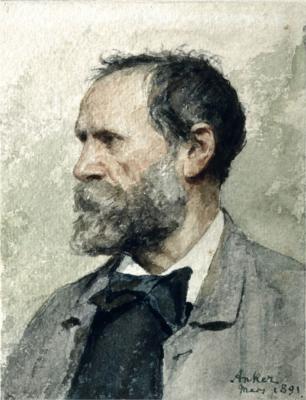
Six years of theological study preceded his conversion to painting. Born in Ins, Switzerland, in 1831[3], Albrecht Anker trained for the church at Bern and Halle before travelling to Paris to study under Charles Gleyre at the École des Beaux-Arts, where he remained from 1855[3] to 1860. He returned each summer to the village he had grown up in, and it was those summers that generated the thousands of canvases that made his name.
Biography
Anker's subjects were the people of the Swiss[3] countryside: children at their lessons, card-playing old men, women at domestic work. Two paintings submitted to the 1866[3] Paris Salon, 'Schlafendes Mädchen im Walde' and 'Schreibunterricht', won him a gold medal. He was made a Knight of the Légion d'honneur in 1878, and the University of Bern awarded him an honorary doctorate in 1900.
He sat briefly on the Grand Council of Bern between 1870[3] and 1874, but politics interested him less than the studio. His four surviving children appeared repeatedly in his paintings, and he produced more than thirty still lifes alongside hundreds of portraits and watercolours. The range of the output is striking given how narrow the subject matter appears from the outside.
Anker died in Ins in July 1910[3], having spent almost his entire life within a few kilometres of his birthplace. Today his face appears on the Swiss[3] 50-franc note.
Timeline
- 1831Born in Ins, Switzerland
- 1855Studied at École des Beaux-Arts under Charles Gleyre in Paris
- 1860Returned to Switzerland after studying in Paris
- 1866Won a gold medal at the Paris Salon for two paintings
- 1870Sat on the Grand Council of Bern
- 1874Left the Grand Council of Bern
- 1878Made a Knight of the Légion d'honneur
- 1900Awarded an honorary doctorate from the University of Bern
- 1910Died in Ins, Switzerland
Notable Works
Tap to view larger.
Next stop
Impressionism →
Explore the artists and ideas of Impressionism.
Related Artists


Frequently Asked Questions
What is Albrecht Anker known for?
Albrecht Anker is known for his paintings of the people of the Swiss[3] countryside. His subjects included children at lessons, card-playing old men, and women doing domestic work.What is Albrecht Anker's most famous work?
It is difficult to name one single work as Albrecht Anker's 'most famous'. He produced a large body of paintings and drawings, mostly of everyday Swiss[3] family life, and he had a long career exhibiting and selling his work. Anker is best known for his paintings of children, often in rural settings. He captured scenes of them reading, playing, or attending school. These paintings often evoke a sense of warmth and nostalgia for a simpler time. He also painted still lifes and portraits, but these are less well known. His style is realistic, with careful attention to detail and colour. He captured the likenesses and clothing of his subjects with precision. Although Anker's work was popular during his lifetime, it fell out of favour in the early 20th century. However, there has been a renewed interest in his art in recent years, and his paintings are now highly sought after by collectors.What should I know about Albrecht Anker's prints?
Albrecht Anker (1831[3]-1910[3]) was a Swiss[3] painter and illustrator, best known for genre scenes of Swiss rural life. While he is not as widely recognised for printmaking as some of his contemporaries, prints after his paintings were popular during his lifetime and remain collectable. Anker's prints are mainly lithographs, a process that, according to some, he brought to a level rivalling woodcuts through patient experimentation. He employed techniques such as turpentine etching to create tonal areas and textures, resulting in prints with deep blacks and silky greys. These lithographs were often hand-printed, with Anker reworking the stone until the initial drawing became fully graphic. Printsellers' Association declared editions of prints can be distinguished by the presence of an engraved title, the placement of the Association stamp, and signatures by the artist and engraver. These included Artist Proofs, Lettered Proofs, Presentation Proofs, and Proofs before letters.What style or movement did Albrecht Anker belong to?
Albrecht Anker (1831[3]-1910[3]) was a Swiss[3] painter. During the 19th century, many European artists outside France, such as Giovanni Segantini of Italy and Anders Zorn of Sweden, became known outside their own countries. However, developments in the Slavic countries remained largely within their own borders. In France, Realism emerged, associated with Gustave Courbet (1819-1877[3]). Courbet aimed to depict only visual objects and tangible things, using dark colours reminiscent of old masters. Impressionism[3] followed, characterised by lighter tones, flatter surfaces, and an emphasis on light and atmosphere. This movement involved selecting from nature and improvisation, contrasting with Realism's imitation. Symbolism, viewed as anti-realism and anti-impressionism, reflected literary and intellectual trends. Symbolist ideas influenced Post-Impressionism, with artists like Arnold Böcklin, Edvard Munch, and Ferdinand Hodler exploring symbolism in their work. Symbolism also connected with Art Nouveau, Jugendstil, and Modern styles, seen in the decorative works of artists such as Aubrey Beardsley and Gustav Klimt. Some major artists, like Auguste Rodin, were touched by Symbolism without it becoming their main focus.What was Albrecht Anker known for?
Albrecht Anker (1831[3]-1910[3]) was a Swiss[3] painter. Although trained in the tradition of old Netherlandish, German, Spanish and Italian masters, Anker adopted an anti-academic approach, invariably seeking the new and the lively. He is known for an unerring sense of colour, authenticity of form, and in the simplicity and reduction of his structures. From 1890[3] onwards, he dedicated himself increasingly to painting outside and travelled widely during the summer months. His paintings often featured portraits, figural compositions and still lifes. He turned to painting motifs in natural light at a fairly late stage. The short, angular brushstrokes of his earlier works are increasingly replaced by freer, broader and longer strokes. Clear and bright, the sky and the blue lake contrast sharply with the village and the lakeside.When did Albrecht Anker live and work?
Albrecht Anker was born on 1 April 1831[3] in Ins, Switzerland. He died on 16 July 1910[3] in the same town. Anker, also known as Albert Anker, was a Swiss[3] painter and illustrator. He is best known for his genre paintings depicting rural life and scenes of children. From 1845[3] to 1848, Anker attended the Progymnasium in Neuchâtel, where he took lessons from Louis Agassiz. He then studied theology, beginning in 1849, but abandoned this pursuit in 1851 to dedicate himself to art. Anker moved to Paris in 1851, where he studied with Charles Gleyre. From 1855 to 1860, he continued his art education at the École des Beaux-Arts. He established a studio in Paris, where he lived and worked until 1870, when he returned to Ins. In Ins, he served on the cantonal parliament and dedicated himself to painting.Where can I see Albrecht Anker's work?
Albrecht Anker's works can be viewed in numerous public collections, primarily in Switzerland and Germany. Within Switzerland, notable locations include the Aargauer Kunsthaus in Aarau; the Kunstmuseum in Basel; the Kunstmuseum and the Gottfried Keller Stiftung, both in Berne; the Musée d'Art et d'Histoire in Geneva; the Kunstmuseum in Lucerne; the Kunstmuseum in St Gallen; the Kunstmuseum in Winterthur; and the Kunsthaus, the ETH Graphische Sammlung, and the Kunstmuseum, all in Zurich. In Germany, Anker's art can be found in the Brücke Museum and the Nationalgalerie, both located in Berlin; the Kunsthalle in Bremen; the Ludwig Museum and the Wallraf-Richartz Museum, both in Cologne; the Folkwang Museum in Essen; the Kunsthalle in Hamburg; the Niedersächsisches Landesmuseum in Hanover; the Städtische Kunsthalle in Mannheim; the Bayerische Staatsgemäldesammlungen in Munich; and the Von der Heydt Museum in Wuppertal. Additionally, Anker's pieces are held by the Josef-Albers-Museum in Bottrop, and the Kupferstichkabinett (part of the Staatliche Museen SPK) in Berlin. Other international locations include the Museo de Arte Moderno in Barcelona, the Museum of Fine Art in Budapest, the Herbert F. Johnson Museum of Art in Ithaca, New York, the Brooklyn Museum, and the Museum of Modern Art and the Solomon R. Guggenheim Museum, both in New York.Who did Albrecht Anker influence?
Albrecht Anker's paintings of everyday life, especially his depictions of children, had a considerable effect on later artists. His attention to detail and his ability to capture the innocence of childhood resonated with many who followed. Anker's influence can be seen in artists who focused on similar themes of domesticity and childhood, such as the German painter Paula Modersohn-Becker. Her work shares Anker's interest in portraying children in a realistic and sympathetic manner. Other artists who explored similar themes include Claude Monet, Berthe Morisot, and Mary Cassatt. Anker's style was influenced by Dutch art. His paintings, for example Girl Knitting (1881[3]), The Crèche I (1890), The Crèche II (1894), and An Old Woman Sewing with her Granddaughter (1887), reflect this interest. The influence of Dutch masters can be seen in Anker's use of light, his attention to detail, and his focus on domestic scenes.Who was Albrecht Anker?
Albrecht Anker (1831[3]-1910[3]) was a Swiss[3] painter and illustrator, best known for his genre paintings of Swiss village life. Born in Anet, Switzerland, Anker studied art in both Switzerland and France. He developed a style characterised by realistic depictions of everyday scenes, particularly those involving children and families. His paintings often portray scenes of education, leisure, and domestic life within rural communities. Anker's work gained popularity during his lifetime, and he is considered one of the most important Swiss painters of the 19th century. His paintings offer insight into the social and cultural values of the time, presenting an idealised view of rural life in Switzerland. He captured moments of joy, contemplation, and community, appealing to a broad audience with his accessible and heartwarming imagery.How did Albrecht Anker die?
Albrecht Anker died in 1910[3] at the age of 79.
Sources
Editorial draws on the following primary and tertiary references for Albrecht Anker.
- [1] museum Harvard Art Museums Used for: museum holdings.
- [2] museum Victoria and Albert Museum Used for: museum holdings.
- [3] wikipedia Wikipedia: Albrecht Anker Used for: biography, birth dates, death dates, identifiers, movement attribution, nationality.
- [4] book Pierre-Auguste Renoir, Delphi Complete Works of Pierre-Auguste Renoir (Illustrated) (Masters of Art Book 11) Used for: biography.
- [5] book Masterpieces of western art : a history of art in 900 individual studies from the Gothic to the present day Used for: biography.
- [6] book Pierre-Auguste Renoir, Masters of Art - Pierre-Auguste Renoir Used for: biography.
Editorial overseen by Solis Prints. Sources verified 2026-09-30. Click a source for details, or hover over [N] in the page above to preview.
Editorial standardsMethodologyCorrectionsAI disclosureAbout the editorial team