



Alberto Sughi
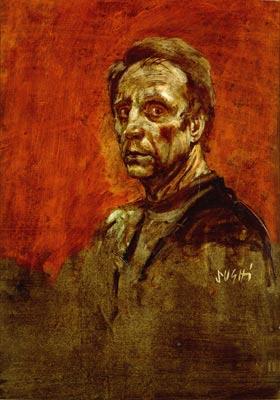
When critic Enrico Crispolti coined the term existential realism in 1956[1] to describe Alberto Sughi's work, it fitted. Sughi's paintings showed ordinary Italians in cafes, at tables, in bars, passing time with no particular destination, and he refused to load them with either socialist optimism or bourgeois anxiety. His figures simply existed, which was the point.
Biography
Born in Cesena in 1928[1], Sughi was self-taught, and the directness of his approach probably owes something to that. He began working in the early 1950s and over the following decades built an output organised into extended thematic cycles: the Green paintings of 1971[1] to 1973; the Supper cycle of 1975 to 1976; a family cycle of the early 1980s comprising twenty paintings and fifteen studies; and the Nocturnal series that toured internationally through 2000. Each cycle approached a single subject from multiple angles, accumulating pressure across canvases rather than resolving it in any single image.
International recognition came earlier than domestic. Moscow hosted a retrospective in 1978[1], followed by Budapest and Prague in 1986, and São Paulo in 1994. A more comprehensive Italian[1] accounting came with the 642-work survey at the Palazzo della Pilotta in Parma in 2005 to 2006. In 1994 he was appointed director of Rome's Ente Quadriennale Nazionale d'Arte.
His final cycle, Un mondo di freddo e di ghiaccio, was selected for the Venice Biennale in 2011[1]. Sughi died in Cesena on 31 March 2012[1].
Timeline
- 1928Born in Cesena, Italy
- 1950Began working as a self-taught artist
- 1956Work described as 'existential realism' by Enrico Crispolti
- 1971Started the Green paintings cycle (1971-1973)
- 1975Started the Supper cycle (1975-1976)
- 1978Retrospective exhibition held in Moscow
- 1980Began the family cycle of paintings
- 1986Exhibitions held in Budapest and Prague
- 1994Exhibition held in São Paulo
- 1994Appointed director of Rome's Ente Quadriennale Nazionale d'Arte
- 2005Survey at the Palazzo della Pilotta in Parma (2005-2006)
- 2011Un mondo di freddo e di ghiaccio selected for Venice Biennale
- 2012Died in Cesena, Italy
Notable Works
Tap to view larger.
Next stop
Browse the movements →
Every movement in the collection, from the Renaissance to Pop art.
Related Artists


Frequently Asked Questions
What is Alberto Sughi known for?
Alberto Sughi is known for his paintings of ordinary Italians in everyday settings such as cafes and bars. His work focused on depicting figures simply existing, without imposing socialist optimism or bourgeois anxiety.What is Alberto Sughi's most famous work?
It is difficult to identify one single work as Alberto Sughi's "most famous". He is known for his paintings that explore themes of alienation, existentialism, and the human condition in modern society. Sughi's style is characterised by its realism and focus on the individual. His paintings often depict solitary figures in urban settings, rendered in muted colours. He frequently portrays people in moments of contemplation or isolation, capturing a sense of psychological depth. Some of his well-regarded works include paintings from the series *The Dinner* (La Cena), which portrays figures around a table, seemingly disconnected from one another. Other notable paintings include *Black Sun* (Sole Nero) and works depicting beach scenes with isolated figures. These paintings encapsulate Sughi's exploration of modern life and the complexities of human relationships. He developed these themes throughout his career.What should I know about Alberto Sughi's prints?
Alberto Sughi (1928[1]-2012[1]) was an Italian[1] painter and printmaker known for his figurative works. When considering Sughi's prints, it is helpful to understand some basic print terminology. An 'original print' is conceived and executed solely as a print, often in a numbered edition, and signed by the artist. Each print is created individually from a plate, stone, screen, or block. There isn't a single 'original' from which copies are made. The artist determines the number of prints in an edition, and numbering accounts for the prints, such as 12/25 (print 12 of an edition of 25). A reproduction is a copy of artwork initially created in another medium, such as painting. It is usually made using photomechanical methods. Numbering and signing do not change its essence; it remains a reproduction, not an original print. Some artists also create artist's proofs, marked 'AP', which are a small percentage of the edition. When buying fine art prints, examine the print, and request documentation about the printmaking process.What techniques or materials did Alberto Sughi use?
Alberto Sughi's painting technique involved a reflective white ground layer. The artist may have used an underpainting, either a grey-toned version of the finished image or a more sophisticated method. This second method involved an underdrawing to establish contours and dark areas on the white ground, covered with a thin, transparent imprimatura. This imprimatura allowed the drawing to show through while establishing a middle tone. Highlights were then added with white paint, completing the values and creating a monochromatic underpainting. Colour was applied as thin, transparent glazes, allowing the underpainting to define the forms. Highlighted areas used minimal local colour, tinting the white underpainting. Dark tones required multiple layers to cover the underdrawing and establish the proper local colour. Sughi may have used impasto white paint for highlights, a technique common among Baroque artists. This allowed for a freer style and larger formats. He may have toned the surface with a middle or darker value, creating the image with washes, and then adding highlights with thick impasto white paint.What was Alberto Sughi known for?
Alberto Sughi (1928[1]-2012[1]) was an Italian[1] painter and printmaker. He is best known for his figurative paintings that explore themes of alienation, existentialism, and the human condition in modern society. Sughi's style is characterised by its realistic approach, often depicting ordinary people in urban settings. His colour palettes are typically muted, with an emphasis on conveying a sense of melancholy and introspection. He frequently portrayed figures in isolation, capturing moments of solitude and contemplation. Throughout his career, Sughi exhibited extensively in Italy and internationally, gaining recognition for his contribution to contemporary Italian art. His work can be found in numerous public and private collections. He was associated with the Italian political left, and his art often reflected his social and political concerns.When did Alberto Sughi live and work?
Alberto Sughi was born in Cesena, Italy, in 1928[1]. His artistic career began in the post-war era, and he continued to work until his death in 2012[1]. Sughi's work gained attention during a period of significant artistic and cultural change in Italy. The late 1950s and early 1960s saw the emergence of new artistic movements, such as Arte Nucleare and Spatialism, alongside the rise of the Informel style, which included artists like Alberto Burri and Lucio Fontana. These movements challenged traditional artistic forms and explored new mediums. Sughi's paintings often explored themes of social alienation and the human condition, setting him apart from the abstraction and experimentation of some of his contemporaries. He remained committed to figurative art throughout his career, focusing on the depiction of everyday life and the complexities of human relationships. Sughi died in Bagno di Romagna in 2012[1].Where can I see Alberto Sughi's work?
To view works by Alberto Sughi, you may need to consult museum catalogues and databases for current holdings and exhibition schedules, as the provided references do not specifically mention Sughi. However, these sources do list numerous museums with significant collections of Italian[1] art. These include: Galleria degli Uffizi (Florence), Pinacoteca di Brera (Milan), Galleria e Museo Estense (Modena), Palazzo Barberini (Rome), and Galleria Internazionale d’Arte Moderna di Ca’ Pesaro (Venice). Other European museums include: Staatliche Museen zu Berlin, Musée du Louvre (Paris), National Gallery of Scotland (Edinburgh), National Gallery (London), and the Mauritshuis (The Hague). Outside of Europe, consider: The Metropolitan Museum of Art (New York), The J. Paul Getty Museum (Los Angeles), and Museo de Arte Alvar y Carmen T de Carillo (Mexico City).Who did Alberto Sughi influence?
It is difficult to identify specific artists who were directly influenced by Alberto Sughi. More research is needed to establish a clear line of influence. However, we can consider the artistic currents of his time. Sughi's figurative style, focusing on social themes and the human condition, places him within a tradition of Italian[1] art concerned with realism and social commentary. His work shares some affinities with the concerns of artists associated with the Scuola Romana (Roman School), a group active in the first half of the 20th century, who moved away from Futurism to explore a more expressive and emotional style of figuration. Similarly, Sughi's focus on the alienation and anxieties of modern life connects him to broader trends in European art after the Second World War, such as existentialism, which influenced many artists. Further study might reveal more specific connections between Sughi and other artists working with similar themes and styles.Who influenced Alberto Sughi?
It is difficult to summarise the influences on Alberto Sughi. However, the Italian[1] cultural milieu, particularly that of writers and artists in the first half of the 20th century, mattered to him. Their debates over reform, good works, grace, and schism were as important to them as Communism and Fascism. Dutch painters were known for their international outlook. Many visited Italy to gain experience and skill. There was a shared conception of art throughout Northern and Southern Europe. Figures such as Samuel van Hoogstraten disseminated views about art. Lambert Lombard believed the renewal of northern culture began around 1450 with Martin Schongauer and was furthered by Dürer, who based his art on firm rules. Lombard studied Dürer's prints and commended his treatise to pupils. Dürer's art and writings played an important role in Lombard’s outlook. Lombard's view also encompassed ideas expressed by Pliny, Vitruvius, Alberti, Pomponius Gauricus, and others. These texts influenced Lombard’s approach to proportion and harmony, as well as his interest in teaching.Why are Alberto Sughi's works important today?
Alberto Sughi (1928[1]-2012[1]) was an Italian[1] painter and printmaker. His art is still relevant because it deals with universal themes of alienation, existential angst, and the human condition in modern society. Sughi's paintings often depict solitary figures or groups of people in urban settings, capturing moments of introspection, isolation, and disconnection. These images reflect the anxieties and uncertainties of contemporary life; this is something that continues to resonate with viewers today. His works invite contemplation on the nature of human relationships, the search for meaning, and the challenges of navigating an increasingly complex world. While he was not associated with the Arte Povera movement directly, his focus on everyday realities and his exploration of inner emotional states align with some of the concerns of that artistic tendency. Sughi's figurative style, with its emphasis on psychological realism, offers a counterpoint to more abstract or conceptual approaches. This provides a perspective on the human experience that remains compelling.What was Alberto Sughi's art style?
According to critic Enrico Crispolti, Alberto Sughi's art style was 'existential realism'. His paintings depicted ordinary Italians in commonplace settings.
Sources
Editorial draws on the following primary and tertiary references for Alberto Sughi.
- [1] wikipedia Wikipedia: Alberto Sughi Used for: biography, birth dates, death dates, identifiers, movement attribution, nationality.
- [2] book guggenheim-italianartnowame00wald Used for: biography.
- [3] book guggenheim-mariomerz00cela Used for: biography.
- [4] book Braun, Emily, 1957-; Asor Rosa, Alberto; Royal Academy of Arts (Great Britain), Italian art in the 20th century : painting and sculpture, 1900-1988 Used for: biography.
Editorial overseen by Solis Prints. Sources verified 2026-10-14. Click a source for details, or hover over [N] in the page above to preview.
Editorial standardsMethodologyCorrectionsAI disclosureAbout the editorial team