



Alaa Awad
When Alaa Awad arrived in Cairo in late 2011, he had not planned to stay. The Port Said Stadium Massacre of February 2012, in which at least 74 people died after a football match, changed that. He spent months on Mohamed Mahmoud Street, the wall-lined corridor between Tahrir Square and the Ministry of Interior that had become the most significant site for revolutionary art in Egypt, painting murals in a style no one else in global street art was using.
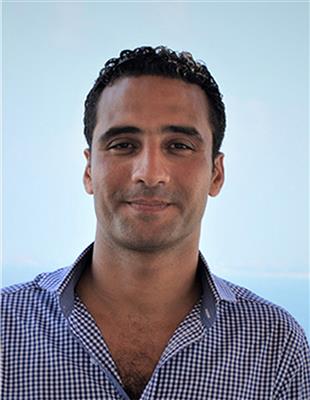
Biography
Awad does not use spray cans. He works with brushes and acrylic, spending up to a week on a single wall, and he builds his compositions directly from the visual grammar of ancient Egyptian[1] temple painting: profile heads, frontal eyes, hierarchical scale, frieze-like registers. His sources are specific and documented: the Ramesseum Temple at Thebes, the Tomb of Ramose (an 18th-dynasty official whose carvings rank among the finest of the New Kingdom), and the battle reliefs at Medinet Habu. Born in Luxor in 1981[1], he grew up across the Nile from these monuments and studied at South Valley University's Faculty of Fine Arts before completing a PhD there in 2019 on the murals of war and peace in ancient Egyptian art.
His recurring subjects are women: funeral processions drawn from Ramesseum reliefs, figures holding papyrus as a sign of knowledge, women climbing ladders adapted from ancient temple imagery. The scholarship and the street-painting practice are the same project.
Since Mohamed Mahmoud Street, his work has been exhibited in Munich, Paris, Baden-Baden, and Melbourne, and has appeared on the covers of two academic books, including Ellen McLarney's "Soft Force" (Princeton University Press, 2015). He holds a position as assistant lecturer in Mural Painting at South Valley University in Luxor.
Timeline
- 1981Born in Luxor, Egypt
- 2011Arrived in Cairo
- 2012Began painting murals on Mohamed Mahmoud Street
- 2015Work appeared on the cover of Ellen McLarney's "Soft Force"
- 2019Completed PhD at South Valley University
- 2019Assistant lecturer in Mural Painting at South Valley University
Notable Works
Tap to view larger.
Next stop
Browse the movements →
Every movement in the collection, from the Renaissance to Pop art.
Related Artists

Frequently Asked Questions
What is Alaa Awad known for?
Alaa Awad is known for his murals, painted in a style derived from ancient Egyptian[1] temple painting. His recurring subjects are women: funeral processions, figures holding papyrus, and women climbing ladders adapted from ancient temple imagery.What is Alaa Awad's most famous work?
It is difficult to name Alaa Awad's single most famous work. She is best known for her work documenting and reinterpreting Egyptian[1] history and popular culture. Her art often blends Pharaonic imagery with contemporary themes, addressing current social and political issues in Egypt. Awad gained recognition for her series of murals and street art created in the wake of the Egyptian Revolution of 2011. These works often featured ancient Egyptian symbols and figures adapted to reflect the spirit of the uprising. By combining historical and contemporary elements, Awad's art creates a visual dialogue between Egypt's past and present, inviting viewers to reflect on themes of identity, power, and social change.What techniques or materials did Alaa Awad use?
Without specific details about Alaa Awad's methods, a comprehensive answer is impossible. However, one can discuss general artistic techniques. Artists employ diverse techniques and materials depending on their vision and training. Drawing involves applying marks to a surface, often paper, using graphite, charcoal, ink, or coloured pencils. Painting uses pigments suspended in a medium, such as oil, acrylic, or watercolour, applied with brushes or other tools to canvas, wood, or paper. Printmaking encompasses methods like etching, screen printing, and lithography, allowing for the creation of multiple originals. Sculpture involves three-dimensional forms created from materials like stone, metal, wood, clay, or mixed media, using carving, modelling, casting, or assemblage. Mixed media combines different artistic techniques and materials in a single work. Digital art uses computer software to create images, animations, or interactive installations. The choice of technique and material is integral to the artist's expression and the final artwork's appearance and meaning.What was Alaa Awad known for?
Alaa Awad is an Egyptian[1] visual artist known for incorporating elements of Pharaonic imagery into contemporary scenes. She often uses graffiti and street art techniques in her work. Her style blends ancient Egyptian aesthetics with modern social commentary. Awad gained recognition after the 2011 Egyptian revolution. Her series, "Women of Upper Egypt", which started in 2012, is one of her best-known projects. It features murals and prints depicting women in traditional Upper Egyptian dress, but with the heads of ancient Egyptian figures. These works often appear in public spaces, and they engage with themes of identity, heritage, and social change. Awad's art explores the connections between Egypt's past and present. By juxtaposing ancient symbols with contemporary life, she creates a visual dialogue that invites viewers to reflect on Egyptian history and culture. Her work has been exhibited in Egypt and internationally.When did Alaa Awad live and work?
Alaa Awad is an Egyptian[1] contemporary artist born in 1984. He lives and works in Cairo. Awad's artistic practice blends Pharaonic imagery with modern Egyptian culture. He is best known for his mixed-media paintings and installations. These works often incorporate elements of street art and graphic design. His art explores themes of identity, memory, and social commentary. Awad gained recognition after the 2011 Egyptian revolution. His work responded to the political and social changes in the country. He uses art to engage with current issues and historical narratives. Awad has exhibited his work in Egypt, across the Middle East, and internationally. His art provides a commentary on contemporary Egyptian society.Where was Alaa Awad from?
Alaa Awad is an Egyptian[1] artist. She was born in Cairo in 1978. Awad's work often references Egyptian history and culture. She is particularly interested in the visual language of ancient Egyptian art. She reinterprets pharaonic imagery using modern styles and techniques. Her practice includes painting, murals, and mixed-media installations. Awad gained recognition after the 2011 Egyptian revolution. Her street art became a feature of the protest movement. These works often combined ancient Egyptian symbols with contemporary political messages. This fusion connected current struggles with the nation's long history. Since then, Awad has exhibited her work internationally. She continues to live and work in Egypt. Her art explores themes of identity, memory, and social change within an Egyptian context.Who did Alaa Awad influence?
Alaa Awad is an Egyptian[1] visual artist, and it is difficult to identify specific individuals who Awad has influenced directly. More broadly, she is part of a cohort of contemporary Middle Eastern artists whose work engages with questions of cultural memory and identity. Awad's practice blends Pharaonic imagery, Arabic calligraphy, and elements of contemporary Egyptian culture. This approach places her within a larger movement of artists exploring similar themes. Her work resonates with viewers interested in the intersection of history and contemporary life in the Middle East. Scholarly sources often discuss artistic influence in terms of direct mentorship or collaboration. In Awad's case, her impact is perhaps more diffuse. She participates in group exhibitions, workshops, and other public-facing activities. This creates opportunities for knowledge exchange among artists. Her distinctive visual language and thematic concerns may inspire other artists to explore similar avenues in their own work. Further research is needed to establish definitive connections between Awad and other artists.Who was Alaa Awad?
Alaa Awad is a visual artist from Egypt. She is known for incorporating elements of ancient Egyptian[1] art into contemporary scenes. Her work often addresses current social and political issues. Awad graduated from the Faculty of Fine Arts, Alexandria University, in 2005. She has participated in several exhibitions, both in Egypt and internationally. These include solo shows at the Mashrabia Gallery of Contemporary Art in Cairo. Her distinctive style involves reinterpreting pharaonic imagery. She places figures resembling ancient Egyptians into modern contexts. This juxtaposition creates a dialogue between the past and the present. Common themes in her art include identity, memory, and the role of women in society. Awad's work can be seen as a form of social commentary, using familiar imagery to engage viewers with contemporary issues facing Egypt and the wider Arab world.What was Alaa Awad's art style?
Awad's art style is based on the visual grammar of ancient Egyptian[1] temple painting. Profile heads, frontal eyes, hierarchical scale, and frieze-like registers characterise his work.When was Alaa Awad born?
Alaa Awad was born in 1981[1].
Sources
Editorial draws on the following primary and tertiary references for Alaa Awad.
- [1] wikipedia Wikipedia: Alaa Awad Used for: biography, birth dates, death dates, identifiers, movement attribution, nationality.
- [2] book Alex Dika Seggerman, Modernism on the Nile: Art in Egypt between the Islamic and the Contemporary Used for: biography.
- [3] book Bardaouil, Sam, Surrealism in Egypt Used for: biography.
- [4] book Kirsten Strom;, The Routledge Companion to Surrealism Used for: biography.
Editorial overseen by Solis Prints. Sources verified 2026-09-30. Click a source for details, or hover over [N] in the page above to preview.
Editorial standardsMethodologyCorrectionsAI disclosureAbout the editorial team