

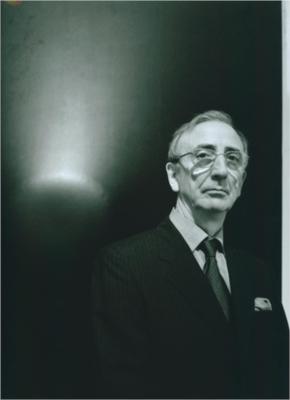
Agostino Bonalumi
When Agostino Bonalumi began working with Enrico Castellani and Piero Manzoni in 1958[1], Italian[1] art was in a state of productive agitation. Lucio Fontana had already slashed his canvases and declared space the proper subject of painting; Manzoni was conceptualising the artist's body and breath as material. Bonalumi's response was characteristically physical: he pushed from behind the canvas surface, creating shaped reliefs that made each work simultaneously painting and sculpture.
Biography
Born in Vimercate in 1935[1], his first solo exhibition was at the Galleria Totti in Milan in 1956[1]. By 1960 he had co-founded the Nouvelle École Européenne in Lausanne, and over the following decade he showed at the Venice Biennale in 1966 and 1970, the São Paulo Biennial in 1967, and staged his first American exhibition at Galeria Bonino in New York in 1967. He called his practice "pittura-oggetto", painting-object, a term that accurately described works that refused to behave as one or the other.
His environmental sculpture *Blu abitabile* (1967[1]) and *Grande Nero* (1968) extended these ideas beyond the wall entirely. In 2001 he received the Premio Presidente della Repubblica for sculpture. Retrospectives followed in Moscow, Modena, and London. He died in Monza in 2013[1], leaving a practice that linked the Italian[1] post-war avant-garde with the Zero movement's international reach.
Timeline
- 1935Born in Vimercate, Italy
- 1956First solo exhibition at Galleria Totti in Milan
- 1958Began working with Enrico Castellani and Piero Manzoni
- 1960Co-founded the Nouvelle École Européenne in Lausanne
- 1966Showed at the Venice Biennale
- 1967Showed at the São Paulo Biennial
- 1967First American exhibition at Galeria Bonino in New York
- 1967Created environmental sculpture *Blu abitabile*
- 1968Created *Grande Nero* environmental sculpture
- 1970Showed at the Venice Biennale
- 2001Received the Premio Presidente della Repubblica for sculpture
- 2013Died in Monza, Italy
Next stop
Browse the movements →
Every movement in the collection, from the Renaissance to Pop art.
Related Artists


Frequently Asked Questions
What is Agostino Bonalumi known for?
Agostino Bonalumi is known for his 'pittura-oggetto' (painting-object) works. These pieces combined painting and sculpture by pushing the canvas from behind to create shaped reliefs.What should I know about Agostino Bonalumi's prints?
Agostino Bonalumi (1935[1]-2013[1]) was an Italian[1] artist associated with the Azimuth group and Spatialism. While he is best known for shaped canvases, prints form a part of his wider practice. Bonalumi's prints often relate to his three-dimensional work. These prints explore similar themes of surface manipulation and the interplay of light and shadow. He employed techniques that allowed him to translate the raised and curved elements of his canvases into a two-dimensional format. Like other Italian artists of his generation, such as Mimmo Paladino, Bonalumi engaged with printmaking to broaden his artistic vocabulary. Paladino, for example, experimented with etching, aquatint, woodcut, and linocut, often creating series of prints that echo the themes in his paintings and sculptures. Collectors interested in Bonalumi's prints should examine the catalogue raisonné to confirm the authenticity and place the works within the context of his overall artistic output. The prints offer a more accessible entry point to understanding Bonalumi's concepts related to space and form.What style or movement did Agostino Bonalumi belong to?
Agostino Bonalumi is associated with the Spatialism movement (Spazialismo) which developed in the mid-20th century. Spatialism sought to move beyond traditional artistic constraints. It aimed to incorporate new technologies and a broader concept of space into art. The movement's origins can be traced back to the ideas of Futurist Umberto Boccioni, who wanted to integrate mechanical civilisation into human life through art, representing forces, speed and rhythms. Spatialism, however, moved beyond the machine age to embrace new scientific advancements such as missiles and radar. Artists explored abstraction and non-pictorial forms to express a new reality, one that was autonomous and not merely evocative. Lucio Fontana, a key figure, explored these concepts by perforating canvases, aiming to introduce a third dimension of space and the importance of light. Other artists associated with Spatialism include Beniamino Joppolo, Carozzi, Crippa, Dova, and Peverelli.What techniques or materials did Agostino Bonalumi use?
Agostino Bonalumi is best known for his shaped canvases. He manipulated the canvas surface to create protrusions and recessions, altering the two-dimensional plane into a three-dimensional one. Bonalumi employed simple materials: canvas, wood, and metal. He would stretch the canvas over shaped wooden or metal supports, creating bulges that cast shadows and catch light. These techniques allowed him to explore the interplay of form, colour, and light. His works often feature monochrome surfaces. Bonalumi applied paint evenly, without brushstrokes, to further emphasise the three-dimensional form. The colour serves to articulate the shape and volume of the altered canvas. By reducing the pictorial elements to a minimum, he directed attention to the object itself. His practice was aligned with the Spatialist ideas of the period, particularly those of Lucio Fontana, though Bonalumi maintained his own distinct approach to objecthood and surface manipulation.What was Agostino Bonalumi known for?
Agostino Bonalumi, born in Vimercate in 1935[1], was an Italian[1] artist known for his contributions to the Spatialism movement. He moved to Milan in the mid-1950s and trained as a designer. Bonalumi's practice involved stretching canvas over shaped supports to create three-dimensional forms. These works explored the interplay of light and shadow on monochrome surfaces. His early pieces used simple geometric shapes to create subtle, yet dynamic, reliefs. In 1958[1], Bonalumi, along with Enrico Castellani and Piero Manzoni, created a space for exhibitions. He participated in the 1960s group Zero exhibitions in Europe. His work gained international recognition, and he exhibited in major venues, including the Venice Biennale. Bonalumi continued to develop his signature style of shaped canvases throughout his career, further investigating the relationship between form, space, and light. He died in 2013[1].When did Agostino Bonalumi live and work?
Agostino Bonalumi (1935[1]-2013[1]) was an Italian[1] artist associated with the Azimuth group and Zero movement. He is best known for shaped canvases that explore the interplay of light and shadow. Born in Vimercate, Italy, Bonalumi moved to Milan in the late 1950s. There, he connected with artists such as Enrico Castellani and Piero Manzoni. With them, he exhibited at the Galleria Azimut and contributed to the journal "Azimuth". These venues promoted new artistic directions beyond traditional painting and sculpture. Bonalumi's distinctive style emerged in the early 1960s. He stretched canvas over shaped supports, creating protrusions and indentations. These altered surfaces caught the light, generating subtle variations in tone and form. His work engaged with questions of space, surface, and the objecthood of art. Throughout his career, Bonalumi exhibited internationally, including at the Venice Biennale. His pieces are held in major museum collections. He continued to explore the possibilities of shaped canvas until his death in 2013[1], leaving behind a substantial body of work.Where can I see Agostino Bonalumi's work?
Agostino Bonalumi's work can be viewed in several locations. These include the Kunstmuseum (Emanuel Hoffmann Foundation) in Basel, the Wilhelm-Lehmbruck-Museum in Duisburg, the Kunstmuseum in Herning, the Courtauld Institute Galleries (Courtauld Collection) in London, and the Museum Ludwig in Cologne. His pieces are also held at the Pinacoteca di Brera (Gift of Emilio and Maria Jesi) in Milan, the Civico Museo d’Arte Contemporanea, Palazzo Reale, also in Milan, and the Museo Civico di Torino. Other locations include the Musée d’Art Moderne de la Ville de Paris, the Musée National d’Art Moderne, Centre Georges Pompidou, also in Paris, the Galleria Communale d’Arte Moderna in Rome, and the Staatsgalerie in Stuttgart. Works are also held by Assitalia SPA, C. Benporat Collection, Collection Lilott and Erik Berganus, Berlin, Galerie Fahnemann, Marx Collection, Collection Rosangela Cochrane, Turin, Attilio Codognato Collection, Venice, Maria Cohen, Turin, Collection Anthony Denney, Collection Mr and Mrs Eric Estorick, Teresita Fontana, Giorgio Franchetti, Rome, Frankfurt am Main, Galeric Neuendorf, Giuliano Gori, Fattoria di Celle, The Alex Hillman Family Foundation, Marie-Anne and Jan Krugier Collection, Geneva, Macerata, Cassa di Risparmio della Provincia di Macerata, Collection Paul Maenz, Cologne, Collection Gianni Malabarba, Collection Giorgio Marconi, Egidio Marzona, Mattioli Collection, Milan, Melotti Collection, Collection Beatrice Monti della Corte, Munich, New York, Courtesy of Jan Krugier Gallery, New York, Courtesy The Sonnabend Collection, New York, Courtesy Sperone Westwater Gallery, Collection Franz Paludetto, Turin, Carla Panicali, Rome, Luciano Pistoi Collection, Lia Rumma, Naples, Paolo Sprovieri, Rome, Collection Ingvild Stocker, Munich, Ch. Szwajcer, Collection Augusto Vallunga, Verona, Galleria dello Scudo, Zurich, Galerie Bruno Bischofberger, and Zurich, Kunsthaus (Vereinigung Ziircher Kunstfreunde).Where was Agostino Bonalumi from?
Agostino Bonalumi was born in Vimercate, Italy, on 10 July 1935[1]. Vimercate is a town in the Province of Monza and Brianza, in the Lombardy region of northern Italy. Although born in Vimercate, Bonalumi later moved to Milan, the regional capital of Lombardy. He initially studied technical and mechanical design. He then turned to art, attending courses in stage design and drawing at the Academy of Fine Arts of Brera. Bonalumi remained based in Milan throughout his career. He died in Desio, another town in the Province of Monza and Brianza, on 18 September 2013[1]. He was 78 years old. Although he exhibited internationally, Bonalumi is considered an important figure in the Milanese art scene of the post-war period. His work is associated with the artistic movements that developed in the city during the 1950s and 1960s.Who did Agostino Bonalumi influence?
Agostino Bonalumi belonged to a generation of Italian[1] artists emerging after 1945[1] who continually referenced Futurism. Bonalumi's practice, along with those of Alberto Burri, Piero Dorazio, Lucio Fontana, and Emilio Vedova, can be seen as building on the innovations of earlier artists like Enrico Prampolini and Giacomo Balla. After the Second World War, Italian art moved away from political realism. Some artists rejected painting in favour of conceptual experimentation, incorporating gestures, simple signs (as in Arte Povera), and minimal images. This period saw a new integration of painting and photography. Artists such as Giulio Paolini, Luca Patella, Emilio Prini, and Franco Vaccari used photography as an ambiguously objective language. The critic Achille Bonito Oliva identified a group of later Italian artists as the trans-avantgarde. These artists shared preoccupations with allegorical, mythological, and oriental subjects, themes of androgeny and hermaphroditism, and a deliberate clumsiness in drawing, paint handling, and perspective.Who influenced Agostino Bonalumi?
Agostino Bonalumi's artistic development occurred within a milieu influenced by several key figures and movements. While a direct, singular influence is difficult to pin down, examining the artistic climate of his time offers some insight. Futurism, with its emphasis on dynamism and modernity, was a significant force in Italian[1] art during the early to mid-20th century. Artists associated with this movement include Umberto Boccioni, Carlo Carra, and Giacomo Balla. Their exploration of speed, movement, and the depiction of modern life may have resonated with Bonalumi, though his mature work diverged significantly. Other artists whose work engaged with abstraction and spatial concepts, such as Lucio Fontana, may have provided a point of reference for Bonalumi's investigations into the properties of the canvas. There is no evidence in the passages of any specific influence.Who was Agostino Bonalumi?
Agostino Bonalumi (1935[1]-2013[1]) was an Italian[1] artist associated with the Milanese art scene. His practice involved altering the canvas surface to create protrusions and recessions, moving beyond the traditional two dimensions of painting. Bonalumi is grouped with artists from the late 1950s onwards who sought a synthesis of the arts, incorporating ideas from architecture and design. He, along with Enrico Castellani, Gianni Colombo, and others, founded La Nuova Tendenza, which explored programmed art and optical-visual experimentation. His early work moved away from the chaotic Art Informel style, favouring a reduction of forms. Bonalumi's manipulation of the canvas created a sense of movement and dynamism, aligning him with artistic trends that examined perception and the interplay between surface and depth.Why are Agostino Bonalumi's works important today?
Agostino Bonalumi (1935[1]-2013[1]) was an Italian[1] artist associated with the Azimuth group, who moved away from the gestural styles of the post-war period. With Enrico Castellani and Piero Manzoni, Bonalumi sought a new artistic purity through simple, analytical methods. His contributions are significant for their optical effects and exploration of three-dimensionality. Bonalumi is best known for his shaped canvases, where he stretched the material to create protrusions and recessions. These works, often monochrome, play with light and shadow, achieving a virtual three-dimensionality. Rather than piling material onto the canvas, as in the Informale style, Bonalumi manipulated the surface itself. This approach aligns with a broader interest in the period in reducing art to its primary elements and analysing visual phenomena. His practice aimed to create an optical flow of light, expanding from the centre to the perimeter, from the painting and into the room.
Sources
Editorial draws on the following primary and tertiary references for Agostino Bonalumi.
- [1] wikipedia Wikipedia: Agostino Bonalumi Used for: biography, birth dates, death dates, identifiers, movement attribution, nationality.
- [2] book Braun, Emily, 1957-; Asor Rosa, Alberto; Royal Academy of Arts (Great Britain), Italian art in the 20th century : painting and sculpture, 1900-1988 Used for: biography.
- [3] book Masterpieces of western art : a history of art in 900 individual studies from the Gothic to the present day Used for: biography.
- [4] book Post-impressionism : cross-currents in European painting Used for: biography.
Editorial overseen by Solis Prints. Sources verified 2026-10-14. Click a source for details, or hover over [N] in the page above to preview.
Editorial standardsMethodologyCorrectionsAI disclosureAbout the editorial team