



Agim Sulaj
Working for the Albanian[1] political magazine *Hosteni* in the 1980s meant navigating a delicate line between official sanction and subversive intent. Agim Sulaj managed it through the precision of his caricature: a satirical language that could carry two meanings simultaneously. Born in Vlora, Albania, in 1960[1], he trained at the Fine Arts Academy of Tirana, graduating in 1985. By 1990 he had relocated to Rimini, Italy, where he has lived since.
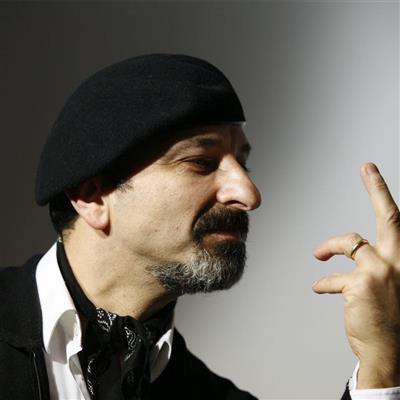
Biography
His practice spans two registers that rarely overlap so successfully. As a caricaturist he has won competitions across Europe, Bursa, Istanbul, Cuneo, and took the CartoonSea national award for humour and satire in Italy in 2010, serving as jury president the following year. As a painter he works in a hyperrealistic mode, and his most substantial canvas, a large-scale oil depicting *The Head of Ali Pasha Tepelena, Presented to Sultan Mahmut II*, is now in the Ali Pasha Museum in Ioannina, Greece.
His work is held by the Norman Rockwell Museum in Stockbridge, Massachusetts, and he has exhibited across European galleries from the mid-1980s onwards. Sulaj's particular skill is in finding the satirical charge in historical and political subjects without reducing them to polemic.
Timeline
- 1960Born in Vlora, Albania
- 1980Worked for Albanian political magazine *Hosteni*
- 1985Graduated from the Fine Arts Academy of Tirana
- 1990Relocated to Rimini, Italy
- 2010Won CartoonSea national award for humour and satire in Italy
- 2011Served as jury president for CartoonSea award
Notable Works
Tap to view larger.
Next stop
Browse the movements →
Every movement in the collection, from the Renaissance to Pop art.
Frequently Asked Questions
What is Agim Sulaj known for?
Agim Sulaj is known for his satirical caricatures and hyperrealistic paintings. As a caricaturist, he has won multiple European competitions, including the CartoonSea national award for humour and satire in Italy in 2010.What is Agim Sulaj's most famous work?
Agim Sulaj is an Albanian[1] painter known for satirical and surreal works. He often focuses on political and social themes. His paintings frequently depict the relationship between humans and animals. While it is difficult to identify a single "most famous work", several pieces have gained considerable attention. These include "Oil Spill", which comments on environmental issues, and "The Reader", which offers a commentary on contemporary society. Sulaj's art uses humour and irony to provoke thought about the world. Sulaj's work has been exhibited in many international exhibitions. He has won awards at various cartoon and humour festivals. His paintings are appreciated for their technical skill and their capacity to engage viewers with important subjects. He continues to produce art that reflects his observations and perspectives on modern life.What should I know about Agim Sulaj's prints?
Agim Sulaj is known for satirical and surreal artworks, often addressing social and political themes with humour. When considering Sulaj's prints, it is helpful to understand some basic principles of printmaking and editions. An original print is conceived as a print, created solely as a print, and usually produced in a numbered edition, each one signed by the artist. Each print in the edition is an original, made from a plate, stone, screen, or block created for that purpose. The artist determines the number of prints in the edition. Numbering accounts for the number of prints in the edition; for example, 12/25 means it is print number 12 of an edition of 25. The edition claim is typically written as a pair of numbers on the lower left margin of the print. The title is in the centre, and the signature is on the right. These are usually signed in pencil. A reproduction is a copy of an artwork conceived in another medium, such as painting. Numbering and signing a reproduction does not make it an original print. The market plays a role in determining the worth of art. The Professional Art Dealers Association of Canada has defined what constitutes an original print and a reproduction, which is accepted by major arts organisations in Canada.What style or movement did Agim Sulaj belong to?
Without specific references to Sulaj's artistic affiliations, it is difficult to place him definitively within a particular movement. However, one can analyse elements of his work in relation to broader art historical trends. Looking at general stylistic elements, one might consider if his work aligns with aspects of Surrealism, a movement that began in the early 1920s. Surrealism is known for unexpected juxtapositions and dreamlike imagery. Alternatively, some aspects of Sulaj's output might relate to Magic Realism, a style which combines realistic depictions with fantastical or dreamlike elements. It emerged in the 1920s as well, and continues to be a relevant category. Without further information, any classification remains speculative. Further research into Sulaj's influences, exhibition history, and critical reception would be needed for a more precise art-historical categorisation.What techniques or materials did Agim Sulaj use?
Agim Sulaj is known for his satirical and surreal paintings. He works primarily in oil on canvas. His technique involves layering paint to create detailed images. Sulaj often employs glazing, a method of applying thin, transparent layers of paint to build up colour and depth. Sulaj's style is characterised by hyperrealism, with a strong emphasis on minute details. He uses fine brushes to achieve this level of precision. His paintings often feature sharp contrasts between light and shadow, adding to their dramatic effect. The artist's careful manipulation of light enhances the three-dimensional quality of his work. While oil on canvas is his main medium, Sulaj also produces drawings and sketches. These preparatory works often serve as studies for his larger paintings. Sulaj's artistic process combines traditional painting methods with a contemporary sensibility, resulting in visually striking and thought-provoking pieces.What was Agim Sulaj known for?
Agim Sulaj is best known for his work in bronze, terracotta, wood, and paper. His artistic output includes sculpture and collage. In 1959, he produced the "Architectural Bronzes" series; each untitled bronze measured 8 x 9 x 6 cm. From 1961 to 1962, Sulaj created the "Beds" series, using terracotta. These works were also untitled and measured roughly 20 x 14 x 7 cm. In 1963, he created a bronze model for the "Brigata Sassari" Monument, measuring 60 x 50 cm. Sulaj's "Beaches" series, executed between 1967 and 1972, consists of terracotta pieces, each 40 x 40 cm. The "Swimming Pools of Los Angeles" series (1970-1971[1]) also used terracotta and measured 40 x 40 cm. One piece from 1971, "The Aroma of Sardinian Roast Meats Attracts the Gods like Flies", is also terracotta and 40 x 40 cm. In 1983, Sulaj created the "Sardinian Work" series in bronze, depicting various labourers. In 1985, he worked in wood to produce "Wood Cutter" (81 x 100 cm) and "Figure" (68 x 84 cm). He also produced a series of nine collages on paper in 1985. Also in 1985, Sulaj worked in rose, red-veined, and white marble for the series "La madre Sarda e il suo Figlio meraviglioso".When did Agim Sulaj live and work?
Agim Sulaj is a contemporary Albanian[1] painter, born in Tirana in 1960[1]. He spent his childhood in Shkodra, a city in north-western Albania. Sulaj is known for satirical and surreal paintings, often commenting on social and political issues. His work combines elements of realism with imaginative imagery. Recurring themes include the relationship between humans and nature, consumerism, and the impact of globalisation. He began his career as a cartoonist and illustrator, working for various newspapers and magazines. This background is evident in his sharp, observational style. Sulaj later transitioned to painting, developing a distinctive approach that blends technical skill with a strong narrative element. Sulaj has exhibited his work extensively in Europe and further afield, including solo shows in Italy, France, and the United States. He has received several international awards for his art. He continues to live and work in Albania, while maintaining an active presence in the international art world. His paintings are held in numerous private and public collections.Where can I see Agim Sulaj's work?
I am unable to provide a list of galleries that hold work by Agim Sulaj. However, many major museums have collections of art, any of which may hold his work. These include institutions in the United States, such as the Metropolitan Museum of Art in New York; the Los Angeles County Museum of Art; the Minneapolis Institute of Arts; the Museum of Modern Art in New York; and the Virginia Museum of Fine Arts in Richmond. In Canada, the Royal Ontario Museum in Toronto may hold his work. Museums in the United Kingdom that may have pieces include the Brighton Museum & Art Gallery; the Geffrye Museum in London; the Manchester Art Gallery; the National Museums of Scotland in Edinburgh; and the Victoria & Albert Museum in London. Other European museums that may hold his art include the Musée des Arts Décoratifs in Paris; the Museu Calouste Gulbenkian in Lisbon; and the Rijksmuseum in Amsterdam.Where was Agim Sulaj from?
Agim Sulaj was born in Tirana, Albania, in 1960[1]. He spent his childhood in his parents' hometown of Shkodër, Albania. Sulaj is known for his work in painting and drawing, especially his satirical and humorous images. His art often incorporates elements of hyperrealism. He is self-taught, developing his skills through independent study and practice. He began exhibiting his work in the 1990s, gaining recognition both in Albania and internationally. Sulaj has received awards at various international competitions, including the International Cartoon Exhibition in Knokke-Heist, Belgium, and the International Biennial of Black Humour in Tolentino, Italy. Though born in Tirana, Sulaj's connection to Shkodër remains a significant part of his biography. He continues to create art that reflects his observations and perspectives on society.Who did Agim Sulaj influence?
It is difficult to identify particular artists who were directly influenced by Agim Sulaj. Sulaj's work, primarily satirical paintings and illustrations, circulates widely on the internet and in publications. This makes it hard to track specific artistic lineages. However, we can make some observations about influence in a broader sense. Sulaj's style shares characteristics with other contemporary satirical artists and illustrators. His work also connects to a longer tradition of political and social commentary through art. His approach to realism, combined with often humorous or pointed messaging, may resonate with younger artists working in similar veins. The accessibility of his images online means that his work is available to a global audience. This potentially exposes a new generation to the possibilities of visual satire. Identifying specific artists who have absorbed his influence will require further research.Who influenced Agim Sulaj?
Agim Sulaj is an Albanian[1] painter known for his satirical and surrealist works. His artistic style developed through exposure to various artists and movements. Sulaj has cited the influence of Salvador Dalí, the Spanish surrealist, on his work. Dalí's dreamlike imagery and technical skill resonate in Sulaj's paintings. The influence of other surrealist painters, such as René Magritte, is also apparent in Sulaj's manipulation of scale and juxtaposition of objects. Beyond surrealism, Sulaj's work shows the impact of social realism, a style prevalent in Albania during his formative years. Social realism aimed to depict everyday life and political themes in an accessible manner. Sulaj adopts this approach in his satirical commentary on contemporary society. His work also has connections with caricature and cartooning. These traditions use exaggeration and humour to convey messages. Sulaj's ability to blend these diverse influences has contributed to his distinctive artistic voice.
Sources
Editorial draws on the following primary and tertiary references for Agim Sulaj.
- [1] wikipedia Wikipedia: Agim Sulaj Used for: biography, birth dates, death dates, identifiers, movement attribution, nationality.
- [2] book guggenheim-refigur00kren Used for: biography.
- [3] book Masterpieces of western art : a history of art in 900 individual studies from the Gothic to the present day Used for: biography.
Editorial overseen by Solis Prints. Sources verified 2026-08-30. Click a source for details, or hover over [N] in the page above to preview.
Editorial standardsMethodologyCorrectionsAI disclosureAbout the editorial team