



Adolf Hirémy-Hirschl
Adolf Hirémy-Hirschl won first prize at Vienna's Academy of Fine Arts in 1880[1] for Farewell: Scene from Hannibal Crossing the Alps, an ambition that says a great deal about the scale of his imagination. He had arrived at the Academy two years earlier on scholarship, born in 1860[1] in Temesvár in what was then the Kingdom of Hungary. A second prize in 1882 gave him the means to travel to Rome, where he would spend the remaining thirty-five years of his life.
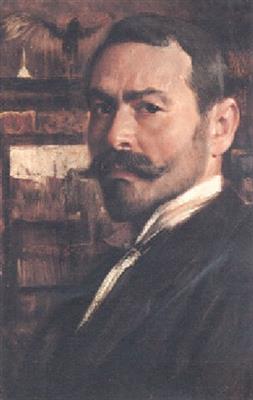
Biography
His subjects were drawn from antiquity and mythology, but with a Symbolist gravity that separated him from the conventional academic painters of his era. The Plague in Rome (1884[1], now lost) was among his early large-scale works; Ahasuerus at the End of the World (1888) established him as a painter of monumental eschatological subjects. His most discussed painting, Souls on the Banks of the Acheron (1898), shows the dead gathered at the river's edge in a scene of quiet, dignified desolation. He won the Imperial Prize in 1891 and was admitted to the Accademia di San Luca in 1911.
His late career produced Sic Transit... (1912[1]), described as an immense allegorical polyptych on the fall of the Roman Empire. A retrospective in 1904 brought together seventy works. He died in Rome in April 1933[1] and is buried in the Protestant Cemetery there. The largest American collection of his paintings is held by the Jack Daulton Collection in Los Altos Hills, California.
Timeline
- 1860Born in Temesvár, Kingdom of Hungary
- 1878Arrived at Vienna's Academy of Fine Arts on scholarship
- 1880Won first prize at Vienna's Academy for 'Farewell'
- 1882Won second prize, enabling travel to Rome
- 1884Painted 'The Plague in Rome'
- 1888Painted 'Ahasuerus at the End of the World'
- 1891Won the Imperial Prize
- 1898Painted 'Souls on the Banks of the Acheron'
- 1904Retrospective exhibition of seventy works
- 1911Admitted to the Accademia di San Luca
- 1912Painted 'Sic Transit...'
- 1933Died in Rome and buried in the Protestant Cemetery
Notable Works
Tap to view larger.
Next stop
Browse the movements →
Every movement in the collection, from the Renaissance to Pop art.
Related Artists




Frequently Asked Questions
What is Adolf Hirémy-Hirschl known for?
Adolf Hirémy-Hirschl is known as a painter of monumental eschatological subjects. His most discussed painting is Souls on the Banks of the Acheron (1898[1]), which depicts the dead gathered at the river's edge.What style or movement did Adolf Hirémy-Hirschl belong to?
Adolf Hirémy-Hirschl (1860[1]-1933[1]) was an Austrian[1] artist whose work moved through several styles. He began with academic history painting, shifted toward Symbolism, and concluded with a more personal, less classifiable approach. Early in his career, Hirémy-Hirschl gained attention for large-scale historical works. These paintings, such as *The Souls of Acheron* (1898[1]), reflected the academic style popular at the time, with its emphasis on dramatic narrative and precise detail. Around the turn of the century, his art began to show Symbolist influences. This is evident in the increased use of allegory and a focus on psychological states. His interest in ancient themes continued, but he now explored them through a more subjective lens. After 1900, Hirémy-Hirschl developed a more individual style. His later works often featured themes of memory, loss, and the passage of time. Although elements of Symbolism remained, these later pieces are characterised by a greater simplicity and emotional directness, moving beyond easy categorisation.What techniques or materials did Adolf Hirémy-Hirschl use?
Adolf Hirémy-Hirschl's techniques are not widely documented in the available sources. However, some inferences can be made based on general art historical context. Glass painting techniques in the late 15th and early 16th centuries involved specific processes. Artists applied colour using transparent coloured-glass pieces. They modulated values with semitranslucent matts and created drawings with opaque contours. Silver stain was used around 1300 to achieve colours from lemon yellow to saturated golden yellow. The building up of paint layers required specific paint consistencies. Watery binders were alternated with oily substances. Glass paints consisted of pulverised glass with metal oxides as colouring agents. These were ground for a long time to ensure smooth application. By the late fifteenth century, glass-painting colours in tones of brown (to red) and white (to gray) played a large role in the palette.What was Adolf Hirémy-Hirschl known for?
Adolf Hirémy-Hirschl (1860[1]-1933[1]) was an Austro-Hungarian painter known for history paintings and portraits. He is associated with late academicism and Symbolism. Born in Timişoara, he studied at the Academy of Fine Arts Vienna. There, he won the Prix de Rome in 1891[1]. This allowed him to live and work in Italy for several years. He eventually settled in Rome permanently. Hirémy-Hirschl's work often dealt with themes from antiquity. One of his most recognised paintings is "The Souls of Acheron" (1898), which depicts figures from Greek mythology. Other notable works include "Messalina" and "Nero on the Ruins of Rome". These paintings show his interest in dramatic historical subjects. He also produced portraits of prominent figures. His style is characterised by detailed realism and dramatic lighting. He had a command of anatomy and perspective. His paintings evoke a sense of grandeur. Although he achieved considerable success during his lifetime, his work was later somewhat forgotten. There has been renewed interest in his art in recent years.When did Adolf Hirémy-Hirschl live and work?
Adolf Hirémy-Hirschl (1860[1]-1933[1]) was a Hungarian-born artist who spent much of his career in Rome and Vienna. He is best known for history paintings and allegorical subjects, often on a grand scale. Born in Temesvár, Austria-Hungary (now Timișoara, Romania), Hirémy-Hirschl studied at the Academy of Fine Arts Vienna under Christian Griepenkerl and Carl Wurzinger. He won the Prix de Rome in 1891[1], which allowed him to study in Italy. He settled in Rome in 1894. Hirémy-Hirschl's Roman period saw him create some of his most celebrated works, such as "The Souls of Acheron" (1898), a large canvas depicting figures from Dante's Inferno. His style combined academic realism with Symbolist elements. After the First World War, Hirémy-Hirschl moved to Vienna. He continued to paint, although his later work is less well-known than his earlier Roman paintings. He died in Rome in 1933. His work can be found in museum collections, including the Österreichische Galerie Belvedere in Vienna.Where can I see Adolf Hirémy-Hirschl's work?
Adolf Hirémy-Hirschl's paintings appear in several public collections, although not in great quantity. The Österreichische Galerie Belvedere in Vienna holds some of his more important works. These include "Seelenwanderung (Souls' Migration)" from 1888[1], a large allegorical painting that treats themes of death and rebirth. The collection also possesses "Die Pest in Rom (The Plague in Rome)", a history painting completed in 1879. Other museums with paintings by Hirémy-Hirschl include the Museo Revoltella in Trieste and the Leopold Museum, also in Vienna. The Leopold Museum's collection is particularly strong in Austrian[1] art from the late 19th and early 20th centuries, so it is a worthwhile place to view works by his contemporaries. Smaller regional museums may also hold his works, but these are less frequently exhibited. Auction house catalogues are useful resources for tracking the locations of paintings by Hirémy-Hirschl that are in private hands.Where was Adolf Hirémy-Hirschl from?
Adolf Hirémy-Hirschl was born in Timişoara in 1860[1]; at the time, the city was part of the Austrian[1] Empire. Today, Timişoara is in Romania. Hirémy-Hirschl began his artistic training at the Akademie der bildenden Künste in Vienna, starting in 1878[1]. He received several awards during his studies there, including the prestigious Rome Prize in 1891. This prize allowed him to study in Italy, which became his adopted home. Although he was born in Timişoara and trained in Vienna, Hirémy-Hirschl spent a significant portion of his career in Rome. He died there in 1933[1]. His artistic output reflects the influences of both his Austrian background and his Italian surroundings. He is often described as an Austrian or Austro-Hungarian artist because of his origins and training.Who did Adolf Hirémy-Hirschl influence?
Adolf Hirémy-Hirschl's influence is difficult to trace directly. He worked within a late academic style, painting historical and allegorical subjects. His popularity peaked around 1900[1], and his work then fell from favour. This makes it hard to identify later artists who consciously adopted his approach. Hirémy-Hirschl's paintings share characteristics with other artists working in Vienna at the time. These include Gustav Klimt and Franz Matsch, who also explored Symbolist themes and classical imagery. However, these connections reflect a shared cultural milieu more than a direct line of influence. Some scholars suggest parallels between Hirémy-Hirschl's monumental compositions and the work of later 20th-century artists. These artists explored similar themes of history, memory, and trauma. But, again, these are broad thematic links, not evidence of specific artistic influence. His impact is more likely seen in the general continuation, within Austrian[1] art, of history painting and mythological subjects. Any exact influence remains a topic for further research.Who influenced Adolf Hirémy-Hirschl?
Adolf Hirémy-Hirschl's artistic development occurred in Vienna during a period of significant change in the art world. He enrolled at the Academy of Fine Arts, Vienna, in 1875[1], where he received instruction from Christian Griepenkerl and Carl Wurzinger. These professors instilled in him an appreciation for classical techniques and historical subject matter. Hirémy-Hirschl's early works show the influence of Hans Makart, a dominant figure in Viennese art. Makart was known for his opulent, theatrical style and historical paintings. However, Hirémy-Hirschl moved away from Makart's flamboyance, adopting a more restrained and academic approach. Later in his career, Hirémy-Hirschl explored Symbolism, which was partly inspired by Arnold Böcklin. Böcklin's allegorical and mythological paintings resonated with Hirémy-Hirschl's interest in exploring themes of mortality, memory, and the human condition. The classical idealism of Ancient Greece and Rome also remained a constant source of inspiration for Hirémy-Hirschl, shaping his artistic vision throughout his career.How did Adolf Hirémy-Hirschl die?
Adolf Hirémy-Hirschl died in 1933[1] at the age of 73.
Sources
Editorial draws on the following primary and tertiary references for Adolf Hirémy-Hirschl.
- [1] wikipedia Wikipedia: Adolf Hirémy-Hirschl Used for: biography, birth dates, death dates, identifiers, movement attribution, nationality.
- [2] book Getty, Getty - Otto Wagner Reflections on the Raiment of Modernity Used for: biography.
- [3] book n.hanh, GM Schielel 4C.qxp Used for: biography.
- [4] book guggenheim-gustavklimtegons00mess Used for: biography.
- [5] book Husslein-Arco, Agnes, editor; Koja, Stephan, editor; Law, Rebecca (Translator), translator; McInnes, Robert (Translator), translator; Somers, Nick, translator; Monet, Claude, 1840-1926. Paintings. Selections; Österreichische Galerie Belvedere, h Used for: biography.
- [6] book By Jeffrey Taylor, In Search of the Budapest Secession: The Artist Proletariat and the Modernism’s rise in the Hungarian Art Market, 1800-1914 Used for: biography.
- [7] book Moshe Barasch, Modern Theories of Art 2 _ From Impressionism to Kandinsky Used for: biography.
Editorial overseen by Solis Prints. Sources verified 2026-10-15. Click a source for details, or hover over [N] in the page above to preview.
Editorial standardsMethodologyCorrectionsAI disclosureAbout the editorial team