



Adam van Noort
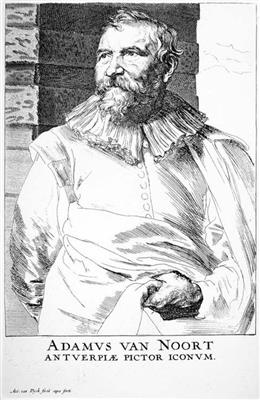
Adam van Noort occupies an unusual place in Flemish art history: he trained two of the most consequential painters of the seventeenth century, Peter Paul Rubens and Jacob Jordaens, yet his own work has attracted modest scholarly attention by comparison. A master of the Antwerp Guild of Saint Luke from 1587[1], he served as the guild's dean from 1597 to 1602, a position that speaks to his standing in the city's artistic community.
Biography
His father Lambert, who designed stained-glass windows and worked as an architect, provided an early introduction to craft and visual problem-solving, though the family lived in straitened circumstances. Adam's manner was rooted in the Romanism of Frans Floris: his early work carries the extended figures and compressed compositions of Mannerism, while by the early seventeenth century the dynamic energy of the emerging Baroque was beginning to shape his approach.
Among his documented works, The Preaching of John the Baptist (1601[1]) and Let the Children Come to Me (c.1609-10) show a confident handling of large figure groups. He attracted approximately thirty-five pupils during his career, a number indicating genuine pedagogical standing. Jordaens, who became his son-in-law, absorbed much from the workshop environment. Rubens spent a briefer period with Van Noort before moving on, but the Antwerp network Van Noort helped sustain played a significant role in shaping the city's artistic life.
He died in Antwerp in 1641[1], having lived to see the full flowering of the Baroque style he helped transmit.
Timeline
- 1562Born
- 1587Became master of Antwerp Guild of Saint Luke
- 1597Served as dean of the Guild of Saint Luke
- 1601Painted 'The Preaching of John the Baptist'
- 1609Painted 'Let the Children Come to Me' (circa 1609-10)
- 1641Died in Antwerp
Notable Works
Tap to view larger.
Next stop
Browse the movements →
Every movement in the collection, from the Renaissance to Pop art.
Related Artists


Frequently Asked Questions
What is Adam van Noort known for?
Adam van Noort is known for training two important painters, Peter Paul Rubens and Jacob Jordaens. He also held the position of dean within the Antwerp Guild of Saint Luke, which indicates his standing within the artistic community of the city.What is Adam van Noort's most famous work?
Adam van Noort is not generally known for one particular, famous work. He was a Flemish painter and architect, active primarily in Antwerp. Instead of individual masterpieces, he is better recognised for his influence as a teacher. Van Noort trained several significant artists in his studio. These included Peter Paul Rubens and Jacob Jordaens; both went on to have major careers. Van Noort's style is considered to be in the Romanist tradition. This means that his paintings show the influence of Italian Renaissance art. Unfortunately, many works once attributed to him have been reassigned. This makes it difficult to build a clear picture of his artistic output. Some paintings still attributed to him include altarpieces for Antwerp churches. Examples are "Saint Luke Painting the Virgin" and "The Last Supper". These paintings demonstrate his skill in figure composition and his use of dramatic lighting effects. His main contribution, however, remains his role as an instructor to younger artists who achieved greater recognition.What should I know about Adam van Noort's prints?
Adam van Noort (1561/62-1641[1]) was an Antwerp painter and draughtsman. He is mainly known today as the teacher of Peter Paul Rubens, Jacob Jordaens, and other significant artists. Few prints are directly attributed to van Noort. He was primarily a painter, producing altarpieces and portraits for local churches and patrons. Any prints associated with him would likely be reproductive, meaning they were created by printmakers after his painted compositions. During the 16th and 17th centuries, Antwerp was a major centre for print production. Many artists, including those who primarily painted, relied on printmakers to disseminate their work to a wider audience. These prints after paintings helped to establish an artist's reputation and generate further commissions. If you encounter a print connected to van Noort, examine it closely for the name of the printmaker, as this individual would have been responsible for the actual engraving or etching. The inscription might read "after Adam van Noort" or similar.What style or movement did Adam van Noort belong to?
Adam van Noort (1561/2-1641[1]) was active as a painter and architect in Antwerp. He is considered part of the Mannerist movement, which was popular in the Netherlands during the 16th century. Mannerism, in general, moved away from the naturalism of the High Renaissance. Mannerist artists such as van Noort often employed elongated figures, exaggerated poses, and complex compositions. They aimed for elegance and sophistication, sometimes at the expense of realism. Van Noort's style is further defined by his focus on physical movement and the expression of interior states of feeling through physical terms. This approach was common among artists working in Holland between 1580[1] and 1610, as they grappled with depicting figures in a plane and conveying emotion. Some artists followed the Italian model, concentrating on devices governing movement and line. Others, like van Noort, explored the human body's potential for movement to express interior states of feeling.What was Adam van Noort known for?
Adam van Noort, active mainly in Antwerp, is remembered today for his role as a teacher. He instructed Peter Paul Rubens, Jacob Jordaens, and Hendrick van Balen; all three became significant artists. Van Noort's influence on the subsequent generation of Flemish painters is therefore considerable. While primarily a painter of historical subjects, van Noort's artistic style is considered to be within the Romanist tradition. This style saw Flemish artists travel to Italy to study, and then return north to create art influenced by Italian Renaissance classicism. He is known to have been the master of other painters, including Sebastiaen Vrancx and Ferdinand van Apshoven the Elder. Van Noort's work is not as well-known as that of his students, but he remains a significant figure in the history of Flemish art due to his impact as an educator.When did Adam van Noort live and work?
Adam van Noort was active as an artist during the late 16th and early 17th centuries. He was born in Antwerp in 1561 or 1562[1]. Van Noort is primarily known for his work in Antwerp. He died there in 1641[1]. Van Noort's career occurred during a period of significant artistic and cultural change in the region. He is remembered today as the first teacher of Peter Paul Rubens, who trained with him from about 1592[1]. Rubens later became the more famous artist. Van Noort also taught Jacob Jordaens, who married his daughter, Elisabeth, in 1616. He instructed many other painters in his Antwerp workshop. Van Noort's paintings include altarpieces, mythological scenes, and portraits.Where can I see Adam van Noort's work?
Works by Adam van Noort can be found in various collections. The Scheepvaartmuseum in Amsterdam holds some examples, as noted in art-history publications from 1986 and later. Other locations include the Staatliche Kunstsammlungen in Kassel, as referenced in publications from the early 2000s, and private collections in Canada. Additional pieces have been documented as formerly residing with the Johnny van Haeften Gallery in London. For those wishing to study his portraits, the Frits Lugt Collection at the Institut Néerlandais in Paris includes his 'Portrait of Hugo Grotius', dating from 1599[1]. Some works have uncertain locations; portraits attributed to Van der Voort (but perhaps by van Noort) once hung in the town hall of Delft, but their current location is unknown.Where was Adam van Noort from?
Adam van Noort was from Antwerp, which was a major commodity market in the Lowlands. After Antwerp was retaken by the Spanish in 1585[1], the insurgent northerners of Holland and Zeeland blocked the Scheldt River. This cut off the city's access to the sea. Consequently, Antwerp's trade shifted to Amsterdam, which was a well-protected port in the north. Amsterdam then developed into a trading centre, providing finance, credit and insurance on a large scale. It became a depot for essential goods. Many Flemish immigrants, seeking opportunity, settled in Amsterdam, contributing to its growth. New institutions were established to facilitate business, including the Chamber of Assurance in 1598 and the United East India Company in 1602. These developments improved the framework for conducting trade in Amsterdam.Who did Adam van Noort influence?
Adam van Noort is best known as a teacher. He ran a studio in Antwerp from the 1580s to the 1620s. Van Noort influenced a number of important artists including Peter Paul Rubens, Jacob Jordaens, and Hendrick van Balen. Rubens (1577[1]-1640[1]) is the most well-known of van Noort's students. He later worked in the courtly circles of The Hague. Jacob Jordaens (1593-1678) remained in Antwerp and is known for large-scale history paintings and genre scenes. Hendrick van Balen (1575-1632) also had a career in Antwerp. Van Balen is known for small, cabinet-sized pictures, often featuring mythological or allegorical subjects. Van Noort's pupils adopted different styles and subject matter, but his instruction provided them with a foundation for their later success.Who influenced Adam van Noort?
Adam van Noort (1561/62-1641[1]) was an Antwerp painter and draughtsman. He is known as the first teacher of Peter Paul Rubens, and also taught Jacob Jordaens, and Hendrick van Balen. Van Noort's artistic origins are somewhat obscure. He trained with his father, Lambert van Noort, a painter, architect, and designer of prints and stained glass. Lambert, in turn, had been a student of Willem Key. Some scholars suggest that Adam van Noort's work reveals the influence of the Francken family of painters. Others point to the influence of Italian art, particularly that of Michelangelo and Raphael. These influences may have been mediated through the work of Antwerp Romanists such as Maerten de Vos and Hendrik Goltzius. Goltzius's prints, circulating widely, disseminated Italian mannerist ideas throughout Northern Europe. Van Noort never travelled to Italy himself. Adam van Noort's known output consists mainly of large-scale religious paintings and portraits.Who was Adam van Noort?
Adam van Noort (1561/2-1641[1]) was a Flemish painter and draughtsman. He is mainly known for his history paintings and portraits. Born in Antwerp, Van Noort was a pupil of his father, Lambert van Noort. Lambert was a painter, architect, and printmaker. Adam became a master in the Antwerp Guild of Saint Luke in 1587[1]. He is noted as the teacher of Peter Paul Rubens, Jacob Jordaens, and Hendrick van Balen. However, some art historians believe Rubens may have been briefly apprenticed elsewhere. Van Noort’s pupils were influenced by his style, which combined Flemish traditions with Italian Renaissance elements. His work displays a talent for composition and figure arrangement. He was known for his turbulent personality. One story recounts how Rubens left Van Noort’s studio after Van Noort struck him. Van Noort’s daughter, Elisabeth, married Jacob Jordaens in 1616. His other daughter, Susanna, married Jan van Cleve. Van Noort died in Antwerp in 1641.Why are Adam van Noort's works important today?
Adam van Noort's significance lies in his influence on the generation of artists who followed him, particularly as the first teacher of Peter Paul Rubens. Van Noort's instruction shaped Rubens' early artistic development, and through Rubens, he indirectly influenced many later painters. Van Noort was active in Antwerp during a period of considerable artistic and economic change. Antwerp was a major centre for trade and artistic production; his work reflects the city's cultural dynamism. While not as well-known as his pupils, van Noort's role in transmitting artistic knowledge and shaping the style of subsequent artists makes him a figure of historical importance. His work provides a connection to the artistic practices and traditions of his time.
Sources
Editorial draws on the following primary and tertiary references for Adam van Noort.
- [1] wikipedia Wikipedia: Adam van Noort Used for: biography, birth dates, death dates, identifiers, movement attribution, nationality.
- [2] book Ekkart, Rudolf E. O., author, Dutch portraits : the age of Rembrandt and Frans Hals Used for: biography.
- [3] book Metropolitan Museum Of Art, Metropolitan Museum Of Art - Dutch Painting, the Golden Age_ an Exhibition of Dutch Pictures of the Seventeenth Century, under the High Patronage of Her Majesty the Queen of the Netherlands - Metropolitan Museum of Art, Toledo Museum of Art, Art Used for: biography.
- [4] book Alexander Marr, Rubens's Spirit Used for: biography.
Editorial overseen by Solis Prints. Sources verified 2026-09-22. Click a source for details, or hover over [N] in the page above to preview.
Editorial standardsMethodologyCorrectionsAI disclosureAbout the editorial team