



Achille D'Orsi
- Verismo
Among the Neapolitan sculptors who made Verismo[1] a distinct regional force in late nineteenth-century Italy, Achille D'Orsi brought the methods of social realism to three-dimensional form with consistent conviction. Born in Naples in 1845[1], he trained at the Accademia di Belle Arti di Napoli under Tito Angelini, absorbing a tradition that combined technical rigour with the Neapolitan preference for close observation of working-class and street life.
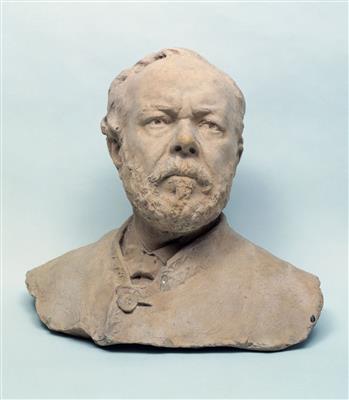
Biography
D'Orsi worked alongside his fellow Neapolitan Vincenzo Gemito, and the two occupied overlapping artistic territory: both rejected the smooth idealisation of academic sculpture in favour of figures caught in unguarded moments, their surfaces textured to catch light in ways that emphasised physical presence over symbolic meaning. Where Gemito often focussed on children and water-sellers, D'Orsi's range extended to genre subjects that reflected the social conditions of post-unification Naples.
His career extended through the long transitional period of Italian[1] art from the Risorgimento decades into the early twentieth century, a span during which the academy tradition he trained in gave way to modernist currents from the north. He continued working until late in life, dying in Naples in 1929[1] at the age of eighty-three.
Timeline
- 1845Born in Naples, Italy.
- 1845Trained at Accademia di Belle Arti di Napoli under Tito Angelini.
- 1845Absorbed Neapolitan tradition of working-class life observation.
- 1845Worked alongside fellow Neapolitan sculptor Vincenzo Gemito.
- 1845Rejected smooth idealization of academic sculpture.
- 1845Focused on genre subjects reflecting social conditions of Naples.
- 1929Died in Naples, Italy at the age of eighty-three.
Notable Works
Tap to view larger.
Next stop
Browse the movements →
Every movement in the collection, from the Renaissance to Pop art.
Related Artists


.jpg!Portrait.jpg)
Frequently Asked Questions
What is Achille D'Orsi known for?
Achille D'Orsi is known for applying social realism to sculpture. His genre subjects reflected the social conditions of post-unification Naples.What is Achille D'Orsi's most famous work?
Achille D'Orsi, an Italian[1] sculptor active in Naples, is best known for his realistic bronze and marble figures. He often depicted the working classes of Naples. His most celebrated sculpture is *Parassiti* (Parasites), also known as *I Parassiti*. D'Orsi completed it in 1882[1]. The bronze sculpture shows several men crowding around a public assistance office, waiting for aid. The figures exhibit a range of emotions, from hope to despair. D'Orsi presented the work at the 1882 exhibition of the Società Promotrice di Belle Arti in Naples. It caused a sensation due to its unflinching portrayal of poverty. The sculpture exists in several versions. The original bronze is in the Galleria Nazionale d'Arte Moderna e Contemporanea in Rome. A marble version is at the Capodimonte Museum in Naples. Smaller bronze replicas were also produced for private collectors. *Parassiti* remains D'Orsi's most recognised creation, securing his place in the history of Italian sculpture.What should I know about Achille D'Orsi's prints?
Achille D'Orsi (1845[1]-1929[1]) was an Italian[1] sculptor, active mainly in Naples. While he is best known for his bronze and marble sculptures, prints of his works offer an accessible way to appreciate his artistic vision. D'Orsi's sculptures often depicted scenes of everyday life, with a particular focus on the working class. His attention to detail and realistic portrayal of human figures made him a popular artist in his time. Prints capture the essence of these sculptures, translating the three-dimensional forms into two-dimensional images. These reproductions allow viewers to study the details of D'Orsi's modelling and the emotional expressions he captured. Many of D'Orsi's sculptures addressed social issues, such as poverty and exploitation. "Proximus Tuus" (1895[1]), for example, portrays the plight of impoverished families. Prints of such works can serve as historical documents, offering insights into the social concerns of late 19th-century Italy. They provide a window into a specific time and place, reflecting the artist's observations and commentary on society. Consider the subject matter and its historical context when viewing prints of D'Orsi's sculptures.What style or movement did Achille D'Orsi belong to?
Achille D'Orsi (1845[1]-1929[1]) was an Italian[1] sculptor associated with Realism, though with some stylistic connections to the late Romanticism of the mid-19th century. His work often depicted scenes of everyday life, particularly of the working classes in Naples. D’Orsi's sculptures aimed to portray his subjects with accuracy and without idealisation. This focus on representing ordinary people and their struggles aligns him with the Realist movement, which sought to depict the world as it was, rather than through a romanticised lens. His best-known works include pieces such as "Parassiti" (Parasites) and "Proximus Tuus", both of which present unflinching portrayals of poverty and social issues. While D'Orsi shared Realism's interest in modern subjects, his style retained elements of Romanticism, such as dramatic compositions and emotional intensity. This blending of Realist subject matter with Romantic sensibilities makes D'Orsi a distinctive figure in Italian sculpture of the late 19th and early 20th centuries.What techniques or materials did Achille D'Orsi use?
Achille D'Orsi was a sculptor, so his techniques involved three-dimensional media. Sculpture involves the physical substrate, the raw material, and also the tools and processes through which it is made. Sculptors often begin by drawing an outline on a rectangular block. Assistants then use axes to cut away the surplus stone. The basic form is established using punches struck with mallets. The form is gradually defined using claw chisels and drills. Fine details and smooth surfaces are then achieved with flat chisels. The slow process of smoothing and polishing continues as the workshop team used metal rasps, emery (crushed stone), and pumice. Clay modelling could serve as the basis of sculpture. Figures were cast from earthen moulds, which had previously been fired at high temperature to withstand the molten metal. Throughout the Renaissance, such sculpture was generally produced using the “lost wax” method.What was Achille D'Orsi known for?
Achille D'Orsi (1845[1]-1929[1]) was an Italian[1] sculptor, known for realist depictions of Neapolitan working-class life. He is associated with the verismo movement, which aimed to portray subjects with accuracy and without idealisation. Born in Naples, D'Orsi studied at the Naples Institute of Fine Arts. He later taught there. His work often focused on the everyday experiences of ordinary people. His sculptures captured moments of labour, leisure, and social interaction. D'Orsi's pieces frequently addressed social issues. He explored themes of poverty, exploitation, and the struggles faced by the lower classes. Among his best-known works are *Parassiti* (Parasites), which exists in multiple versions, and *Il সুতরাং* (The Water Carrier). These sculptures present unflinching portrayals of hardship. They also demonstrate D'Orsi's skill in capturing realistic detail and human emotion. D'Orsi exhibited widely, including at international expositions. His sculptures can be found in museums and private collections. Although his style was rooted in realism, his work also had a theatrical quality. This allowed him to convey narratives and evoke empathy in viewers.When did Achille D'Orsi live and work?
Achille D'Orsi was active in the late 19th century. In 1888[1], the periodical *Archivio Storico dell’Arte* was founded in Rome; it was devoted to Italian[1] cultural heritage, especially the Quattrocento. Also in 1888, the Bologna Esposizione Nazionale di Belle Arti included Previati and Segantini. By winter-spring 1891, Florence held the Esposizione Annuale della Societa per Belle Arti, which included Kienerk, Muller, and Nomellini. Also around 1890, an exhibition of Impressionist-influenced paintings was organised by Muller in Livorno. In January 1891, Milan saw a Ranzoni retrospective at the Societa Permanente. In February-March 1891, the Palazzo delle Esposizioni in Rome held *In Arte Libertas*, which included Grubicy, Moreau, and Segantini. Between when Venturi founded *Archivio Storico dell’Arte* in 1888 and 1891, D'Orsi was working.Where can I see Achille D'Orsi's work?
Achille D'Orsi's sculptures can be viewed in several museum collections. The State Hermitage Museum in Saint Petersburg holds pieces by D'Orsi. In the United States, several institutions have his work. These include the Metropolitan Museum of Art in New York; the Los Angeles County Museum of Art (LACMA); the Minneapolis Institute of Arts; the Charles Hosmer Morse Museum of American Art in Winter Park, Florida; the Virginia Museum of Fine Arts in Richmond; the Museum of Modern Art in New York; and the Wolfsonian at Florida International University in Miami Beach. The Royal Ontario Museum in Toronto also holds pieces. In the United Kingdom, you can find D'Orsi's art at the Victoria & Albert Museum in London; the National Museums of Scotland, Royal Museum in Edinburgh; the Manchester Art Gallery; the Geffrye Museum in London; the Brighton Museum & Art Gallery; and the Bakelite Museum in Williton.Where was Achille D'Orsi from?
Without more specific reference material, it is difficult to provide a detailed biography of Achille D'Orsi. However, some sources mention individuals and locations that may be relevant to his background. For example, M. d’Orsi is listed in the *Bollettino d'arte* as associated with the ‘Gallerie di Roma: Galleria Nazionale romana’ in 1954. Similarly, Baldassarre Orsini is noted in connection with Perugia in 1784, in *Guida al forestiere per l'augusta città di Perugia*. Leandro Ozzola wrote ‘L’Arte alla corte di Alessandro VII’ in *Archivio della Reale Società Romana di Storia Patria*, Rome, in 1908[1]. Giovanni Antonio Pecci was from Siena, as indicated in *Relazione delle cose più notabili della città di Siena si antiche, come moderne* (1752). These references suggest possible locations or associations for individuals with similar names, which might provide clues about Achille D'Orsi's origins.Who did Achille D'Orsi influence?
Achille D'Orsi (1845[1]-1929[1]) taught at the Naples Institute of Fine Arts. He is remembered as a teacher by a number of artists who passed through his studio. D'Orsi's pupils included Vincenzo Gemito (1852[1]-1933[1]), who was a fellow Neapolitan. Gemito's naturalistic sculptures of ordinary people, such as fishermen and water carriers, share some stylistic similarities with D'Orsi's work. D'Orsi's influence can be seen in Gemito's attention to detail and his ability to capture the character of his subjects. Another artist who studied with D'Orsi was Eduardo Monteforte (1849-1933). Monteforte was also a sculptor, and he produced a number of public monuments and portrait busts. D'Orsi's influence can be seen in Monteforte's academic style and his technical skill. While D'Orsi's name may not be widely known today, his impact on Italian[1] sculpture is evident in the work of his students. He helped to train a generation of sculptors who went on to achieve great success.Who influenced Achille D'Orsi?
Achille D'Orsi (1845[1]-1929[1]) was an Italian[1] sculptor known for his realistic depictions of everyday life. He spent his career in Naples. D'Orsi's early training occurred at the Accademia di Belle Arti in Naples, where he studied under Tito Angelini. Angelini was a sculptor working in the classical tradition. D'Orsi moved away from classicism, however. He instead embraced verismo, a post-Romantic aesthetic that valued naturalism. The shift toward verismo in Italian art was partly inspired by developments in French Realism, particularly the work of Gustave Courbet. While there is no direct evidence that D'Orsi studied with Courbet, he certainly knew his art. D'Orsi's focus on ordinary people and his unidealised portrayals reflect Courbet's influence. His sculptures often presented working-class figures with an unprecedented level of realism. This approach aligns him with the broader European Realist movement. He shared its interest in representing contemporary society without romanticism.Who was Achille D'Orsi?
Achille D'Orsi (1845[1]-1929[1]) was an Italian[1] sculptor, active mainly in Naples. He is best known for realist depictions of everyday life, often featuring working-class subjects. D'Orsi studied at the Academy of Fine Arts in Naples. There, he was a pupil of Tito Angelini. He began exhibiting in the 1870s, gaining recognition for his sculptures that portrayed Neapolitan society. His work often explored themes of poverty, labour, and social issues. He captured the struggles and dignity of ordinary people. One of his most famous sculptures is "Parassiti" (Parasites), which depicts impoverished figures crowding around a public soup kitchen. It won an award at the 1880[1] Turin Exhibition. Another notable work is "Il Contadino" (The Peasant). D'Orsi's sculptures are held in several public collections. These include the Galleria Nazionale d'Arte Moderna in Rome and the Museo di Capodimonte in Naples. His art provides insight into the social realities of late 19th-century Italy.
Sources
Editorial draws on the following primary and tertiary references for Achille D'Orsi.
- [1] wikipedia Wikipedia: Achille D'Orsi Used for: biography, birth dates, death dates, identifiers, movement attribution, nationality.
- [2] book Braun, Emily, 1957-; Asor Rosa, Alberto; Royal Academy of Arts (Great Britain), Italian art in the 20th century : painting and sculpture, 1900-1988 Used for: biography.
- [3] book Post-impressionism : cross-currents in European painting Used for: biography.
- [4] book Post-impressionism : cross-currents in European painting Used for: biography.
Editorial overseen by Solis Prints. Sources verified 2026-10-07. Click a source for details, or hover over [N] in the page above to preview.
Editorial standardsMethodologyCorrectionsAI disclosureAbout the editorial team