

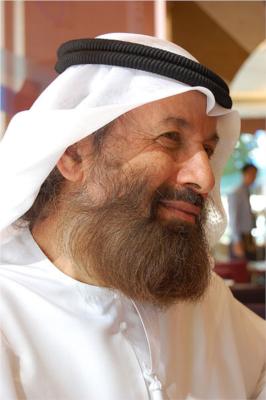
Abdul Qader Al Raes
- Hurufiyya movement
Abdul Qader Al Raes began painting at fourteen, shortly after his father's death, and largely taught himself. Born in Dubai in 1951[1], he spent formative adolescent years in Kuwait during that country's 1960s cultural renaissance, absorbing a range of influences before returning to the Emirates. He then stopped painting entirely for twelve years, from 1974 to 1986, while working as a labour inspector.
Biography
The resumption was decisive. Al Raes turned first to political subjects, responding to the Gulf War and the Palestinian intifada, then gradually shifted towards landscape and abstraction. He is now associated with the Hurufiyya movement[1], which fuses Arabic calligraphy and script with geometric abstraction. His mature canvases layer Arabic letterforms over flat planes of colour, making legibility and visual form work against each other in ways that are simultaneously decorative and conceptually weighted.
A founding member of the Emirates Fine Art Society, Al Raes is considered one of the pioneers of contemporary art in the UAE. His 1968 painting The Wait was selected as the oldest Emirati artwork displayed at the country's Venice Biennale pavilion. His work is held in the British Museum, the Museum of Contemporary Art in Shanghai, and India's National Gallery of Modern Art. In 2015 Sheikh Mohammed commissioned him to paint murals for Dubai Metro carriages.
He has received the Sultan Al Owais Award three times, in 1992, 1994, and 1996, the most prestigious arts prize in the Gulf, and has shown consistently in regional and international exhibitions across five decades.
Timeline
- 1951Born in Dubai, UAE
- 1965Absorbed cultural influences in Kuwait
- 1968Painted 'The Wait', oldest Emirati artwork at Venice Biennale
- 1974Stopped painting, worked as a labour inspector
- 1986Resumed painting, focused on political subjects
- 1992Received Sultan Al Owais Award
- 1994Received Sultan Al Owais Award
- 1996Received Sultan Al Owais Award
- 2015Commissioned to paint murals for Dubai Metro carriages
Notable Works
Tap to view larger.
Next stop
Browse the movements →
Every movement in the collection, from the Renaissance to Pop art.
Frequently Asked Questions
What is Abdul Qader Al Raes known for?
Abdul Qader Al Raes is considered one of the pioneers of contemporary art in the UAE. His 1968 painting The Wait was selected as the oldest Emirati artwork displayed at the country's Venice Biennale pavilion; his work is held in the British Museum, the Museum of Contemporary Art in Shanghai, and India's National Gallery of Modern Art; and in 2015 Sheikh Mohammed commissioned him to paint murals for Dubai Metro carriages.Who was Abdul Qader Al Raes?
Abdul Qader Al Raes was born in Dubai in 1951[1] and began painting at fourteen, largely teaching himself. A founding member of the Emirates Fine Art Society, he is considered one of the pioneers of contemporary art in the UAE.What was Abdul Qader Al Raes's art style?
Al Raes is associated with the Hurufiyya movement[1], which fuses Arabic calligraphy and script with geometric abstraction. His mature canvases layer Arabic letterforms over flat planes of colour, making legibility and visual form work against each other in ways that are simultaneously decorative and conceptually weighted.When was Abdul Qader Al Raes born?
Abdul Qader Al Raes was born in 1951[1].
Sources
Editorial draws on the following primary and tertiary references for Abdul Qader Al Raes.
- [1] wikipedia Wikipedia: Abdul Qader Al Raes Used for: biography, birth dates, death dates, identifiers, movement attribution, nationality.
- [2] book guggenheim-refigur00kren Used for: biography.
- [3] book guggenheim-twopri00weis Used for: biography.
- [4] book Masterpieces of western art : a history of art in 900 individual studies from the Gothic to the present day Used for: biography.
Editorial overseen by Solis Prints. Sources verified 2026-08-30. Click a source for details, or hover over [N] in the page above to preview.
Editorial standardsMethodologyCorrectionsAI disclosureAbout the editorial team