



Aaron Shikler
In 1970[1], Jacqueline Kennedy bypassed the usual committee process and selected Aaron Shikler personally to paint the official White House portrait of her late husband. The result broke with every convention in presidential portraiture: Kennedy shown with his head bowed and arms folded, turned away from the viewer. No official president had been depicted that way before. The commission established Shikler as the portraitist of record for the Kennedy family, and he went on to paint Jackie Kennedy's official White House portrait as well.
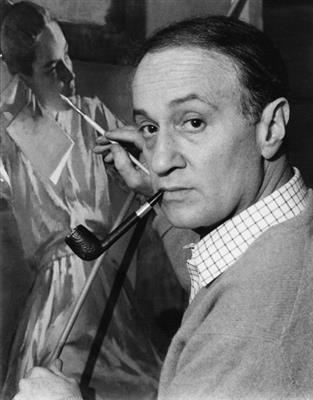
Biography
Born in Brooklyn in 1922[1], Shikler trained at the Tyler School of Art in Philadelphia and then at Hans Hofmann's school in New York. Hofmann's European modernist teaching gave him a grounding quite different from the Social Realist tendency dominant in American figurative painting at the time. During the Second World War he served as a cartographer with the U.S. Army Air Corps in Europe.
The Reagan White House commissioned him to paint both the President and First Lady in 1989[1]. His portrait of Nancy Reagan in a red dress became his most widely reproduced work. His painting of Ronald Reagan was later replaced by Everett Raymond Kinstler's version in 1991.
Shikler was elected to the National Academy of Design in 1965[1] and won the Thomas B. Clarke Prize three times: in 1958, 1960, and 1961. His work is held in the Metropolitan Museum of Art, the Brooklyn Museum, and the Hirshhorn Museum. He died in Manhattan in November 2015[1], aged 93.
Timeline
- 1922Born in Brooklyn, New York
- 1940Studied at Tyler School of Art in Philadelphia
- 1940Studied at Hans Hofmann's school in New York
- 1941Served as a cartographer in U.S. Army Air Corps during WWII
- 1958Won the Thomas B. Clarke Prize
- 1960Won the Thomas B. Clarke Prize
- 1961Won the Thomas B. Clarke Prize
- 1965Elected to the National Academy of Design
- 1970Commissioned to paint JFK's White House portrait
- 1989Commissioned to paint portraits of Ronald and Nancy Reagan
- 1991Reagan portrait replaced by Everett Raymond Kinstler's version
- 2015Died in Manhattan, New York
Notable Works
Tap to view larger.
Next stop
Browse the movements →
Every movement in the collection, from the Renaissance to Pop art.
Frequently Asked Questions
What is Aaron Shikler known for?
Aaron Shikler is known for his official White House portraits of John F. Kennedy and Jacqueline Kennedy. His portrait of Nancy Reagan in a red dress also became his most widely reproduced work.What is Aaron Shikler's most famous work?
While it is difficult to name one single 'most famous' work, Aaron Shikler is well-regarded for his portraits, especially the posthumous portrait of John F. Kennedy that hangs in the White House. This painting is considered one of the more iconic images of the former president. Shikler was chosen by Jackie Kennedy to paint an official portrait after the president's death. Instead of depicting Kennedy in the standard pose, Shikler showed him in a moment of reflection with his head bowed. This choice moved Jackie Kennedy, and it has resonated with the public since its unveiling. Shikler also painted portraits of other prominent figures, including First Lady Nancy Reagan. He favoured a realistic style, and his portraiture captured both the likeness and the personality of his subjects.What should I know about Aaron Shikler's prints?
When considering Aaron Shikler's prints, bear in mind that the art market distinguishes between original prints and reproductions. An original print is conceived as a print, and executed solely as a print, often in a numbered edition, and signed by the artist. Each print in the edition is an original, printed individually from a plate, stone, or block created for that purpose. There is no single original print from which copies are made. The artist decides the number of prints in the edition, and each print has a specific number, such as 12/25, indicating the twelfth print of an edition of twenty-five. Not all early prints were numbered or signed. Reproductions are copies of artworks conceived in another medium, such as painting or watercolour, and made by photo-mechanical means. Numbering and signing a reproduction does not make it an original print. Original prints command higher prices than posters because they are sold in limited editions. The number of prints is limited by the number of impressions that can be made before the plate wears out. Some publishers impose limits to increase a print’s value. These limits may be set as high as 700 to 1,000 impressions, but some prints are limited to 250 to 500, making them highly prized by collectors.What style or movement did Aaron Shikler belong to?
Aaron Shikler (1922[1]-2015[1]) was an American portrait artist. His work does not fit neatly into a single artistic movement. However, some context can be provided by examining the art movements that were current during his career. Abstract Expressionism emerged in New York in the 1940s. It is characterised by energetic, gestural painting on large canvases. Artists applied paint rapidly, sometimes dripping or throwing it. The expressive method was as important as the painting itself. Simultaneously, Art Informel developed in France. It sought a new way to create images without recognisable forms, using improvisation and free brushstrokes. Pop Art emerged in the USA and Britain in the 1950s. It drew inspiration from consumer society and pop culture, using comic strips, advertising, and mass-produced objects. These movements contrast with Shikler's representational portraiture.What techniques or materials did Aaron Shikler use?
Information regarding Aaron Shikler's techniques is scarce. However, one can analyse the techniques of similar artists. Some artists prepare their surfaces with a chalky white acrylic polymer. This gives the work a built-up surface texture. By working paint in one direction, up to the boundary of the next form, the artist creates a ridge. This reinforces the form and makes it more volumetric. Other artists grind their own pigments and use egg tempera. Max Doerner's handbook, *The Materials of the Artist and Their Use in Painting*, discusses these traditional materials. Doerner also recommended new synthetic materials, such as titanium white and coal tar. Artists apply paint with brushes, squeegees, and cotton swabs. They also use spray bottles, paper towels, and scrapers. Washes, scrapes, and drips can create variety. Water spritzed onto semi-dry paint, then blotted with a paper towel, removes the spray pattern. Edges can be broken with splatter and drips.What was Aaron Shikler known for?
Aaron Shikler (1922[1]-2015[1]) was an American portrait artist known for his paintings of prominent figures. He worked primarily in the medium of egg tempera, and he also created charcoal drawings. Shikler received commissions from the Kennedy family to paint a posthumous portrait of President John F. Kennedy. This portrait, completed in 1970[1], is perhaps his most recognised work; it hangs in the White House. Instead of depicting Kennedy as a powerful leader, Shikler chose to portray him in a more contemplative and informal pose, head bowed and arms crossed. Beyond the Kennedy portrait, Shikler painted portraits of other notable individuals, including First Lady Jacqueline Kennedy Onassis and their children, Caroline and John Jr. His sitters also included figures from the arts, politics, and society, such as the artist Robert Motherwell and the writer Philip Roth. Shikler's work is characterised by its realism and attention to detail.When did Aaron Shikler live and work?
Aaron Shikler was an American portrait artist, born in Brooklyn, New York, on 18 March 1922[1]. He died in New York City on 12 November 2015[1]. Shikler was known for his portraits of prominent figures. These included President John F. Kennedy; the official White House portrait is perhaps his best-known work. He also painted portraits of First Lady Jacqueline Kennedy Onassis; their children, Caroline and John Jr; and other members of the Kennedy family. He created portraits of other public figures, such as the artist Robert Motherwell. Shikler's style combined realism with an emphasis on capturing the subject's character and personality. He often worked in a muted colour palette, focusing on subtle details and expressions. His work can be found in many public and private collections.Where can I see Aaron Shikler's work?
It is difficult to pinpoint exactly where to view works by Aaron Shikler, as the available sources do not list his works in specific collections. However, many major museums hold collections of American art that may include pieces by him. Some of these are: The Metropolitan Museum of Art in New York; the Los Angeles County Museum of Art; the Art Institute of Chicago; the Philadelphia Museum of Art; the Museum of Fine Arts, Boston; and the National Gallery of Art in Washington, D.C. University art galleries such as the Yale University Art Gallery (New Haven) and the University of Michigan Museum of Art (Ann Arbor) may also hold his pieces. These museums often have substantial holdings, so it is worth checking their online catalogues or contacting them directly for information about specific works by Aaron Shikler in their collections.Where was Aaron Shikler from?
Aaron Shikler was not listed in the provided documents. However, the documents do contain biographical information on other artists. Tobi Kahn was born in New York on 8 May 1952[1]. David Alfaro Siqueiros was born in Chihuahua, Mexico, in 1898. K. R. H. Sonderborg was born in Sonderborg (Alsen), Denmark, in 1923. Peter Stroud was born in London in 1921. Illi-Sverre Syverson was born in Kincaid, Saskatchewan, Canada, in 1939. Fernando de Szyszlo was born in Lima, Peru, in 1925. Rufino Tamayo was born in Oaxaca, Mexico, in 1899. Vecheskiel Streichman was born in Lithuania in 1906. Charles Simonds was born in New York. Michael Singer was born in Brooklyn, New York, in 1945. David Smith was born in Decatur, Indiana, in 1906. Robert Smithson was born in Rutherford, New Jersey. Richard Stankiewicz was born in Philadelphia in 1922[1]. Mark Rothko was born in Dvinsk, Russia, on 26 September 1903.Who did Aaron Shikler influence?
It is difficult to identify specific artists directly influenced by Aaron Shikler. However, we can consider the artistic lineage and context in which he worked. Examining earlier American portraitists such as John Singleton Copley and Gilbert Stuart reveals that they emulated their British contemporaries. Later, artists like Fuller and Morse showed influences from the Munich school or British art. These influences found greater expression in the work of Thomas Eakins, Frank Duveneck, and William Merritt Chase. Winslow Homer was influenced by Eakins, and George Bellows descended from Chase. These connections illustrate how artistic styles and techniques are passed down and adapted through generations. While a direct line of influence from Shikler to specific later artists is not explicitly documented in the provided texts, the broader context of American art history shows a pattern of artists learning from and building upon the work of their predecessors.Who was Aaron Shikler?
Aaron Siskind (1903-1991[1]) was a photographer whose work gained recognition from Abstract Expressionist painters. His photographs were regularly exhibited at the Charles Egan Gallery, alongside work by de Kooning, Joseph Cornell, Franz Kline, and Philip Guston. Siskind began using a camera in the early 1930s in New York City. Initially, he worked as a documentary photographer. However, he became interested in photography as a visual language, one that could convey metaphors and symbols. His abstract approach sometimes puzzled critics, who interpreted his photographs as abstract expressionist paintings. Siskind found inspiration and encouragement from the New York abstract expressionist community in the 1940s. Siskind aimed to find a poetic language that linked experience with memory, sight with surprise, and common objects with unknown signs. He played piano and wrote poetry before turning to photography. His background was in literature, and he recognised Marcel Proust, James Joyce, T. S. Eliot, and William Blake as important influences. Siskind explored architectural photography, still life, social documentary, and abstraction.Why are Aaron Shikler's works important today?
Aaron Shikler (1922[1]-2015[1]) was an American portrait artist known for his realistic depictions of figures. Although not considered a Photo-Realist, his paintings paid careful attention to literal qualities. Shikler aimed to capture the essence of his subjects, going beyond mere surface appearances. He sought to understand his subjects thoroughly, believing that artists can only truly paint what they know well. This approach resonates today, as viewers appreciate art that offers insight into the human condition. His best-known work is probably the posthumous portrait of John F. Kennedy, which departs from traditional, formal presidential portraits. Instead, it presents a contemplative Kennedy, capturing a sense of introspection. This intimate portrayal continues to affect viewers, offering a glimpse into the private persona of a public figure. Shikler's emphasis on realism and his ability to convey deeper meaning make his works relevant in contemporary art.
Sources
Editorial draws on the following primary and tertiary references for Aaron Shikler.
- [1] wikipedia Wikipedia: Aaron Shikler Used for: biography, birth dates, death dates, identifiers, movement attribution, nationality.
- [2] book Carol Strickland and John Boswell, The Annotated Mona Lisa Used for: biography.
- [3] book Carol Strickland and John Boswell, The Annotated Mona Lisa Used for: biography.
- [4] book Carol Strickland and John Boswell, The Annotated Mona Lisa Used for: biography.
Editorial overseen by Solis Prints. Sources verified 2026-08-30. Click a source for details, or hover over [N] in the page above to preview.
Editorial standardsMethodologyCorrectionsAI disclosureAbout the editorial team