


In the 1850s, Japanese woodblock prints began arriving in Europe, packed as wrapping paper around ceramics and other trade goods. Artists in Paris noticed. Within two decades, the flattened perspective, bold outlines, asymmetric compositions, and saturated colour of ukiyo-e had altered the course of Western painting.
The Prints in the Wrapping Paper
Japan had been closed to most foreign trade since 1639. When Commodore Perry's ships forced the country open in 1853, centuries of accumulated art began flowing westward. The prints of Hokusai and Hiroshige reached European artists who had never seen anything like them. The absence of linear perspective, the use of flat areas of colour bounded by strong outlines, and the willingness to crop compositions at unexpected angles were revelations.
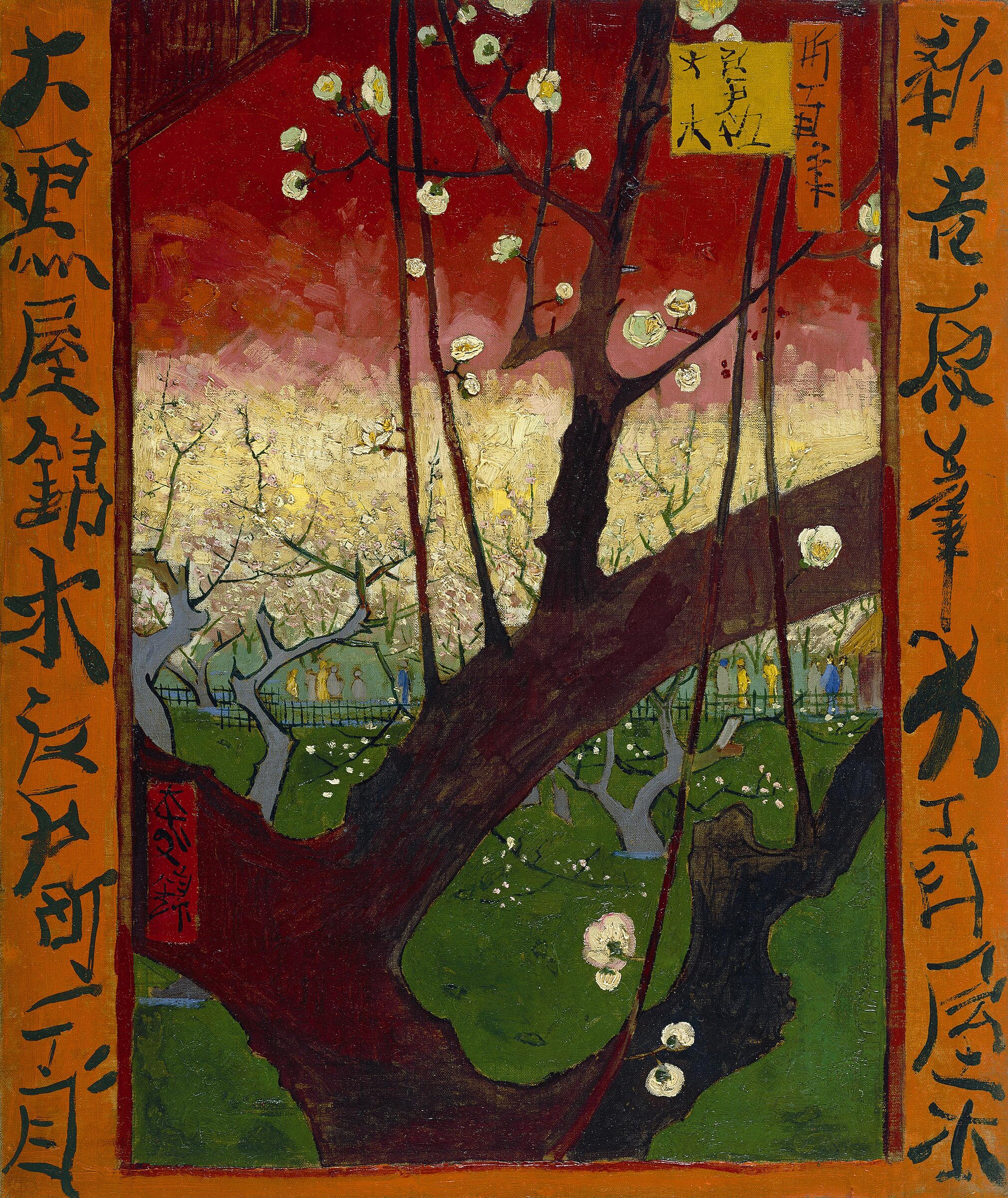
Van Gogh was perhaps the most enthusiastic collector. He owned hundreds of Japanese prints and copied several in oil, including Hiroshige's Plum Garden at Kameido, adding a border of Japanese characters copied from magazine covers (he could not read Japanese). The exercise taught him about flat colour and compositional boldness, lessons that appeared in his own work for the rest of his career.
Cassatt, Degas, and the Flat Print
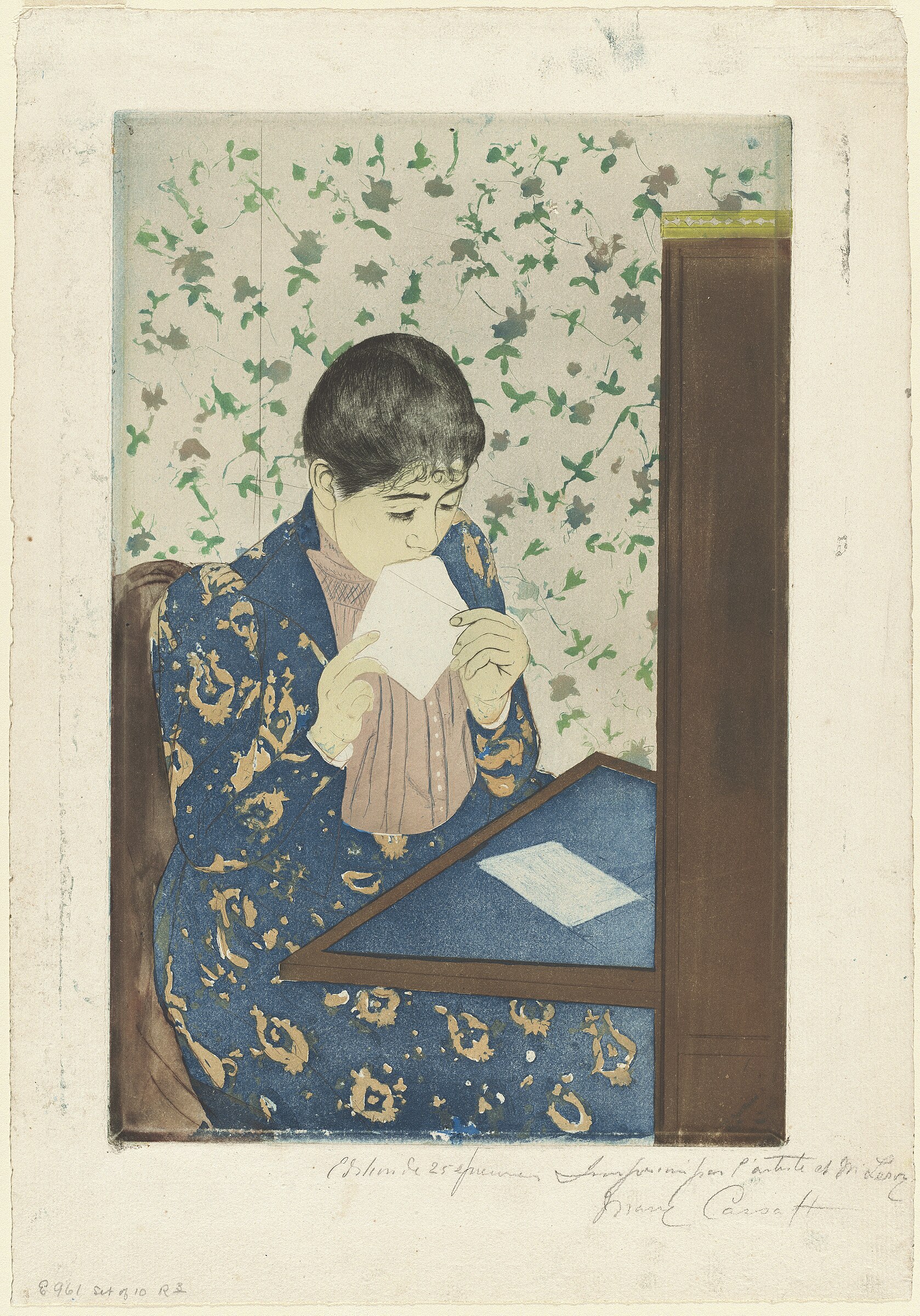
Mary Cassatt saw a major exhibition of Japanese prints at the École des Beaux-Arts in Paris in 1890 and immediately began a series of colour prints that adapted ukiyo-e techniques to Western subjects. The Letter shows a woman at a desk, rendered in flat areas of patterned colour with bold outlines. The floral wallpaper, the woman's dress, and the writing desk are treated as interlocking planes of decoration rather than three-dimensional objects in space. The debt to Utamaro's beauty prints is direct and acknowledged.
Degas collected Japanese prints and adopted their compositional devices: figures cut by the frame edge, high viewpoints looking down on scenes, and empty space used as an active element. Whistler absorbed Japanese principles of tonal harmony. Monet built a Japanese garden. The influence was pervasive, but it was never simple imitation. European artists took what they needed from Japan and used it to solve problems that European art had created for itself.
Japonisme was not a movement but an infatuation, and like most infatuations it changed both parties. Japanese artists, seeing how Europeans used their techniques, began to reconsider their own traditions. The exchange, once started, never stopped.


