


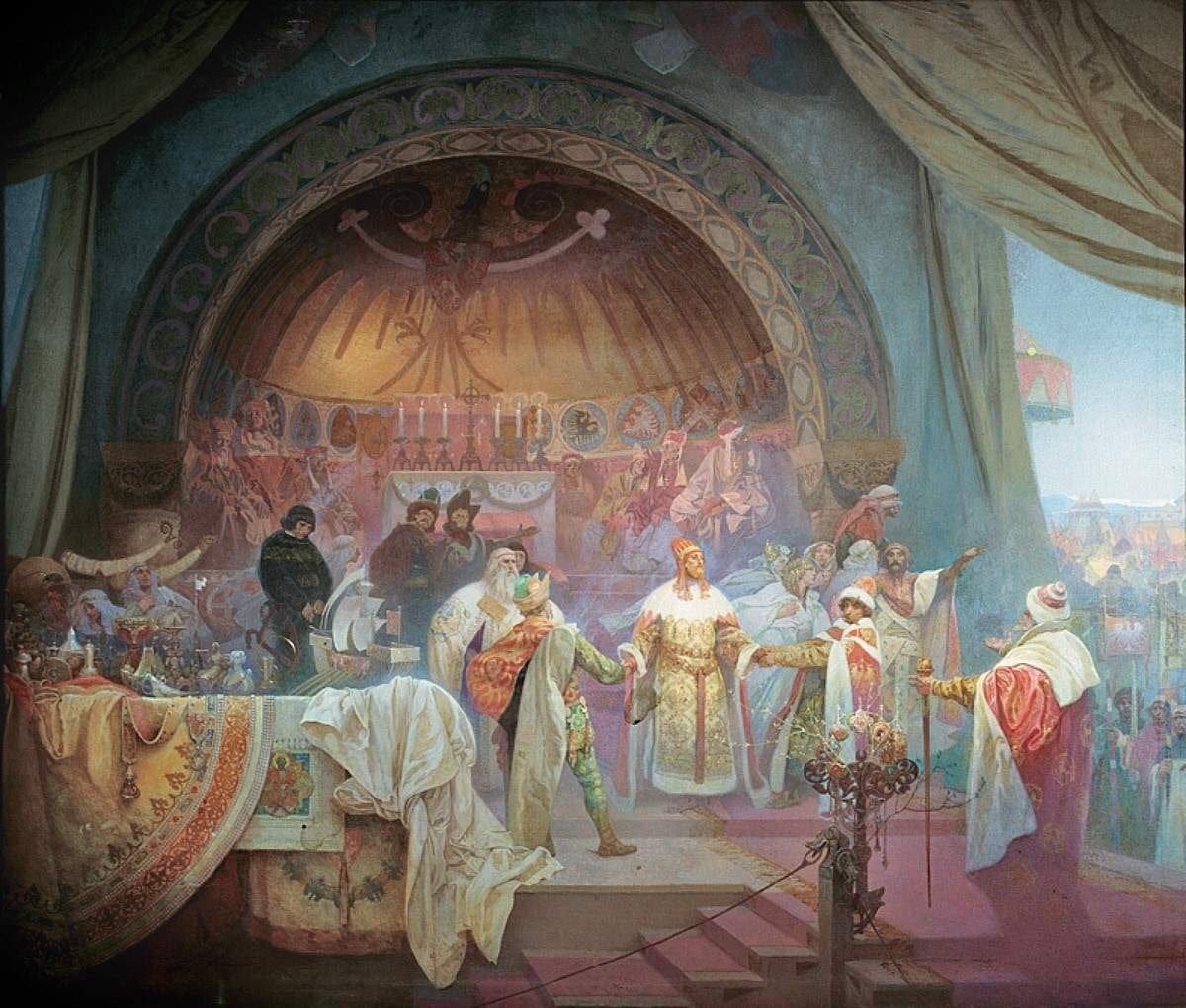
After achieving international acclaim in Paris during the late nineteenth century, Alphonse Mucha abandoned commercial poster design to create the Slav Epic. This monumental series was completed after his return to his native country in 1913, fulfilling an ambition for large decorative painting that defined his entire career.
Early Education and Mural Beginnings
Alphonse Mucha was born on 14 July 1860 in Ivancice, a town in Moravia within the present-day Czech Republic. Raised in a modest household as the son of a court marshal, he received artistic encouragement from an early age. His initial aesthetic experience took place in Saint Peter's baroque church in Brno, where curvilinear interior decorations derived from natural forms filled the space. Although he worked as an office clerk while drawing as an amateur, his application to the Prague Academy of Fine Arts in 1877 was rejected. In 1879, he answered a newspaper advertisement and moved to Vienna to work as a theatrical designer for the firm Kautsky-Brioschi-Burghardt. This employment ended when a fire destroyed the Ringtheater on 10 December 1881.
Mucha subsequently moved to the small town of Mikulov, where he met Count Karl Khuen. The wealthy landowner commissioned him to paint frescoes for the dining room of Emmahof Castle. This initial experience with mural painting established Mucha's lifelong ambition to execute large-scale decorative projects. Count Khuen financed Mucha's formal artistic education, offering him a choice to study in Rome or Paris. Choosing Paris, Mucha arrived in 1888 and enrolled in the Académie Julian, where he met artists associated with the Nabis group, including Paul Sérusier, Édouard Vuillard, Pierre Bonnard and Maurice Denis.
The Parisian Breakthrough and Public Reception
Count Khuen abruptly ended his financial support in late 1889. Forced to leave the Académie Colarossi, Mucha experienced a period of poverty before earning a modest income as a magazine illustrator in the early 1890s. His technique remained essentially academic until the mid-1890s, when he was influenced by Symbolist mysticism. The rise of Art Nouveau permitted Mucha to move away from academic constraints. His sudden fame occurred when his poster for Sarah Bernhardt's play Gismonda was posted on Parisian walls. Bernhardt subsequently hired him to design sets and posters, cementing his position in the French capital.
Public taste at the turn of the century was shifting away from the pessimistic realisms known as the slice of life. Viewers welcomed romantic themes drawn from Byzantium, Greece, China, Italy, the Middle Ages and the Renaissance. Mucha's visual style responded directly to this demand, offering a blend of classical memories, contemporary languor and Byzantine ornament. Major posters produced during this productive phase included designs for Lorenzaccio, La dame aux camélias, Amants, the Revue pour les jeunes filles, Job cigarette papers and Champagne biscuits.
Decorative Principles and Structural Logic
Mucha operated primarily as a decorative artist who systematically extracted elements of beauty and harmony from nature. He studied natural structures methodically to establish precepts of balance and logic. In his complex compositions, every line or mass was compensated by another line or mass of proportionate strength. His arrangements achieved clarity because each element occupied a calculated position within the overall ensemble. This structural balance was evident across his book covers, magazine layouts, page decorations and commercial posters.
During the late 1890s, Mucha expanded his output into the broader decorative arts, producing designs for furniture, place settings, shop windows, jewellery and metal biscuit tins. The sinuous, organic contours of his draughtsmanship proved suited to metalwork. Despite his cosmopolitan surroundings and academic training under Jean-Paul Laurens, Mucha incorporated a distinct Slavic character into his Parisian poster output. For the 1900 Universal Exposition in Paris, he selected the paintings for Austria's official representation and designed the pavilion for the provinces of Bosnia-Herzegovina.
Academic History Painting and Contrast
In addition to his decorative commissions, Mucha executed fifteen historical compositions for the Scenes and Episodes of German History. These works differed in technique and inventive character from his typical output. Reviewers noted that the ornamental designer stepped aside for a dramatist whose power remained external. The compositions relied on violent gestures, heroic postures and academic exactness, conforming to the annual historical paintings produced by official state painters across Europe. The personal signature and stylistic traits characteristic of Mucha were absent from these canvases.
This academic project demonstrated that conventional historical painting strained Mucha's natural inclinations. While official state painting demanded adherence to institutional formulas, Mucha's true strength lay in combining structural logic with spontaneous decorative invention. His earlier mural work at Emmahof Castle and his large poster projects had already demonstrated a preference for monumental decorative synthesis rather than dry academic history painting.
American Interlude and the Slav Epic
By 1906, Mucha recognised that Parisian public interest in his decorative style was waning. Seeking portrait commissions and teaching positions, he departed for the United States. His years in America prior to the First World War proved disappointing professionally and artistically. Nevertheless, Mucha remained determined to paint a monumental series of canvases dedicated to Slavic history. He viewed his commercial illustrations and decorative objects as preparation for this larger, ultimate task.
Mucha returned permanently to his native country in 1913, dedicating the rest of his career to painting the Slav Epic. Working on a monumental scale, he applied the structural balance, decorative harmony and spatial organisation he had perfected over decades. He continued working on these massive canvases until his death in 1939. The series realised his lifelong goal of large-scale decorative painting, translating his personal artistic principles into a comprehensive national narrative painted at scale.


