


In 1893, German artist Käthe Kollwitz attended a performance of Gerhart Hauptmann's play The Weavers. Inspired by the theatrical depiction of labour oppression, she created her first major print series, A Weavers' Revolt. The project established her focus on social criticism, working-class struggle, and graphic printmaking techniques.
Inspiration and A Weavers' Revolt
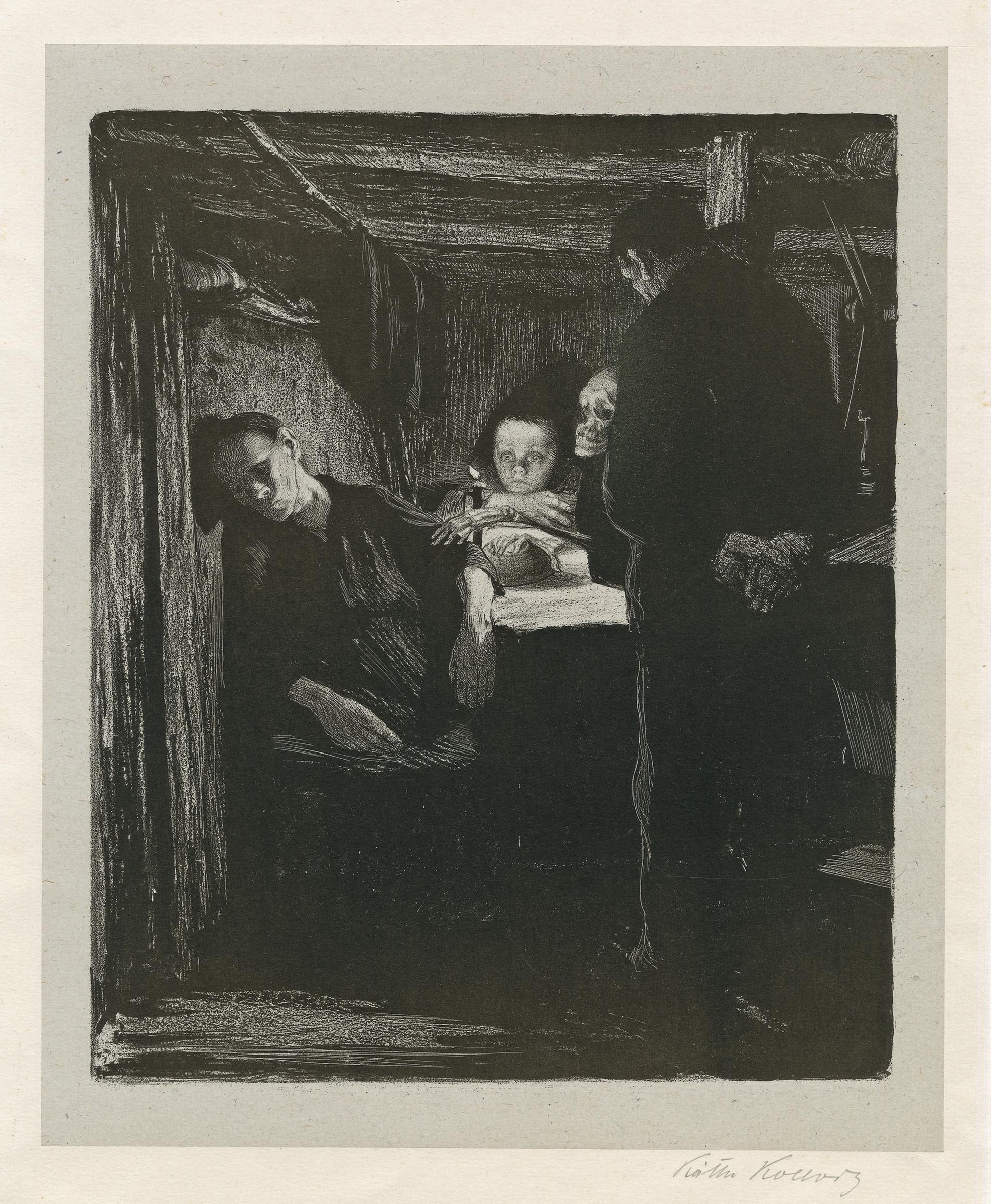
Käthe Kollwitz was born in Königsberg, East Prussia, in 1867. She trained initially as a painter, but turned to printmaking around 1890 to produce images centred on social criticism. Attending Gerhart Hauptmann's play The Weavers in 1893 inspired her to depict the severe hardships of industrial workers. Kollwitz wrote that Hauptmann's drama helped her recognise art's capacity to transform ugly reality into something deceptively grand. Between 1893 and 1897, she developed her six-plate series titled A Weavers' Revolt. In the lithograph Need, executed between 1893 and 1897, she depicted a dark, cramped room where a despairing mother holds her head while watching her sleeping infant.
The series concluded with prints such as March of the Weavers in 1897. At the 1898 Great Berlin Art Exhibition, the jury voted to award Kollwitz a gold medal for A Weavers' Revolt. Emperor Wilhelm II rejected the decision, stating that granting a medal to a woman went too far. Conservative critics supported this exclusion. Hans Rosenhagen, editor of a German magazine, claimed that women's art lacked powerful expression, originality of invention, and depth of feeling. Despite these institutional obstacles, Kollwitz continued using historical accounts and direct observation of economic inequality to construct direct visual statements equal in emotional intensity to the work of Edvard Munch.
Printmaking Techniques and Social Reality
In 1891, Käthe Kollwitz married Karl Kollwitz, a physician who treated working-class families. The couple established their home in a proletarian quarter of Berlin, where Kollwitz witnessed the physical and emotional distress of industrialisation. To record these conditions, she chose printmaking because it was immediate and accessible. She focused primarily on etching until about 1911, before expanding into lithography to create direct graphic compositions. Kollwitz reduced her visual compositions to essential gestures and forms, eliminating extra detail to ensure her depictions of working-class struggle remained direct and universally understandable.
Kollwitz drew artistic inspiration from various sources, including an 1871 illustration by Arthur Boyd Houghton published in the magazine The Graphic. In her 1903 etching Woman with Dead Child, she produced a raw portrait of maternal grief, depicting a mother clinging tightly to her deceased infant. Later, when commissioned by the Society for Historical Art (Verbindung für Historische Kunst) to illustrate the German Peasants' Revolt of 1522 to 1524, Kollwitz used herself as the visual model for the revolutionary figure Black Anna in preparatory drawings. In the fifth plate of that series, Black Anna raises her arms to urge a crowd of peasants into battle.
Political Commitments and Opposition
Kollwitz was raised in a family with radical political and religious beliefs. After reading August Bebel's 1883 treatise Woman under Socialism, she formed the belief that female emancipation required a socialist society. Although she viewed herself as a moderate socialist, political violence by the Free Corps pushed her views further to the left. Following the assassination of communist leader Karl Liebknecht, his family asked Kollwitz to create a death-bed portrait. Her response, Commemorative Print for Karl Liebknecht, marked her first experiment with the woodcut medium, serving as a visual memorial to Liebknecht and the working class.
The Liebknecht woodcut appeared at the Workers' Art Exhibition in Berlin in 1920. Kollwitz donated her earnings from print sales to fund similar public exhibitions. She also designed posters for anti-famine campaigns organised by International Workers' Aid, collaborating alongside cultural figures such as Albert Einstein, George Grosz, Henri Barbusse, Upton Sinclair, and Maxim Gorky. Her art generated opposition from the political left as well as conservative groups. In 1920, the communist newspaper Die rote Fahne published a critique asserting that her prints overemphasised hopelessness rather than encouraging active armed resistance. Kollwitz defended her practice by clarifying that her work represented life itself rather than mere social misery.
War, Grief, and the Woodcut Medium
The outbreak of the First World War altered Kollwitz's personal life and artistic direction. Her youngest son, Peter, died in combat in 1914. Devastated by his death, Kollwitz embraced pacifism and redirected her prints toward themes of mourning, sacrifice, and human suffering. Around 1920, inspired by the wood sculptures and prints of Ernst Barlach, she began working with woodcuts. The woodcut process allowed her to move away from classical graphic detail toward opaque, exaggerated shapes that heightened the emotional weight of her figures.
Between 1918 and 1923, Kollwitz created her woodcut portfolio Krieg (War), which was published in 1924. The series addressed the aftermath of conflict through simplified, heavy forms. She applied this woodblock technique to individual prints, including Infant Mortality in 1925, which depicted a mother overwhelmed by sorrow using stark black tones. Kollwitz intended her prints to remain widely accessible in price and message to working people. However, art publishers Emil Richter and Alexander von der Becke encouraged her to produce limited special printings alongside regular runs to cater to a private market of art collectors.
Prussian Academy and Later Years
In January 1920, the post-war socialist government appointed Kollwitz to the Prussian Academy of Arts, making her the first woman elected to the institution. She maintained her dedication to portraying the poor and unemployed throughout the Weimar era. When the National Socialist regime took power, authorities expelled Kollwitz from the academy and banned her from exhibiting her work in galleries. Despite this official ban, Nazi propaganda agencies occasionally appropriated her graphic imagery without her consent.
During the Second World War, Allied bombing raids damaged Berlin severely. In one air raid, Kollwitz's Berlin apartment was destroyed, resulting in the loss of numerous original drawings and prints. She relocated to the town of Moritzburg to escape further bombing. Kollwitz died in Moritzburg in 1945, approximately two weeks before the official surrender of Germany. Over a career spanning five decades, she produced 275 distinct prints, working almost exclusively in black and white to document social inequality, maternal grief, political struggle, and the destruction of war.


_(BM_2018,7046.1).jpg)