


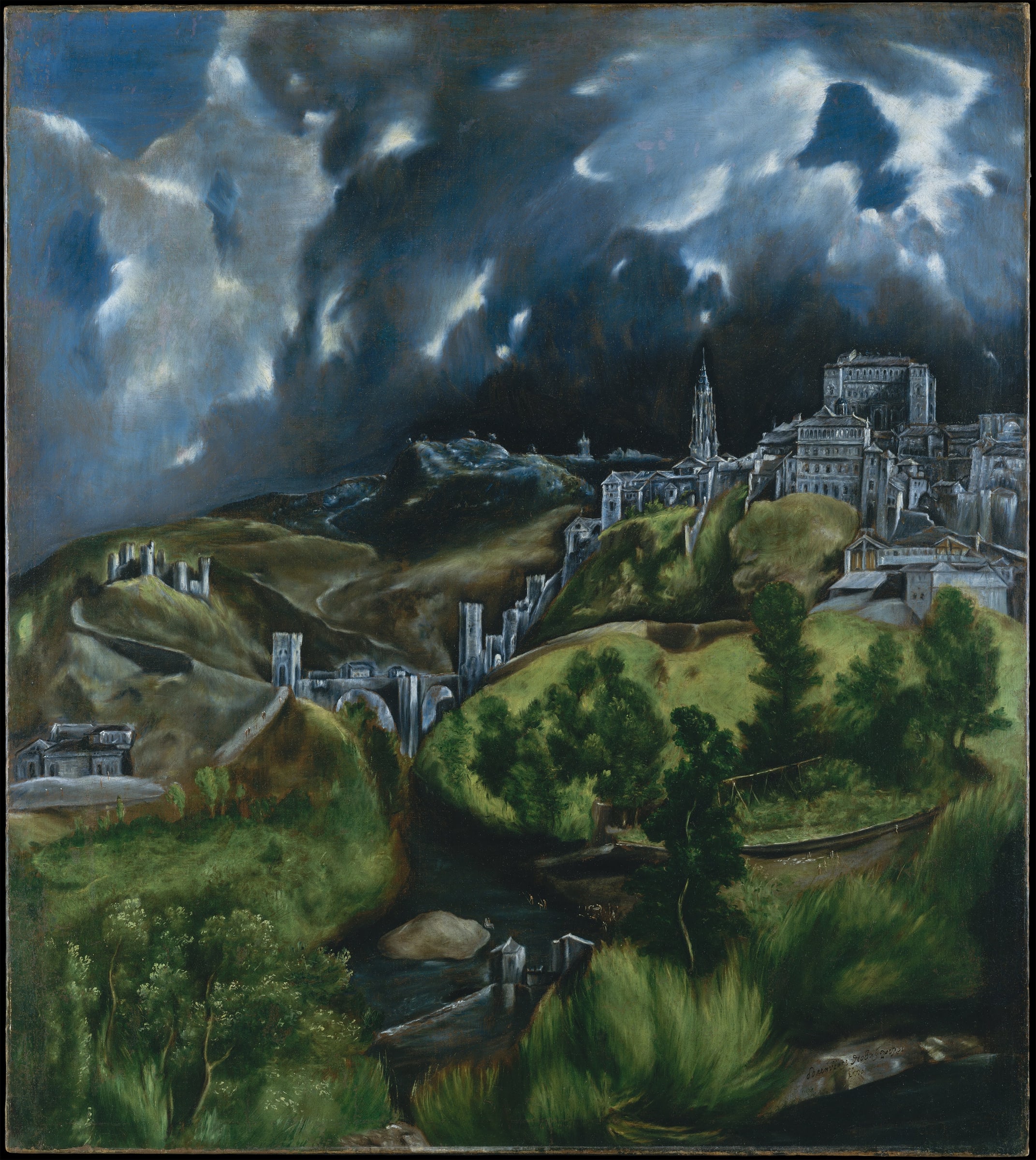
El Greco created View of Toledo as an interpretive study of his adopted home under dark, storm-filled skies. Rather than recording exact geography, the painting rearranges key architectural monuments against a dramatic sky, producing the artist's only pure landscape painting.
Cartography and Emblematic Representation
El Greco painted two surviving landscapes of his adopted Spanish home. The later canvas, titled View and Plan of Toledo, was produced between 1608 and 1614 and hangs in the Museo de El Greco. That work documents the urban environment in cartographic terms, providing an accurate layout that is emblematic in intention. In contrast, the earlier canvas titled View of Toledo, housed in the Metropolitan Museum of Art in New York, offers an interpretative portrayal rather than a strict documentary record of the city's actual appearance.
In View of Toledo, the artist presented the urban skyline from a northern vantage point situated above the Tagus River. A completely accurate view from this specific position would have omitted the cathedral entirely. El Greco altered local geography by transposing the cathedral to the left side of the dominant Alcazar palace. By rearranging these primary landmarks, the painter assembled the city's notable monuments into a single image that captures both past and present civic grandeur.
This selective arrangement of characteristic features belongs to a tradition of emblematic city views. An identical panorama of Toledo appears in the background of El Greco's Saint Joseph and the Christ Child, painted in 1599 for the Capilla de San Jose. This repetition suggests that the composition for View of Toledo was conceived in connection with that commission. The inclusion of the town across his art acknowledges how much his work relied upon the inspiration of his home environment.
Terrain Manipulation and Sky Composition
Toward the end of his career, El Greco executed View of Toledo as the sole example of pure landscape painting in his entire oeuvre. From a low standpoint, the viewer's gaze moves up the hill toward the city centre, dominated by the Alcazar and the cathedral. The composition establishes a dynamic movement running from bottom to top and from the foreground into the background.
A distinct diagonal joins this movement. This line starts at the left edge of the canvas, crosses the Roman bridge of Alcantara spanning the Tajo valley, follows along the city wall, and ascends toward the cathedral spire. The way the painter disposed these land masses is similar to his method of grouping figures in The Resurrection. This arrangement creates tension between the flat silhouettes on the picture plane and the implicit three-dimensional space.
El Greco unconcerned himself with representational detail, blurring the transitions between trees and distant mountains. This reduction of detail causes individual monuments to stand out sharply in a ghostly light. Above the city, thunderclouds as black as night gather over the cathedral and the fortress, representing the sacred and secular centres of Toledo. Clouds and solid buildings are interwoven across the broad sky, reflecting the abstract style of his late period.
Palette Techniques and Italian Influences
The painting relies on a depiction of the sky achieved through distinct colour contrasts. Dark clouds above contrast with the glowing green hills situated below. El Greco used a palette dominated by cold greens, leaden blues, and red-earth ground covered with a lattice of silver and green tones. His technical method involved applying light colours over dark underpainting, prioritising colour over rigid adherence to natural forms.
His handling of colour assimilated ideas from the Italian Renaissance and late Mannerism. Before moving to Spain in 1576, El Greco worked in Rome, where his rejection of Michelangelo's techniques and unconventional approach had attracted enmity. He briefly stayed in Madrid before settling permanently in Toledo, the religious capital of Spain. His palette recalls the colour choices of Titian, while his physical distortions derive from the stylistic methods of Tintoretto.
In several paintings, El Greco blended form and space so that skies appear just as solid and dominant as physical objects and figures. By renouncing standard descriptive details, his late works feature broadly treated drapery and blurred contours. Figures twist like flames, and apocalyptic skies represent divine forces. This expressive handling of tone pulls the composition together, distinguishing his landscape work from the prevailing artistic conventions of sixteenth-century Europe.
The City in Sacred and Allegorical Narrative
Toledo served as the backdrop for major religious and mythological compositions throughout El Greco's career. In Laocoon, an allegorical horse trots in the middle distance toward a city spread out beneath a glowering, doom-laden sky. Although the narrative depicts the ancient mythological fall of Troy, the setting is explicitly Toledo. Painting this drama of transgressing mortals during the Counter-Reformation signalled the orthodoxy of his religious convictions within contemporary Spain.
The artist also introduced storm-like light effects into purely sacred subjects. In his treatment of The Holy Family with St Anne for the Hospital de San Juan Bautista, executed roughly ten years earlier, he used a bright palette. A later version of the same subject is strikingly darker in colour, featuring light effects suggestive of a storm. The young John the Baptist points heavenward, turning the domestic grouping into a vision of the future Passion of Christ.
In that darker canvas, five figures gather closely together while maintaining complicated spatial relationships. St Anne bends over the infant Jesus lying in his mother's lap, recalling traditional Pieta imagery. Joseph looks on from behind, complementary to St Anne. By avoiding direct eye contact between the figures, El Greco evoked an unreal, dream-like atmosphere. His modelling of the children features blurred outlines, marking a transition away from the portrayal of idealized nature.
Historical Context and Modern Reception
Landscape paintings were rare in Spanish art during the Renaissance and Baroque periods. The Council of Trent instituted a ban against pure landscape painting, making View of Toledo the first major Spanish landscape canvas of its era. The symbolism of the canvas echoes the religious mysticism that infused Toledo, when Platonist philosophy, ancient Neo-Platonism, the liturgy, and the writings of the Church fathers were widely studied.
El Greco gained major public commissions in Toledo, beginning with an altar painting for the cathedral in 1577. Although he was esteemed as a sculptor and portraitist alongside his large religious canvases, he left no real followers. His methods failed to fit into any dominant stylistic school of his era, leaving his work isolated immediately following his death. His individual style remained unique in art history until later generations reassessed his output.
In the modern era, painters such as Goya and Picasso revived interest in El Greco's art. When artists associated with Expressionism and Surrealism encountered View of Toledo, they greeted the canvas as a revelation. The cataclysmic quality of the sky, the tension between two-dimensional silhouettes and three-dimensional space, and the free handling of colour provided these twentieth-century movements with a historical precursor for abstract and expressive visual strategies.


