


Gustave Courbet transformed nineteenth-century French painting by depicting a small-town funeral on a canvas over six metres wide. By granting ordinary provincial citizens the monumental scale reserved for history painting, Courbet redefined the scope of artistic subjects.
Courbet and the Return to Ornans
Gustave Courbet was born in 1819 in Ornans, a provincial town near Besançon and the Swiss border. His father, a former peasant, was a prosperous landowner and vintner. Courbet moved to Paris in 1839 to study painting. By the late 1840s, he became a prominent figure in the bohemian cafés of the Left Bank. There he met writer Charles Baudelaire, socialist journalist Pierre-Joseph Proudhon, and art critic Champfleury. Under Proudhon's influence, Courbet adopted socialist views, while Champfleury directed his attention toward Realism. Champfleury collected popular prints, broadsides, and children's art, urging Courbet to paint the rural life of his home region.
In the autumn of 1849, Courbet returned to Ornans to paint A Burial at Ornans. He worked in his family attic, inside a small studio barely wider than the canvas itself. The completed oil painting measures approximately ten feet high by twenty-two feet wide, extending over six metres in length. Rather than painting classical legends or historical battles, Courbet selected a local, everyday event. He rendered every figure at life-size scale, applying the monumental format of traditional academic history painting to ordinary provincial citizens who would otherwise leave no official record in history.
The Structure of the Provincial Ceremony
The painting portrays a funeral gathering in a bleak landscape featuring overcast skies, barren cliffs, and the Roche du Mont. Over fifty local residents attended the service and posed for Courbet. The artist arranged forty-six identified citizens across the canvas in a wavering horizontal line, viewing them at eye level. This wall of figures blocks deep perspective, creating a simple composition. In the centre foreground, an open grave pit cuts directly into the viewer's space, accompanied by a skull that marks human mortality.
Courbet grouped his subjects strictly according to local social roles and gender. On the left, four pallbearers in wide-brimmed hats carry the coffin, turning their heads away from the smell of decay. Beside them stand a verger carrying a cross, two servers, and the priest Bonnet reading the Prayer for the Dead. Two scarlet-clad beadles follow: the long-nosed shoemaker Clément and the wine-grower Muselier. A gravedigger kneels in shirt sleeves near the pit. To the right stand local patricians, including Courbet's father Régis, the plump mayor, and deputy Justice of the Peace Pierre-Joseph Proudhon.
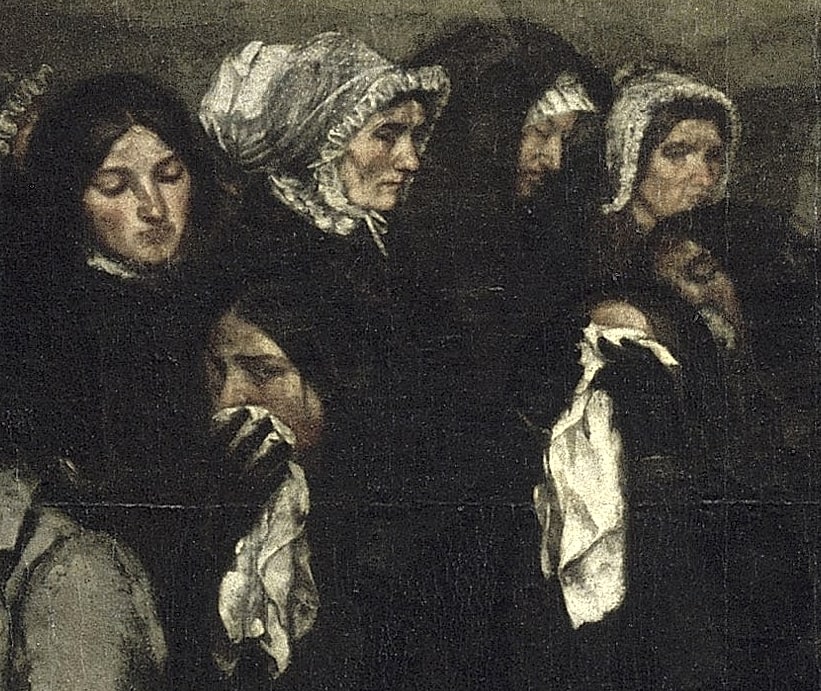
Separated from the men, the local women complete the gathering on the right side of the canvas. Among them are Courbet's sisters: Juliette crying into a handkerchief, Zoé covering her face, and Zélie lost in thought. On the far right edge, Courbet's mother holds a small child by the hand. Two veterans of the 1793 revolution stand near the grave in Jacobin attire. On the far left edge stands Courbet's grandfather, Jean-Antoine Oudot, a republican veteran who died in 1848. Though Oudot's death may have prompted the work, Courbet depicted him alive as a witness to his own funeral.
Technique and Artistic Departure
Courbet abandoned the idealised formulas of academic art and traditional history painting. He omitted Baroque dramatic effects, emotional theatricality, and classical pyramidal compositions such as those used in Benjamin West's The Death of General Wolfe. Instead, he used a democratic compositional structure without a central heroic figure. Every element carries equal weight, making a village dog in the foreground as prominent as the mayor or priest. Courbet derived his simple arrangement from popular art forms, including song sheets, broadsides, and almanacs.
The painting relies on a restrained palette dominated by black, white, and dirty grays, fractured by the bright red robes of the beadles. Courbet applied pigment using a palette knife to quickly place and unify large daubs of paint across the surface. This technique created a roughly wrought texture that departed from traditional academic illusionism. Traditional contemporaries viewed these direct methods as crude and unrefined, describing Courbet as a primitive who committed brutalities against established technique. Courbet maintained that painting is a concrete art that must deal only with real, existing things visible on the retina.
Salon Reception and Scandal
When exhibited at the Paris Salon of 1850-51, A Burial at Ornans caused immediate outrage among traditional viewers and critics. The public objected to the coarse depiction of provincial figures. Courbet documented unkempt hair, bulbous noses, grotesquely wrinkled faces, and the red faces of the beadles without idealisation. Critics accused him of pursuing a cult of ugliness and producing an undignified, godless caricature. The core of the controversy was Courbet's decision to treat a village genre scene with the monumental scale reserved for state events and heroic narratives.
The painting also carried political implications under the Second Republic. Critics viewed the unvarnished depiction of the provincial bourgeoisie as a political threat, recognizing the voting power of rural populations. Conservative reviewers labelled the work as overly socialist. Courbet defended his approach in 1851, stating that he was a Realist because Realist meant a sincere lover of the honest truth. He rejected academic depictions of invisible subjects, famously noting that he had never seen angels and would only paint one if shown an angel.
The Pavilion of Realism
In 1855, the academic jury for the Exposition Universelle rejected two paintings submitted by Courbet: A Burial at Ornans and The Stone Breakers. The jury deemed the works too large and politically coarse. In response, Courbet withdrew all his accepted works and constructed a private exhibition building outside the official grounds. Calling his space the Pavilion of Realism, Courbet staged the first independent one-man exhibition in art history. Inside, he presented his works alongside a written manifesto defining his philosophy of Realism.
Courbet's rejection of academic theatricality influenced younger artists, including future Impressionists like Claude Monet and Auguste Renoir, who observed his bold palette and heavy pigment application. In 1857, the art critic Champfleury defended A Burial at Ornans, writing that while it represents a small-town funeral, it reproduces the funerals of all small towns. By capturing the unadorned realities of daily existence in rural France, Courbet established a new path for modern painting.


.jpg)