


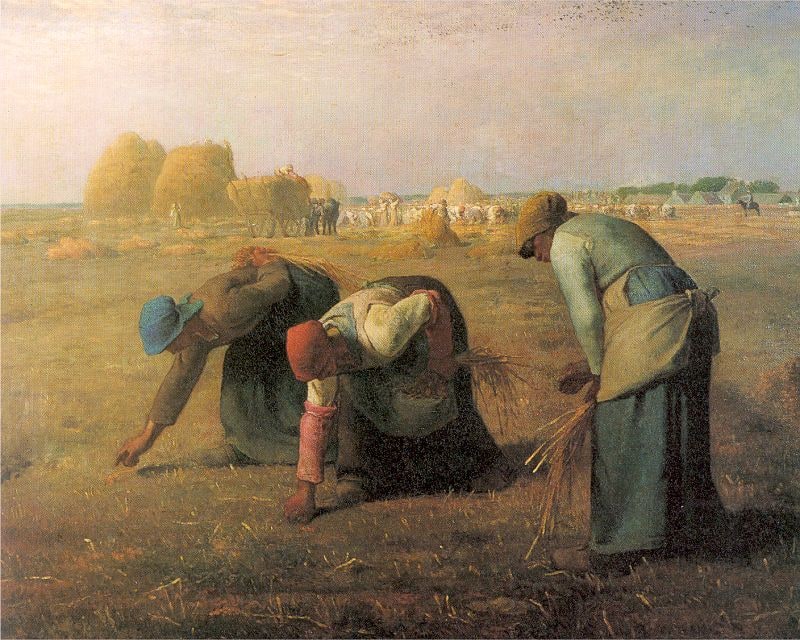
In his 1857 oil painting The Gleaners, Jean-François Millet depicts three impoverished peasant women bent over a harvested field, collecting remaining scraps of wheat. The work combines detailed rural observation with direct commentary on social inequality in nineteenth-century France.
Composition and Subject Description
In The Gleaners, painted in 1857, Jean-François Millet places three peasant women squarely in the foreground of a wide, open field. The women perform the backbreaking and tedious work of collecting the scanty remains left behind after a wheat harvest. Their figures are heavy, shown with curved backs and anonymous faces as they scour the newly harvested ground. Each woman bends low to gather leftover grain, filling her apron with whatever slim pickings can be found. Millet used simplified, sculptural forms to depict these labourers, giving their physical posture a monumental quality that dominates the lower portion of the canvas.
The background of the canvas creates a spatial contrast with the three central figures in the foreground. In the distance, along a flat horizon bordered by haystacks, cottages, trees, and small figures of workers, the main harvesters are busy loading up a plentiful crop onto wagons. A cool, golden light illuminates the entire countryside scene, exposing the vast gap between the abundant harvest gathered for the landowners and the sparse leftovers left for the poor. By placing the impoverished women in front against a broad sky, Millet ensured that their labour remains the primary focus of the viewer.
The Practice and Social Context of Gleaning
Gleaning was an established rural practice in France, historically permitted by landowning nobles for the lowest level of peasant society. After the primary crop was reaped and gathered, impoverished individuals were allowed onto the land to collect any remaining scraps of wheat. The task was time-consuming and physically demanding, yet essential for the survival of the poorest rural families. Millet documented this custom during a historical period when traditional countryside routines were beginning to be displaced by the growth of the Industrial Revolution.
Prior to Millet's painting, gleaning had typically been represented in Western art through religious history, most notably the Old record story of Ruth. In those earlier artistic traditions, Ruth was depicted as a modest, virtuous woman, placing the practice within a framework of moral piety. Millet broke away from these traditional conventions by presenting gleaning with flagrant realism. Rather than offering a biblical narrative, he depicted the harsh physical reality of rural poverty, showing anonymous women engaged in tedious physical labour without idealised divine intervention.
Millet and the Barbizon School
Jean-François Millet was born in 1814 into a prosperous farming family in northern France. He initially pursued artistic training locally before moving to Paris in his early twenties to continue his education at the École des Beaux-Arts under the painter Paul Delaroche. During his early years in Paris, Millet worked primarily as a portrait painter. However, following the political upheavals of the 1848 French Revolution, he decided to leave the capital and relocated to the small village of Barbizon, situated near Fontainebleau Forest.
In Barbizon, Millet became a central figure among a group of artists known as the Barbizon School, who specialised in detailed pictures of the countryside and forest environments. While many of his contemporaries focused strictly on scenery details, Millet brought his own rural background to bear on his subjects, identifying with the hard lot of the country poor. He concentrated on painting scenes of rural life, depicting agricultural workers with empathy and solemn grandeur that elevated working-class subjects to a monumental scale.
Political Controversy and Public Reaction
When Millet exhibited The Gleaners in Paris, the painting provoked strong disdain and suspicion among conservative thinkers and the French public. In the aftermath of the 1848 revolution, the prosperous middle class and landowning elites were alarmed by depictions that invested the poor with dignity and monumentality. Middle-class landowners were increasingly resisting the traditional granting of gleaning rights, fearing the rural poor and linking them to the newly emerging, politically active urban working class.
Conservative critics viewed Millet's depiction of working-class poverty as a subversive political statement and a direct criticism of French social structures. They condemned what they perceived as an improper glorification of peasants and the working poor. During this period, prominent political writers such as Karl Marx and Friedrich Engels, alongside novelists including Émile Zola and Charles Dickens, were actively championing the working class, making Millet's artistic subjects deeply contentious among middle-class viewers.
Despite this hostility from conservative quarters, other contemporary viewers and socialist commentators strongly defended Millet's work. Admirers praised his bold stance and artistic approach, viewing The Gleaners as a celebration of honest, hard-working lives rather than a political threat. They appreciated his empathy for agricultural labourers and his use of surprisingly varied colours to convey the dignity of peasant life.
Style, Technique, and Modernity
Measuring approximately 83.5 by 111 centimetres, The Gleaners demonstrates Millet's mastery of oil on canvas technique. The painter achieved a calm atmosphere across the surrounding countryside through a balanced composition and a refined palette of earthy tones, muted yellows, and soft blues. His preliminary drawings for the composition show a sculptural simplification of form, reducing complex figures to heavy, solid shapes that emphasise their intimacy with the land and the physical gravity of their pose.
By portraying the reality of rural labour without academic polish, Millet represented a broader transition from traditional academic painting to Naturalism and Realism, paving the way towards modern art. Although his paintings retained a certain sentimentality compared to the uncompromising works of Gustave Courbet, Millet's realistic treatment of peasant life altered how working people were portrayed in art history. Today, The Gleaners is housed in the Musée d'Orsay in Paris, where it remains a central work of nineteenth-century French painting.


