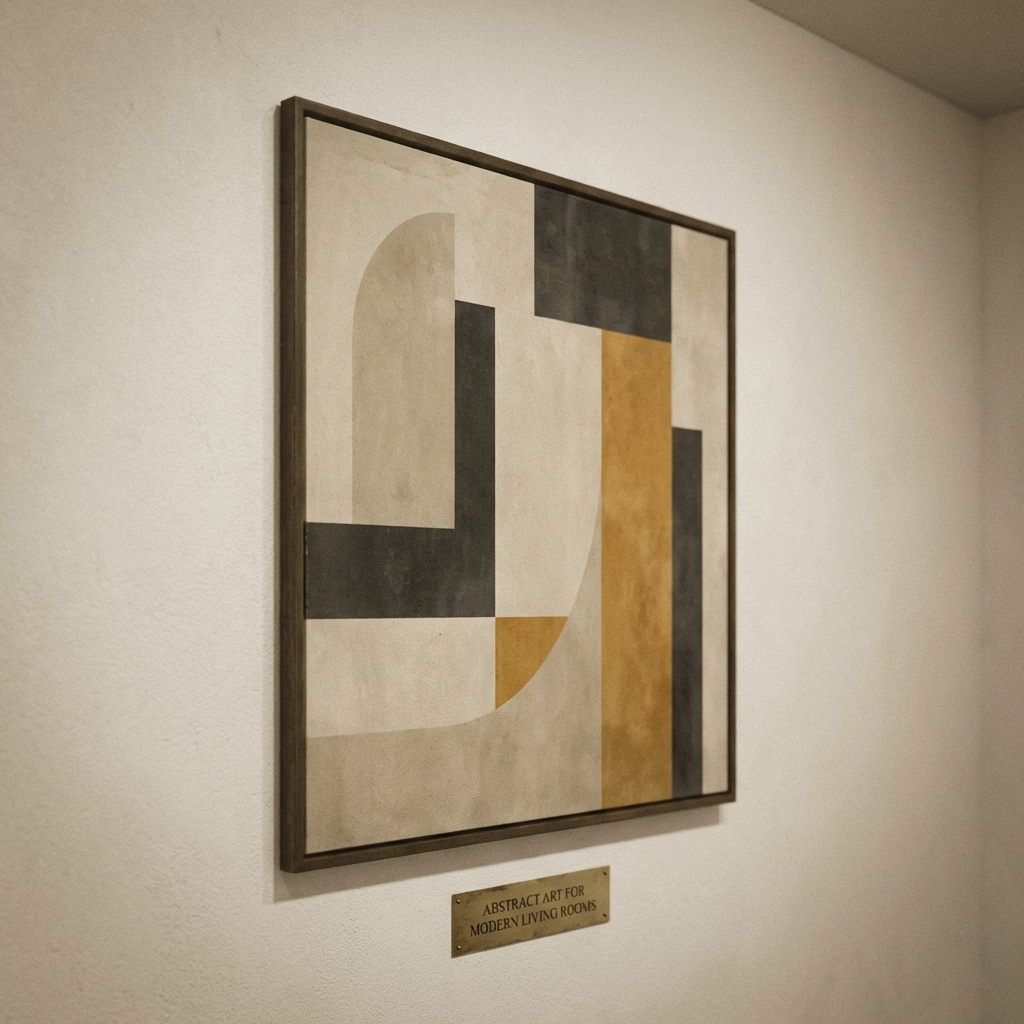
In the landscape of modern interior design, the living room serves as the primary gallery of the home. It is where personal taste meets public presentation, a space that demands a focal point capable of sparking conversation without overwhelming the senses. Abstract art, with its detachment from literal representation, offers the perfect solution for contemporary British homes. Whether your aesthetic leans towards the stark minimalism of industrial lofts or the warm textures of mid-century modern revival, abstract prints provide a sophisticated visual language that transcends trends.
Choosing the right abstract piece is less about matching colours and more about balancing energy. A chaotic, dynamic composition can invigorate a neutral room, while structured geometric forms can bring order to an eclectic space. In this curator’s guide, we explore three distinct approaches to integrating abstract art into your modern living room, featuring timeless works from the Bauhaus movement, the spiritual depth of Paul Klee, and the bold simplicity of the avant-garde.
1. Geometric Precision and Primary Colours
For living rooms defined by clean lines and functional furniture, geometric abstraction is a natural companion. The De Stijl movement, led by Piet Mondrian, championed the use of pure primary colours and rigid grid structures to achieve universal harmony. These pieces work exceptionally well in white-walled spaces where the artwork acts as an architectural element rather than mere decoration.

The clarity of Mondrian’s compositions echoes the principles of the Bauhaus school, which sought to unify art, craft, and technology. A framed print featuring strong vertical and horizontal lines can visually expand a room, making ceilings feel higher or walls wider. When styling such bold geometry, opt for low-profile furniture and avoid competing patterns in your soft furnishings. Let the artwork command the space.
2. Organic Forms and Lyrical Abstraction
Not all modern living rooms require rigid structure. For spaces that utilise natural materials-such as linen, wood, and rattan-organic abstraction offers a softer, more poetic touch. Paul Klee was a master of this style, blending cubist fragmentation with a childlike sense of wonder and deep colour theory. His works often feel like musical compositions translated onto canvas, full of rhythm and vibration.
Klee’s Composition VIII (by his contemporary Wassily Kandinsky, shown above) exemplifies the shift from static geometry to dynamic movement. The floating forms and intersecting lines create a sense of weightlessness, perfect for softening the hard edges of modern architecture. Similarly, the organic shapes found in the work of Henri Matisse-particularly his later cut-outs-bring a sense of joy and fluidity. These pieces are ideal for 'breaking' the grid of a gallery wall or acting as a standalone statement above a velvet sofa.
3. The Power of Monochrome Minimalism
There is a profound confidence in silence. For the ultra-modern living room, where the palette is often restricted to greys, blacks, and whites, the Suprematist movement offers the ultimate statement. Kazimir Malevich’s Black Square is widely considered the 'zero point' of painting-a total rejection of objective reality in favour of pure feeling.
While a total black void might be too severe for some, the principle remains: high-contrast, monochrome abstract art creates an immediate anchor in a room. It draws the eye without introducing clashing colours. This approach pairs beautifully with the industrial textures of concrete or exposed brick often found in converted UK properties. For a slightly more playful take on bold simplicity, consider the dots and nets of Yayoi Kusama or the graphic punch of Pop Art, which often utilises high-contrast abstraction to capture the modern zeitgeist.
Curating Your Abstract Collection
When selecting abstract art for your living room, consider the 'temperature' of the piece. Does the room need the warmth of Klee’s earth tones or the cool, intellectual distance of Mondrian’s grids? Remember that abstract art is subjective; its power lies in what it evokes in you, the viewer. Whether you choose a classic museum-grade print or a series of smaller geometric studies, the goal is to create a space that feels both curated and lived-in.