

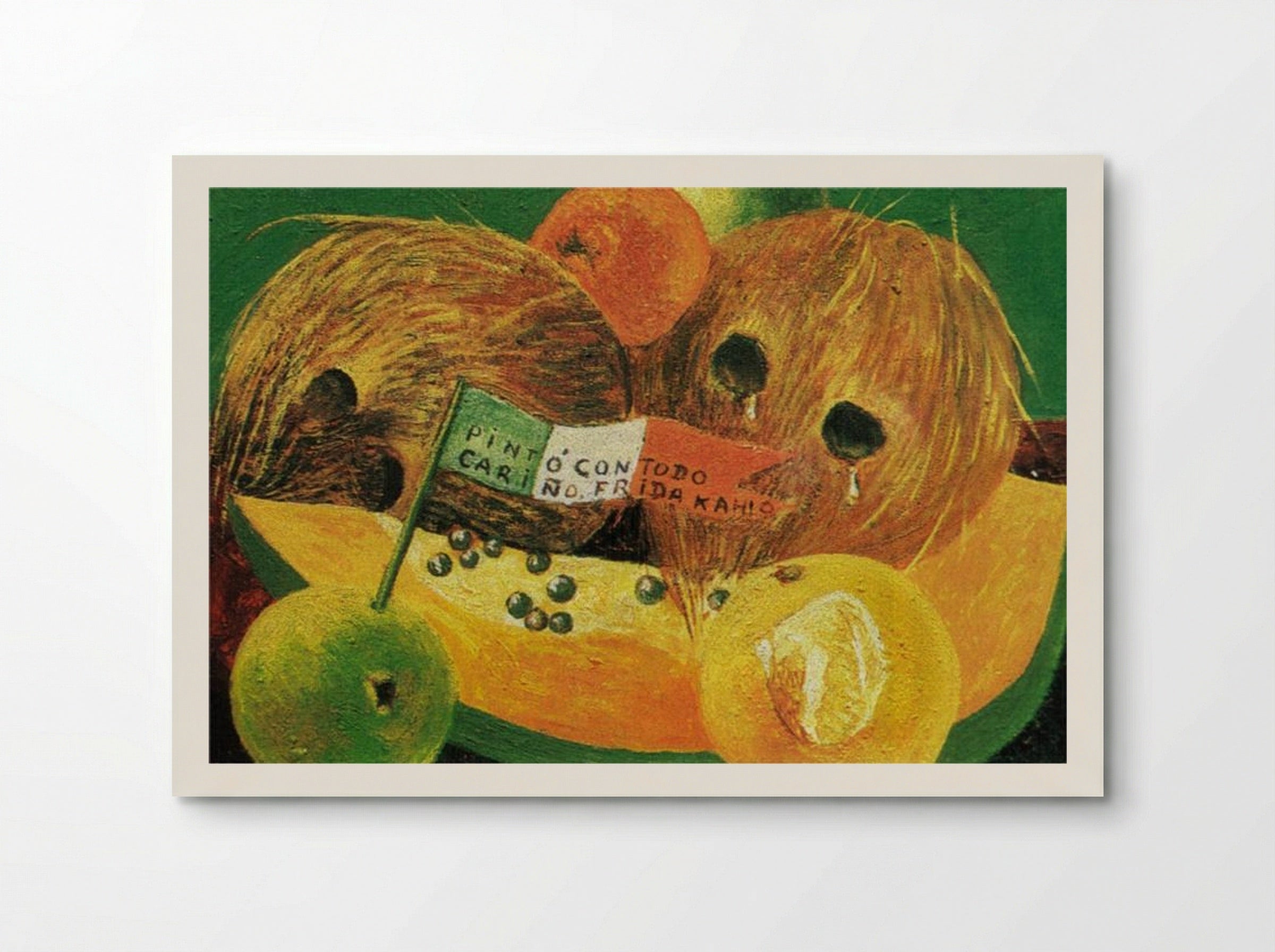
Weeping Coconuts - Frida Kahlo
Archival giclée
Frames arrive ready to hang
Secure checkout
Made to order
Description
A 1951 still life by Frida Kahlo featuring anthropomorphised coconuts shedding tears, accompanied by a personal inscription on a small Mexican flag.
Frida Kahlo painted Weeping Coconuts in 1951, a period during which her health was in decline and her work became increasingly focused on still life subjects. This composition features two coconuts, anthropomorphised with facial features, appearing to shed tears. The fruit is presented alongside a slice of papaya and other produce, set against a dark, dense green background. A small Mexican flag is inserted into the arrangement, bearing the inscription: 'Pinto con todo cariño, Frida Kahlo' (I paint with all affection, Frida Kahlo). The work reflects Kahlo's tendency to imbue inanimate objects with human emotion and personal narrative. By transforming the coconuts into weeping figures, she externalises her physical suffering and emotional state. The texture of the coconut husks is rendered with short, deliberate brushstrokes, contrasting with the smoother, flatter application of paint on the papaya and the flag. The inclusion of the flag serves as a direct address to the viewer, grounding the surreal elements in a specific, personal context. The colour palette is dominated by earthy browns, deep greens, and the bright yellow of the fruit, creating a sombre yet visually arresting image. This piece is characteristic of Kahlo's later still life paintings, where the boundaries between the botanical and the psychological are blurred. The work avoids the grand scale of her earlier self-portraits, focusing instead on the intimate and the domestic. It remains a clear example of her ability to use traditional genres to communicate complex internal experiences. The painting is currently held in a private collection, representing a specific moment in the artist's career where her output was defined by a quiet, reflective intensity.
Return policy
Because every print is made to order, we don't offer change-of-mind returns, refunds or exchanges. If your order arrives faulty, damaged or incorrect, we'll replace it free of charge — just contact us within 48 hours of delivery. See our refunds page for full details.
Shipping
We ship worldwide, printing at the production hub nearest to your delivery address. Delivery times and costs vary by destination — you'll see the options available to you at checkout.
Manufacturing
Each print is produced to order using 12-colour giclée printing on FSC-certified archival paper. Designed in Britain and printed at your nearest production hub to reduce waste and speed up delivery.
Weeping Coconuts - Frida Kahlo

Artist Biography
Frida Kahlo
She had already been ill. Polio at six left her right leg thinner than her left, a disproportion she hid with long skirts. The bus accident compounded everything. She would have thirty-five operations over her lifetime. Pain was the background condition of her work, though reducing her paintings to autobiography misses what she actually did with the medium.
She married Diego Rivera in 1929. He was twenty years older, already Mexico's most famous muralist, and physically twice her size. Her parents called the marriage a union between an elephant and a dove. They divorced in 1939, remarried in 1940, and continued a relationship that was mutually unfaithful, politically intense, and artistically competitive. Rivera said she was the better painter. He may have been right.
Her paintings are small. Most are self-portraits. They use the visual language of Mexican folk art, ex-votos, and Aztec mythology, combined with a physical directness that makes Surrealism look polite. Andre Breton called her a Surrealist. She disagreed: 'I paint my own reality.' She was right about that too.
She died in 1954 at forty-seven. Her diary entry for the last day reads 'I hope the leaving is joyful and I hope never to return.'
Our Features
Designed for Lasting Impact
Specific Features
Every Solis piece is made to order with archival, gallery-quality materials built to last.
- Museum-grade giclée printing for rich, fade-resistant colour
- Archival matte fine-art paper, FSC-certified
- Multiple sizes and framing options available
- Frames in black, natural wood, dark wood or white
- Framed prints arrive ready to hang
Care & Cleaning
To keep your artwork looking its best:
- Dust gently with a soft, dry cloth
- Avoid prolonged direct sunlight
- Never use liquid cleaners on the print or canvas surface
- Keep in a dry, room-temperature space
- Handle prints with clean, dry hands
Materials & Sizing
Museum-grade giclée on FSC-certified archival matte paper, with framed and canvas options.
- Paper sizes: A4, A3, A2, A1, A0 and B2 (50×70 cm)
- Canvas: XS (20×30 cm) to Large (60×90 cm)
- Frames: black, natural wood, dark wood or white
Why Choose Us ?
Damage-free delivery guarantee
Fast Shipping
Museum-Quality Materials
Artist Biography
Frida Kahlo
She had already been ill. Polio at six left her right leg thinner than her left, a disproportion she hid with long skirts. The bus accident compounded everything. She would have thirty-five operations over her lifetime. Pain was the background condition of her work, though reducing her paintings to autobiography misses what she actually did with the medium.
She married Diego Rivera in 1929. He was twenty years older, already Mexico's most famous muralist, and physically twice her size. Her parents called the marriage a union between an elephant and a dove. They divorced in 1939, remarried in 1940, and continued a relationship that was mutually unfaithful, politically intense, and artistically competitive. Rivera said she was the better painter. He may have been right.
Her paintings are small. Most are self-portraits. They use the visual language of Mexican folk art, ex-votos, and Aztec mythology, combined with a physical directness that makes Surrealism look polite. Andre Breton called her a Surrealist. She disagreed: 'I paint my own reality.' She was right about that too.
She died in 1954 at forty-seven. Her diary entry for the last day reads 'I hope the leaving is joyful and I hope never to return.'
You May Also Like