

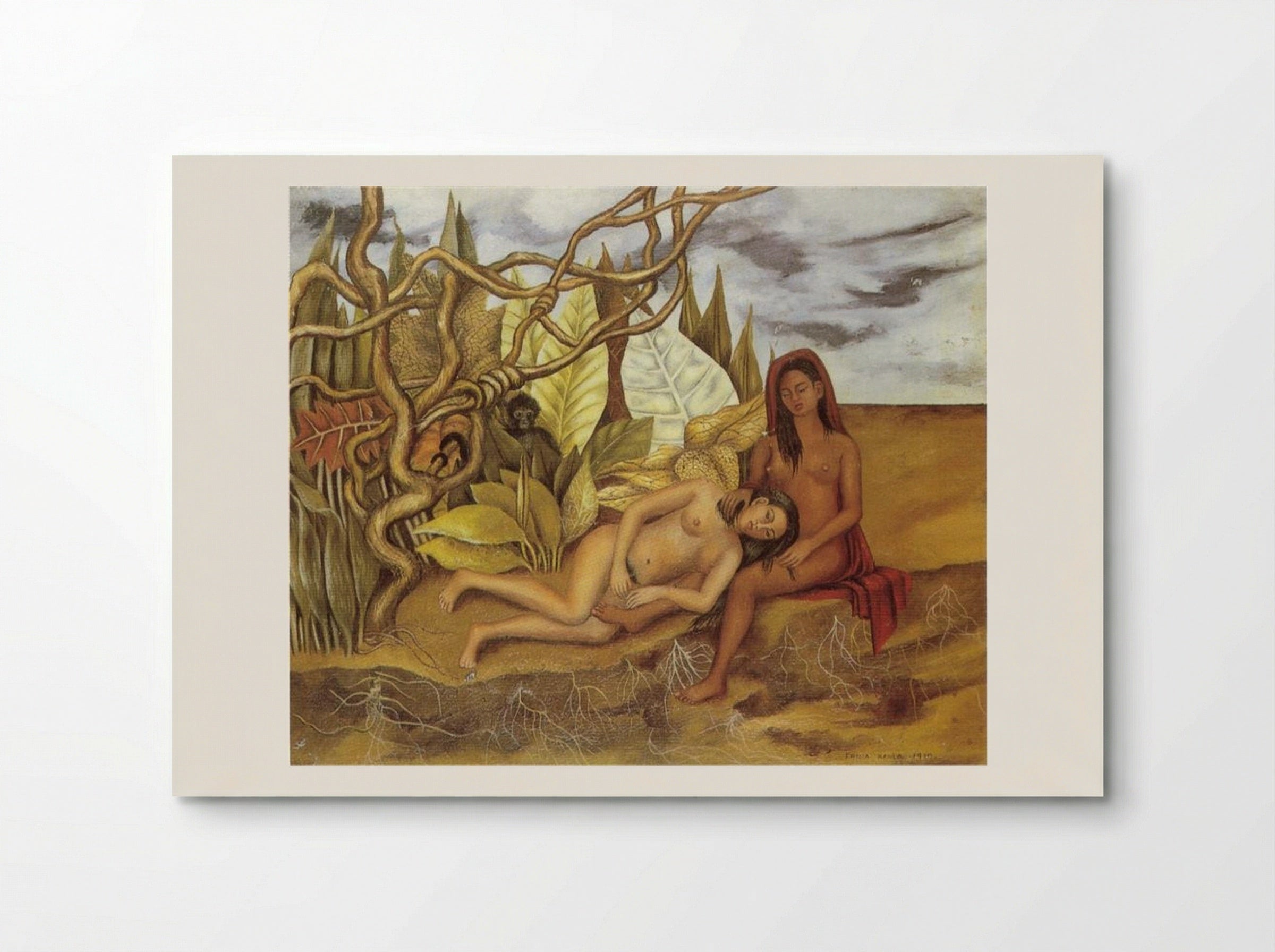
Two Nudes in the Forest (The Earth Itself) - Frida Kahlo
Archival giclée
Frames arrive ready to hang
Secure checkout
Made to order
Description
A 1939 oil painting by Frida Kahlo exploring themes of duality, identity, and the connection between the human form and the natural world.
Painted in 1939, Two Nudes in the Forest (The Earth Itself) is a significant work by Frida Kahlo. It depicts two female figures, one with lighter skin and one with darker skin, resting within a dense, stylised thicket. The composition is divided between the lush, overgrown vegetation on the left and a barren, open expanse on the right. A small monkey, a recurring motif in Kahlo's work, peers from behind the large leaves. The painting demonstrates Kahlo's interest in duality and identity. The two figures are often interpreted as representations of the artist's own fractured sense of self, reflecting her mixed European and Mexican heritage. The contrast between the protective, leafy environment and the exposed, dry ground suggests a tension between safety and vulnerability. Kahlo employs a flattened perspective, which draws focus to the symbolic elements rather than realistic depth. The roots visible beneath the soil connect the figures directly to the earth, reinforcing the title's emphasis on the natural world as a grounding force. Technically, the work is executed on metal, a choice that allowed for a smooth surface and precise application of paint. The colour palette is dominated by earthy ochres, deep greens, and muted browns, which create a sombre, reflective mood. The figures are rendered with a deliberate lack of idealisation, maintaining a raw, honest quality that is characteristic of Kahlo's approach to portraiture. This piece offers a window into the artist's internal world, where personal history and cultural symbolism merge. It remains a compelling example of how Kahlo used her own experiences to explore broader themes of belonging, heritage, and the human condition.
Return policy
Because every print is made to order, we don't offer change-of-mind returns, refunds or exchanges. If your order arrives faulty, damaged or incorrect, we'll replace it free of charge — just contact us within 48 hours of delivery. See our refunds page for full details.
Shipping
We ship worldwide, printing at the production hub nearest to your delivery address. Delivery times and costs vary by destination — you'll see the options available to you at checkout.
Manufacturing
Each print is produced to order using 12-colour giclée printing on FSC-certified archival paper. Designed in Britain and printed at your nearest production hub to reduce waste and speed up delivery.
Care and materials
Specific Features
Every Solis piece is made to order with archival, gallery-quality materials built to last.
- Museum-grade giclée printing for rich, fade-resistant colour
- Archival matte fine-art paper, FSC-certified
- Multiple sizes and framing options available
- Frames in black, natural wood, dark wood or white
- Framed prints arrive ready to hang
Care & Cleaning
To keep your artwork looking its best:
- Dust gently with a soft, dry cloth
- Avoid prolonged direct sunlight
- Never use liquid cleaners on the print or canvas surface
- Keep in a dry, room-temperature space
- Handle prints with clean, dry hands
Materials & Sizing
Museum-grade giclée on FSC-certified archival matte paper, with framed and canvas options.
- Paper sizes: A4, A3, A2, A1, A0 and B2 (50×70 cm)
- Canvas: XS (20×30 cm) to Large (60×90 cm)
- Frames: black, natural wood, dark wood or white
Two Nudes in the Forest (The Earth Itself) - Frida Kahlo

Artist Biography
Frida Kahlo
She had already been ill. Polio at six left her right leg thinner than her left, a disproportion she hid with long skirts. The bus accident compounded everything. She would have thirty-five operations over her lifetime. Pain was the background condition of her work, though reducing her paintings to autobiography misses what she actually did with the medium.
She married Diego Rivera in 1929. He was twenty years older, already Mexico's most famous muralist, and physically twice her size. Her parents called the marriage a union between an elephant and a dove. They divorced in 1939, remarried in 1940, and continued a relationship that was mutually unfaithful, politically intense, and artistically competitive. Rivera said she was the better painter. He may have been right.
Her paintings are small. Most are self-portraits. They use the visual language of Mexican folk art, ex-votos, and Aztec mythology, combined with a physical directness that makes Surrealism look polite. Andre Breton called her a Surrealist. She disagreed: 'I paint my own reality.' She was right about that too.
She died in 1954 at forty-seven. Her diary entry for the last day reads 'I hope the leaving is joyful and I hope never to return.'
Why Choose Us ?
Damage-free delivery guarantee
Fast Shipping
Museum-Quality Materials
You May Also Like