

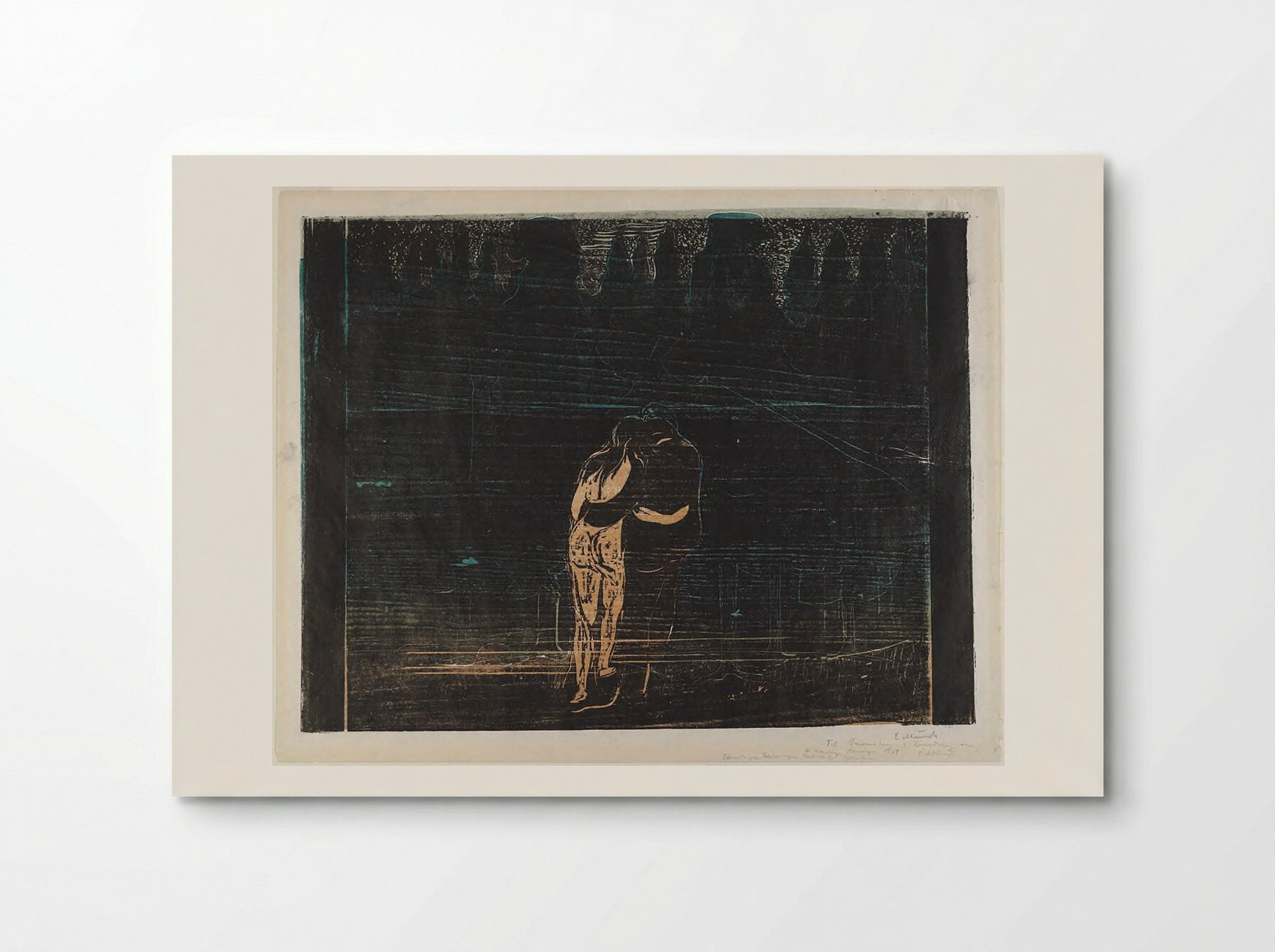
Towards the Forest I - Edvard Munch
Archival giclée
Frames arrive ready to hang
Secure checkout
Made to order
Description
A striking woodcut by Edvard Munch, capturing a couple at the edge of a dark, textured forest through high-contrast forms and expressive lines.
Edvard Munch produced Towards the Forest I in 1897, a period during which he experimented heavily with the woodcut medium. This work belongs to a series of prints that explore the psychological tension between human figures and their environment. The composition features a couple standing at the edge of a dark, dense forest. The figures are rendered with minimal detail, their forms merging into the surrounding shadows. This lack of definition forces the viewer to focus on the emotional weight of their proximity rather than their individual identities. Munch utilised the physical properties of the woodblock to create the texture of the forest. The grain of the wood is visible throughout the dark areas, providing a tactile quality that contrasts with the smoother, lighter forms of the couple. The stark use of black ink against the natural tone of the paper creates a high-contrast image that feels both claustrophobic and expansive. The forest acts as a psychological barrier, a space of mystery and potential danger that the figures are drawn towards. Technically, this print demonstrates Munch's innovative approach to printmaking. He often sawed his woodblocks into several pieces, inked them separately, and reassembled them before printing. This allowed him to introduce different colours and tones within a single impression. In this specific work, the focus remains on the interplay between the light-coloured figures and the overwhelming darkness of the trees. The result is an image that captures a sense of unease and longing, themes that recur throughout Munch's career. By stripping away unnecessary detail, he directs attention to the raw emotional state of the subjects. This print remains a significant example of how Munch used traditional techniques to convey modern psychological states.
Return policy
Because every print is made to order, we don't offer change-of-mind returns, refunds or exchanges. If your order arrives faulty, damaged or incorrect, we'll replace it free of charge — just contact us within 48 hours of delivery. See our refunds page for full details.
Shipping
We ship worldwide, printing at the production hub nearest to your delivery address. Delivery times and costs vary by destination — you'll see the options available to you at checkout.
Manufacturing
Each print is produced to order using 12-colour giclée printing on FSC-certified archival paper. Designed in Britain and printed at your nearest production hub to reduce waste and speed up delivery.
Towards the Forest I - Edvard Munch

Artist Biography
Edvard Munch
Munch, a leading figure in both the Symbolism and Expressionism movements, sought to externalise internal states. His art became a canvas for raw emotion, exploring themes of love, death, and existential dread. He achieved this through bold colours, distorted forms, and a distinctive use of line that conveys a sense of perpetual motion and unease. Works like 'The Sick Child II' and 'The Voice / Summer Night' exemplify his ability to capture fleeting moments of intense feeling.
Munch's unflinching exploration of the human condition continues to resonate deeply. His art speaks to the anxieties and uncertainties of modern life, making his prints a powerful and evocative addition to any collection. His enduring influence can be seen in countless artists who have followed in his footsteps, daring to confront the darker aspects of the human experience. Owning a Munch print is not just acquiring a piece of art; it's embracing a conversation about what it means to be human.
Our Features
Designed for Lasting Impact
Specific Features
Every Solis piece is made to order with archival, gallery-quality materials built to last.
- Museum-grade giclée printing for rich, fade-resistant colour
- Archival matte fine-art paper, FSC-certified
- Multiple sizes and framing options available
- Frames in black, natural wood, dark wood or white
- Framed prints arrive ready to hang
Care & Cleaning
To keep your artwork looking its best:
- Dust gently with a soft, dry cloth
- Avoid prolonged direct sunlight
- Never use liquid cleaners on the print or canvas surface
- Keep in a dry, room-temperature space
- Handle prints with clean, dry hands
Materials & Sizing
Museum-grade giclée on FSC-certified archival matte paper, with framed and canvas options.
- Paper sizes: A4, A3, A2, A1, A0 and B2 (50×70 cm)
- Canvas: XS (20×30 cm) to Large (60×90 cm)
- Frames: black, natural wood, dark wood or white
Why Choose Us ?
Damage-free delivery guarantee
Fast Shipping
Museum-Quality Materials
Artist Biography
Edvard Munch
Munch, a leading figure in both the Symbolism and Expressionism movements, sought to externalise internal states. His art became a canvas for raw emotion, exploring themes of love, death, and existential dread. He achieved this through bold colours, distorted forms, and a distinctive use of line that conveys a sense of perpetual motion and unease. Works like 'The Sick Child II' and 'The Voice / Summer Night' exemplify his ability to capture fleeting moments of intense feeling.
Munch's unflinching exploration of the human condition continues to resonate deeply. His art speaks to the anxieties and uncertainties of modern life, making his prints a powerful and evocative addition to any collection. His enduring influence can be seen in countless artists who have followed in his footsteps, daring to confront the darker aspects of the human experience. Owning a Munch print is not just acquiring a piece of art; it's embracing a conversation about what it means to be human.
You May Also Like