

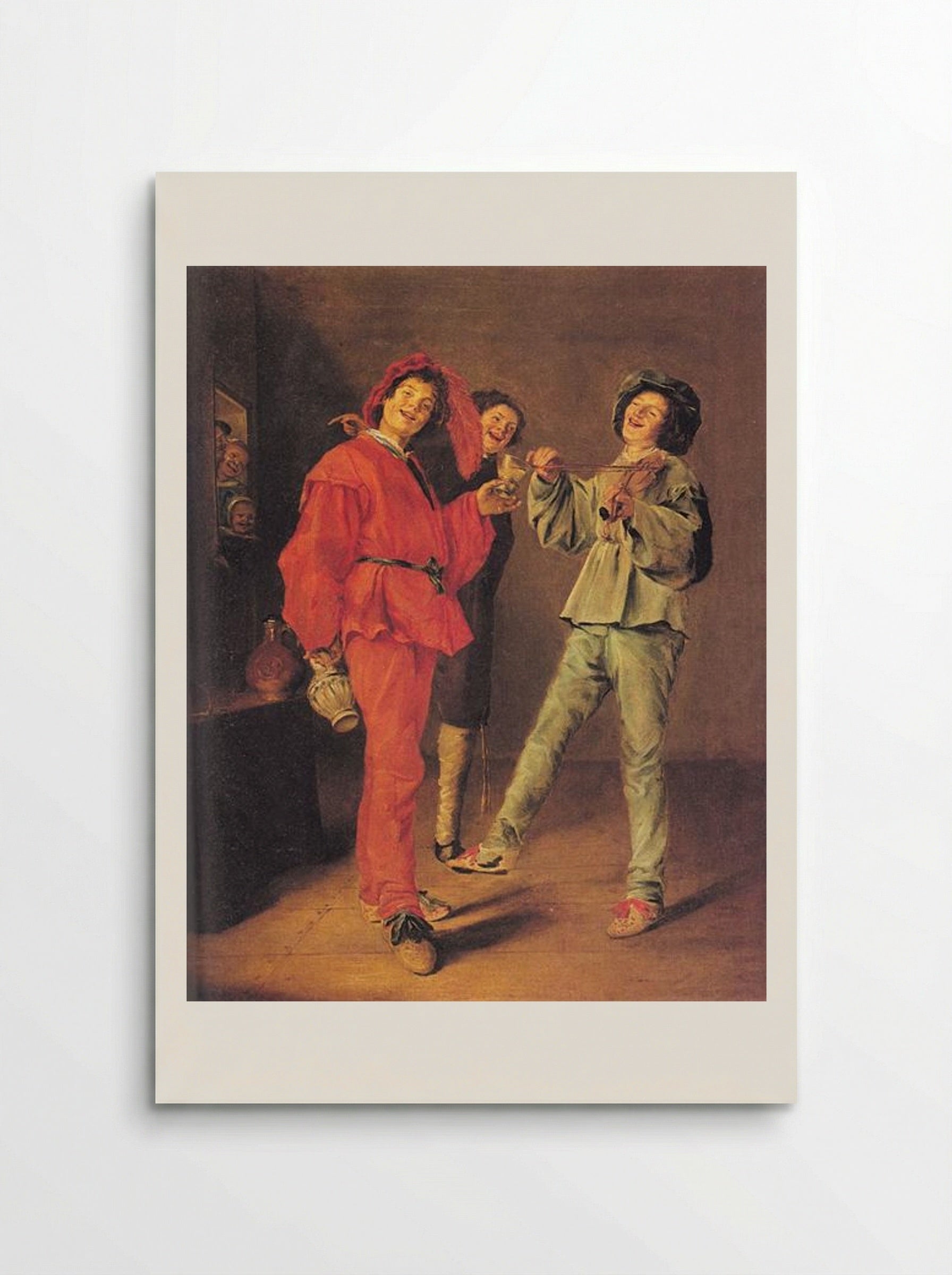
Three Boys Merry-making - Judith Leyster
Archival giclée
Frames arrive ready to hang
Secure checkout
Made to order
Description
A lively genre scene by Dutch Golden Age painter Judith Leyster, capturing three youths in a moment of musical celebration and laughter.
Judith Leyster, a significant figure of the Dutch Golden Age, produced this work during her early career in Haarlem. The painting depicts three youths engaged in a musical performance, capturing a moment of spontaneous joy. The central figure, dressed in a striking red costume with a feathered cap, holds a glass and a jug, while his companion to the right plays a violin. A third figure stands between them, laughing, which adds to the sense of camaraderie and informal atmosphere typical of Leyster's genre scenes. Leyster employs a tenebrist approach to lighting, where the figures emerge from a dark, neutral background. This technique directs the viewer's attention to the expressive faces and the textures of the clothing. The composition is balanced, with the figures arranged to suggest movement and interaction. In the background, a small window reveals additional figures peering in, a common device in Dutch genre painting to suggest a wider social context or to add a layer of narrative curiosity. The brushwork is confident and fluid, demonstrating Leyster's technical skill in rendering fabric and human expression. This piece reflects the interest of seventeenth-century Dutch artists in everyday life and social pastimes. Leyster was one of the few women admitted to the Haarlem Guild of Saint Luke, and her work often shares stylistic similarities with Frans Hals, though she maintained a distinct approach to characterisation and light. The painting remains a clear example of her ability to animate a scene through gesture and facial expression, avoiding static poses in favour of a dynamic, fleeting moment. The palette is dominated by warm, earthy tones, punctuated by the bold red of the central figure's attire, which provides a visual anchor for the composition.
Return policy
Because every print is made to order, we don't offer change-of-mind returns, refunds or exchanges. If your order arrives faulty, damaged or incorrect, we'll replace it free of charge — just contact us within 48 hours of delivery. See our refunds page for full details.
Shipping
We ship worldwide, printing at the production hub nearest to your delivery address. Delivery times and costs vary by destination — you'll see the options available to you at checkout.
Manufacturing
Each print is produced to order using 12-colour giclée printing on FSC-certified archival paper. Designed in Britain and printed at your nearest production hub to reduce waste and speed up delivery.
Three Boys Merry-making - Judith Leyster

Artist Biography
Judith Leyster
She was one of the first women admitted to the Haarlem Guild of St Luke, in 1633, at twenty-four. She ran her own workshop and trained students. When one of her apprentices left to join Frans Hals's workshop without Guild permission, she sued Hals. The case was settled: the student's mother paid four guilders in damages. Leyster had asked for eight.
Her best paintings were made in the seven years between 1629 and 1636. The Jolly Toper, Self-Portrait, The Proposition: they are warm, confident, technically assured, painted in a style close to Hals's but with a subtlety of expression that is entirely her own. The Proposition, showing a woman by lamplight being offered money by a man leaning over her shoulder, is one of the most psychologically complex genre paintings of the Dutch Golden Age.
In 1636 she married the painter Jan Miense Molenaer. After the marriage, painting gave way to children and household management. She probably contributed to her husband's workshop, but she stopped signing work in her own name. The solo career lasted seven years.
After her death in 1660 her work was systematically attributed to Hals. The misattribution lasted until 1893, when a painting that had been admired for over a century as a Hals was recognised as hers.
Our Features
Designed for Lasting Impact
Specific Features
Every Solis piece is made to order with archival, gallery-quality materials built to last.
- Museum-grade giclée printing for rich, fade-resistant colour
- Archival matte fine-art paper, FSC-certified
- Multiple sizes and framing options available
- Frames in black, natural wood, dark wood or white
- Framed prints arrive ready to hang
Care & Cleaning
To keep your artwork looking its best:
- Dust gently with a soft, dry cloth
- Avoid prolonged direct sunlight
- Never use liquid cleaners on the print or canvas surface
- Keep in a dry, room-temperature space
- Handle prints with clean, dry hands
Materials & Sizing
Museum-grade giclée on FSC-certified archival matte paper, with framed and canvas options.
- Paper sizes: A4, A3, A2, A1, A0 and B2 (50×70 cm)
- Canvas: XS (20×30 cm) to Large (60×90 cm)
- Frames: black, natural wood, dark wood or white
Why Choose Us ?
Damage-free delivery guarantee
Fast Shipping
Museum-Quality Materials
Artist Biography
Judith Leyster
She was one of the first women admitted to the Haarlem Guild of St Luke, in 1633, at twenty-four. She ran her own workshop and trained students. When one of her apprentices left to join Frans Hals's workshop without Guild permission, she sued Hals. The case was settled: the student's mother paid four guilders in damages. Leyster had asked for eight.
Her best paintings were made in the seven years between 1629 and 1636. The Jolly Toper, Self-Portrait, The Proposition: they are warm, confident, technically assured, painted in a style close to Hals's but with a subtlety of expression that is entirely her own. The Proposition, showing a woman by lamplight being offered money by a man leaning over her shoulder, is one of the most psychologically complex genre paintings of the Dutch Golden Age.
In 1636 she married the painter Jan Miense Molenaer. After the marriage, painting gave way to children and household management. She probably contributed to her husband's workshop, but she stopped signing work in her own name. The solo career lasted seven years.
After her death in 1660 her work was systematically attributed to Hals. The misattribution lasted until 1893, when a painting that had been admired for over a century as a Hals was recognised as hers.
You May Also Like