

The Wren and the Bear - Arthur Rackham
Archival giclée
Ready to hang
Secure checkout
Made to order
Description
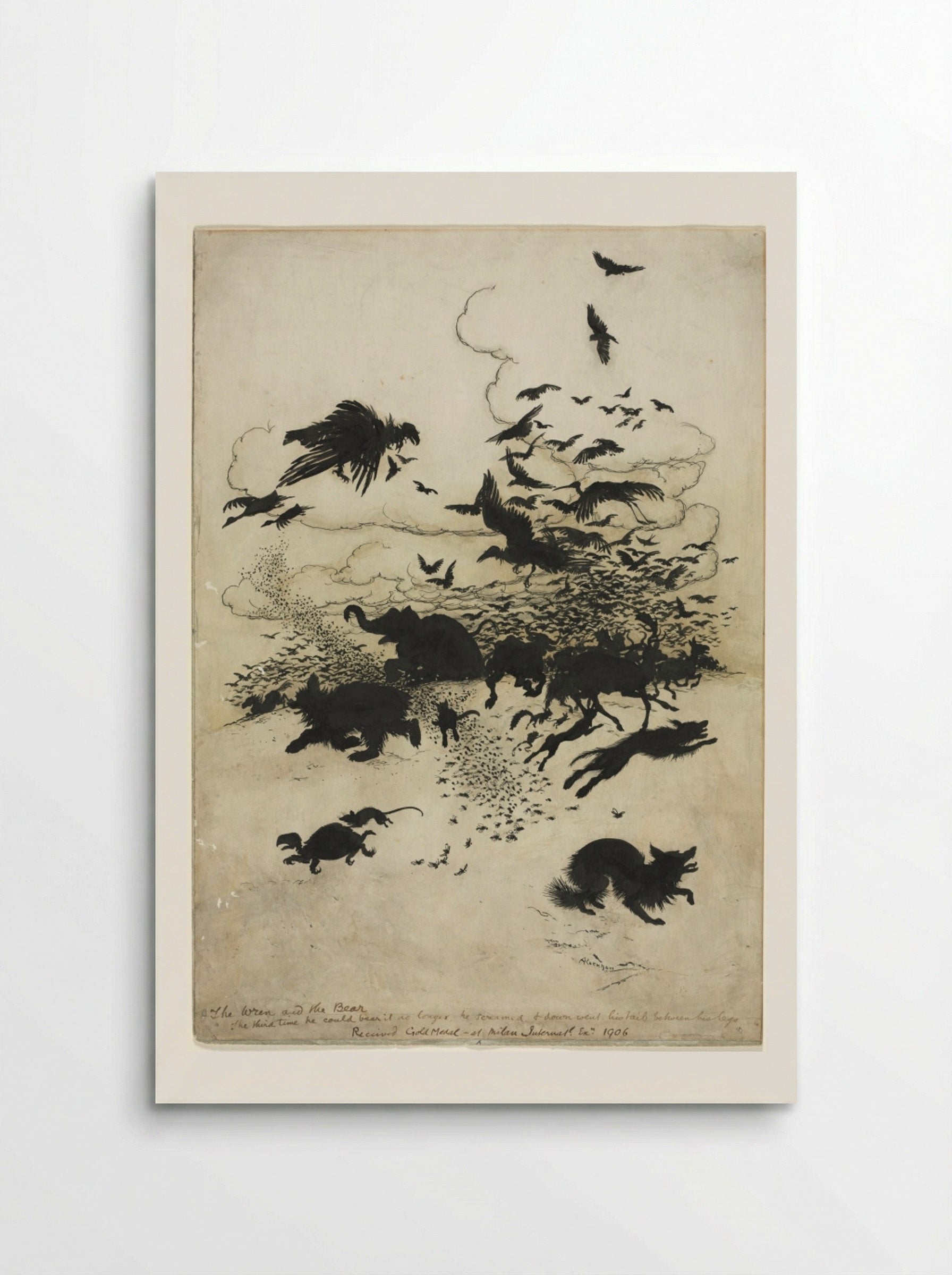
A dramatic ink and watercolour illustration by Arthur Rackham depicting the climactic scene from the Brothers Grimm tale, The Wren and the Bear.
Arthur Rackham produced this illustration for the Brothers Grimm fairy tale, The Wren and the Bear. The composition depicts a chaotic scene where a vast army of birds and insects descends upon the animal kingdom. Rackham employs a distinct technique of fine, calligraphic ink lines combined with subtle washes of watercolour to define the silhouettes of the fleeing creatures. The bear, central to the narrative, is shown in a state of retreat, pursued by the relentless swarm. Rackham was a master of the pen-and-ink medium, often using a restricted palette to focus the viewer on the movement and characterisation of his subjects. In this work, the contrast between the dark, solid forms of the animals and the airy, sketch-like quality of the clouds creates a sense of depth and urgency. The artist's ability to render individual creatures within a massive, swirling group demonstrates his technical precision. The work was recognised at the Milan International Exhibition in 1906, where it received a gold medal. This piece reflects the aesthetic sensibilities of the early twentieth-century British illustration tradition. Rackham avoids excessive ornamentation, preferring to let the fluid lines and the dramatic tension of the narrative drive the composition. The inclusion of the handwritten caption at the base of the sheet provides a direct link to the artist's process and the specific moment of the story being depicted. It is a clear example of how Rackham balanced the demands of commercial book illustration with a high degree of artistic craft.
Return policy
Because every print is made to order, we don't offer change-of-mind returns, refunds or exchanges. If your order arrives faulty, damaged or incorrect, we'll replace it free of charge — just contact us within 48 hours of delivery. EU customers have a 14-day cooling-off right. See our refunds page for full details.
Shipping
We ship worldwide, printing at the production hub nearest to your delivery address. Delivery times and costs vary by destination — you'll see the options available to you at checkout.
Manufacturing
Each print is produced to order using 12-colour giclée printing on FSC-certified archival paper. Designed in Britain and printed at your nearest production hub to reduce waste and speed up delivery.
The Wren and the Bear - Arthur Rackham
Our Features
Designed for Lasting Impact
Specific Features
Every Solis piece is made to order with archival, gallery-quality materials built to last.
- Museum-grade giclée printing for rich, fade-resistant colour
- Archival matte fine-art paper, FSC-certified
- Choose poster, framed print, canvas or framed canvas
- Frames in black, natural wood, dark wood or white
- Framed prints arrive ready to hang
Care & Cleaning
To keep your artwork looking its best:
- Dust gently with a soft, dry cloth
- Avoid prolonged direct sunlight
- Never use liquid cleaners on the print or canvas surface
- Keep in a dry, room-temperature space
- Handle prints with clean, dry hands
Materials & Sizing
Museum-grade giclée on FSC-certified archival matte paper, with framed and canvas options.
- Paper sizes: A4, A3, A2, A1, A0 and B2 (50×70 cm)
- Canvas: XS (20×30 cm) to Large (60×90 cm)
- Frames: black, natural wood, dark wood or white
Why Choose Us ?
100% Satisfaction Guarantee
Fast Shipping
Museum-Quality Materials

Artist Biography
Arthur Rackham
He came back to London and got a job as an insurance clerk at the Westminster Fire Office, studying part-time at the Lambeth School of Art. In 1892 he left insurance for the Westminster Budget, where he worked as a reporter and illustrator. The illustration work took over. His watercolour of Winchelsea had already been accepted by the Royal Academy and sold for two guineas when he was twenty-one.
He met the painter Edyth Starkie over a garden fence. She encouraged him to stop imitating other illustrators and follow his own instinct, which ran toward twisted trees, gnarled roots and creatures that lived in the gaps between the real and the imagined. They married in 1903. That same year he illustrated The Fairy Tales of the Brothers Grimm, which was reprinted twice and made his name.
His style fused northern European line drawing (Durer, Altdorfer) with Japanese woodblock composition. The trees have faces. The roots have fingers. Peter Pan in Kensington Gardens and Rip Van Winkle followed, the latter a turning point in book production: its fifty-one colour plates demonstrated that colour-separated printing could accurately reproduce original artwork.
Guillermo del Toro cited Rackham as an influence on the Faun in Pan's Labyrinth. Brian Froud credited him with sparking an interest in fairy illustration. He worked until the end: his final commission, The Wind in the Willows, was completed in 1939 shortly before his death at seventy-one.
You May Also Like