

Fine Art Poster
From £28
A giclée print on 200gsm matte fine art paper, using a twelve-colour process for accurate, fade-resistant colour. Supplied unframed, delivered flat or rolled.



Archival giclée
Frames arrive ready to hang
Secure checkout
Made to order
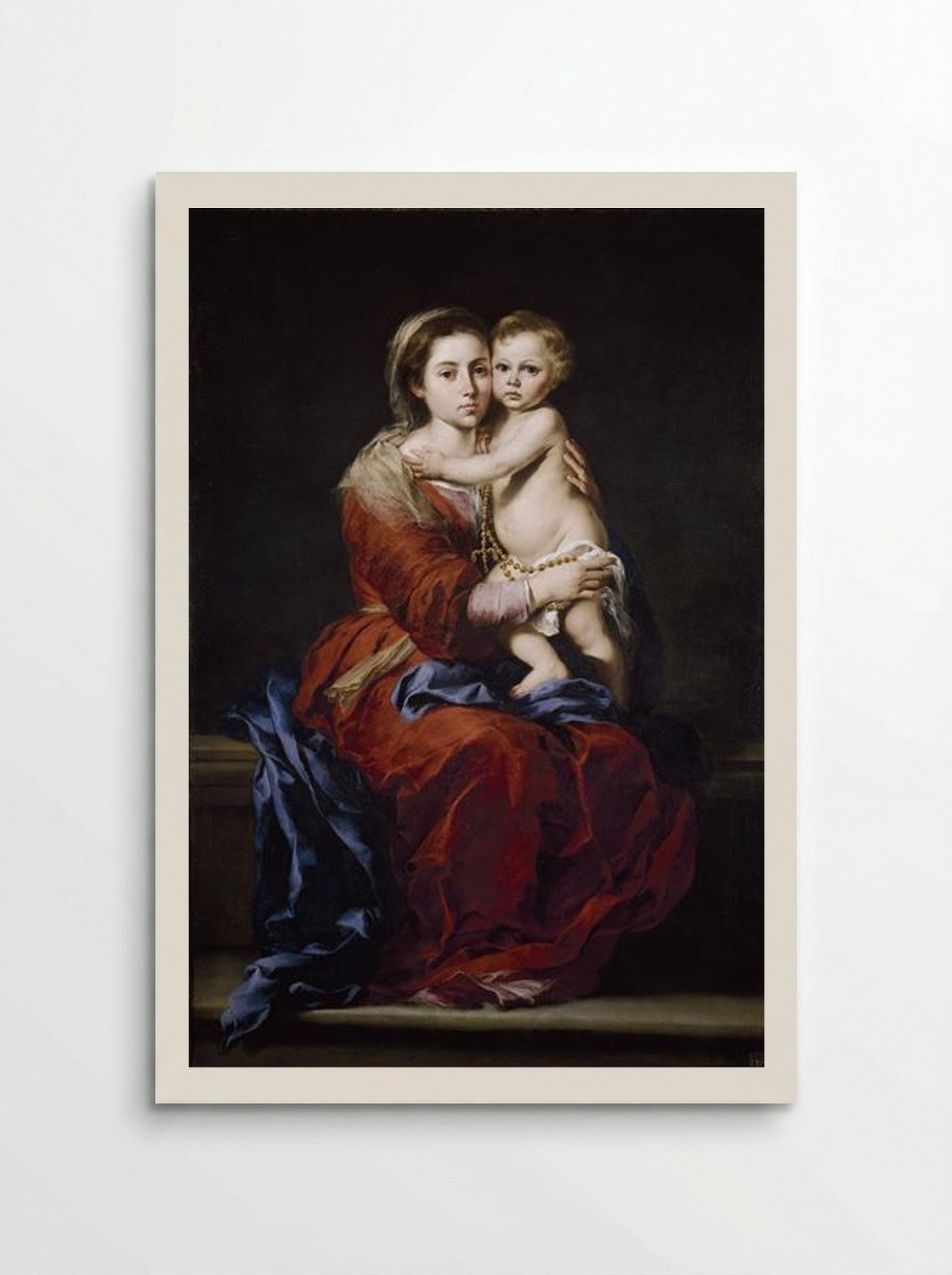
A tender depiction of the Virgin Mary and the Christ Child by the Spanish Baroque master Bartolomé Esteban Murillo.
Bartolomé Esteban Murillo, a master of the Spanish Golden Age, painted this work during the latter part of his career. The composition features the Virgin Mary seated, holding the Christ Child, who leans against her shoulder. The figures emerge from a dark, atmospheric background, a technique that draws the viewer's attention to the soft modelling of the skin and the folds of the drapery. Mary wears a deep red gown paired with a blue mantle, colours traditionally associated with her iconography. The Christ Child is depicted with a naturalistic quality, his posture relaxed as he rests against his mother. A rosary, from which the painting derives its name, is draped over the Virgin's arm and the child's body. Murillo avoids excessive ornamentation, focusing instead on the emotional connection between the two figures. The lighting is characteristic of Murillo's approach, using a gentle chiaroscuro to define the forms without harsh transitions. The brushwork is fluid, particularly in the rendering of the fabric, which displays a tactile quality. This work reflects the artist's ability to imbue religious subjects with a sense of human warmth and accessibility. The composition is balanced and stable, typical of his mature period in Seville, where he produced numerous devotional images for both private and ecclesiastical patrons. The focus remains on the tender interaction, presented with a clarity that avoids unnecessary artifice. This print captures the subtle tonal shifts of the original oil painting, preserving the quiet dignity of the scene.
Because every print is made to order, we don't offer change-of-mind returns, refunds or exchanges. If your order arrives faulty, damaged or incorrect, we'll replace it free of charge — just contact us within 48 hours of delivery. See our refunds page for full details.
We ship worldwide, printing at the production hub nearest to your delivery address. Delivery times and costs vary by destination — you'll see the options available to you at checkout.
Each print is produced to order using 12-colour giclée printing on FSC-certified archival paper. Designed in Britain and printed at your nearest production hub to reduce waste and speed up delivery.

Artist Biography
Our Features
Designed for Lasting Impact
Every Solis piece is made to order with archival, gallery-quality materials built to last.
To keep your artwork looking its best:
Museum-grade giclée on FSC-certified archival matte paper, with framed and canvas options.
Made to order
Every piece is printed to order. These are the five finishes, and what makes each one different.
From £28
A giclée print on 200gsm matte fine art paper, using a twelve-colour process for accurate, fade-resistant colour. Supplied unframed, delivered flat or rolled.

From £45
The same fine art print in a solid wood frame with UV-protective acrylic glaze and rigid backing. Five frame colours. Arrives ready to hang.

From £85
A deeper solid wood frame: 33mm deep with a 20mm face and Perspex glaze. The print sits unmounted for a clean gallery presentation. Black, white or natural.

From £30
Hand-stretched canvas with neat gallery-wrapped edges, giving the artwork surface texture and depth. Arrives ready to hang.

From £135
Stretched canvas set in a floating wood frame, our most substantial finish. Arrives ready to hang.
Why Choose Us ?
Damage-free delivery guarantee
Fast Shipping
Museum-Quality Materials
Artist Biography
Bartolomé Esteban Murillo
You May Also Like
We use cookies to measure our marketing and see which prints people love.We use cookies to measure our marketing.
By continuing to browse, you agree · Privacy Policy