



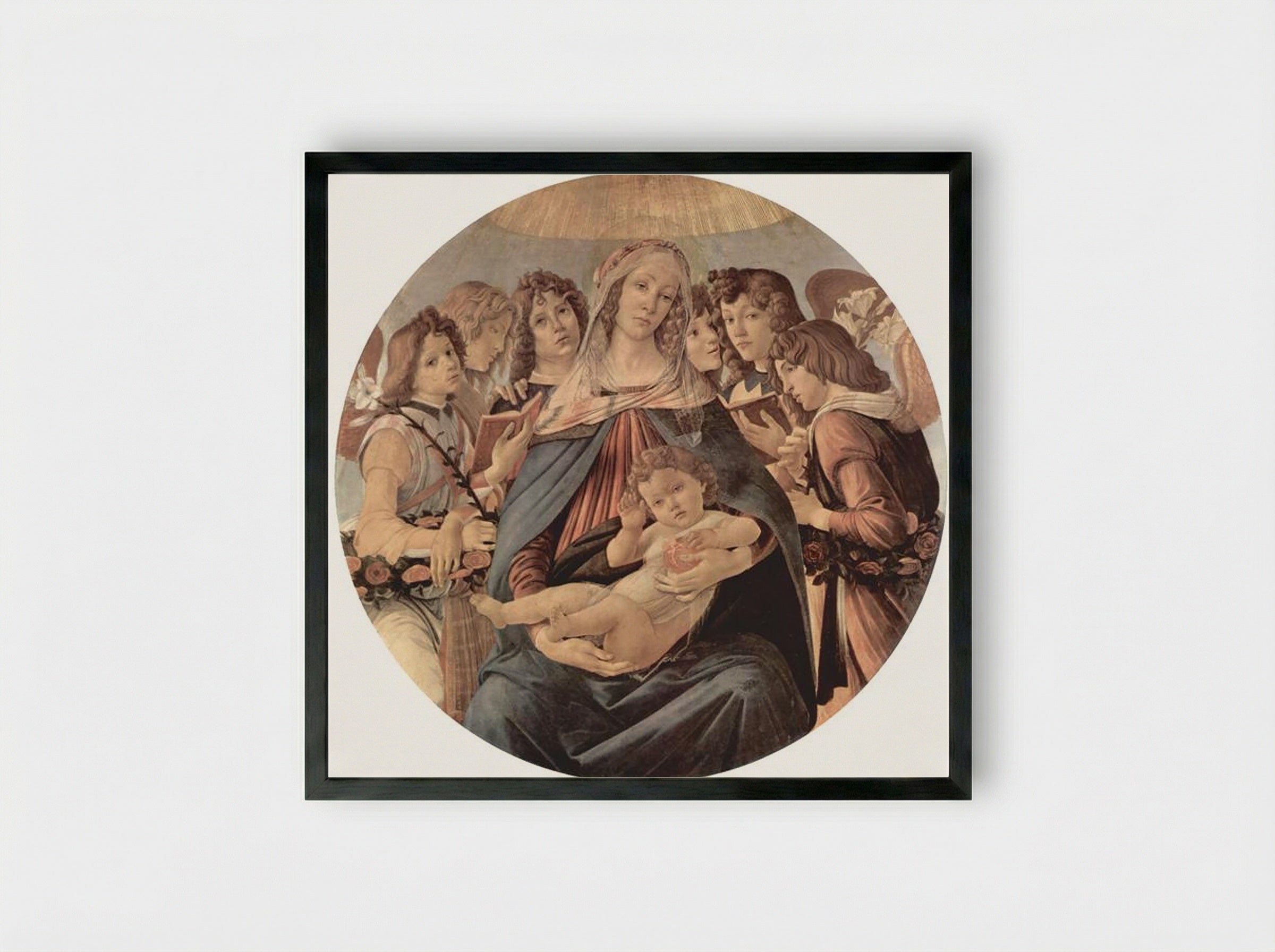
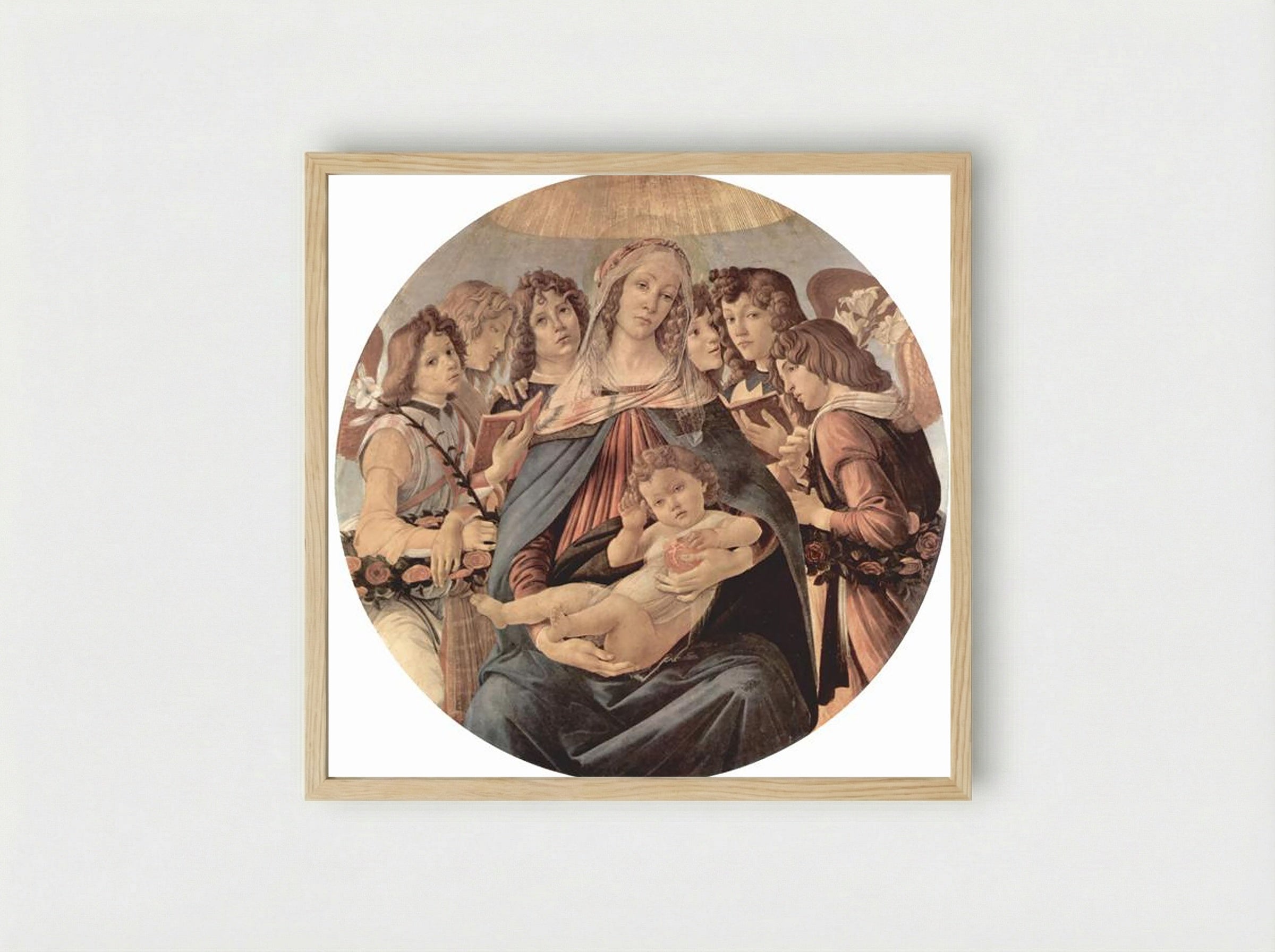
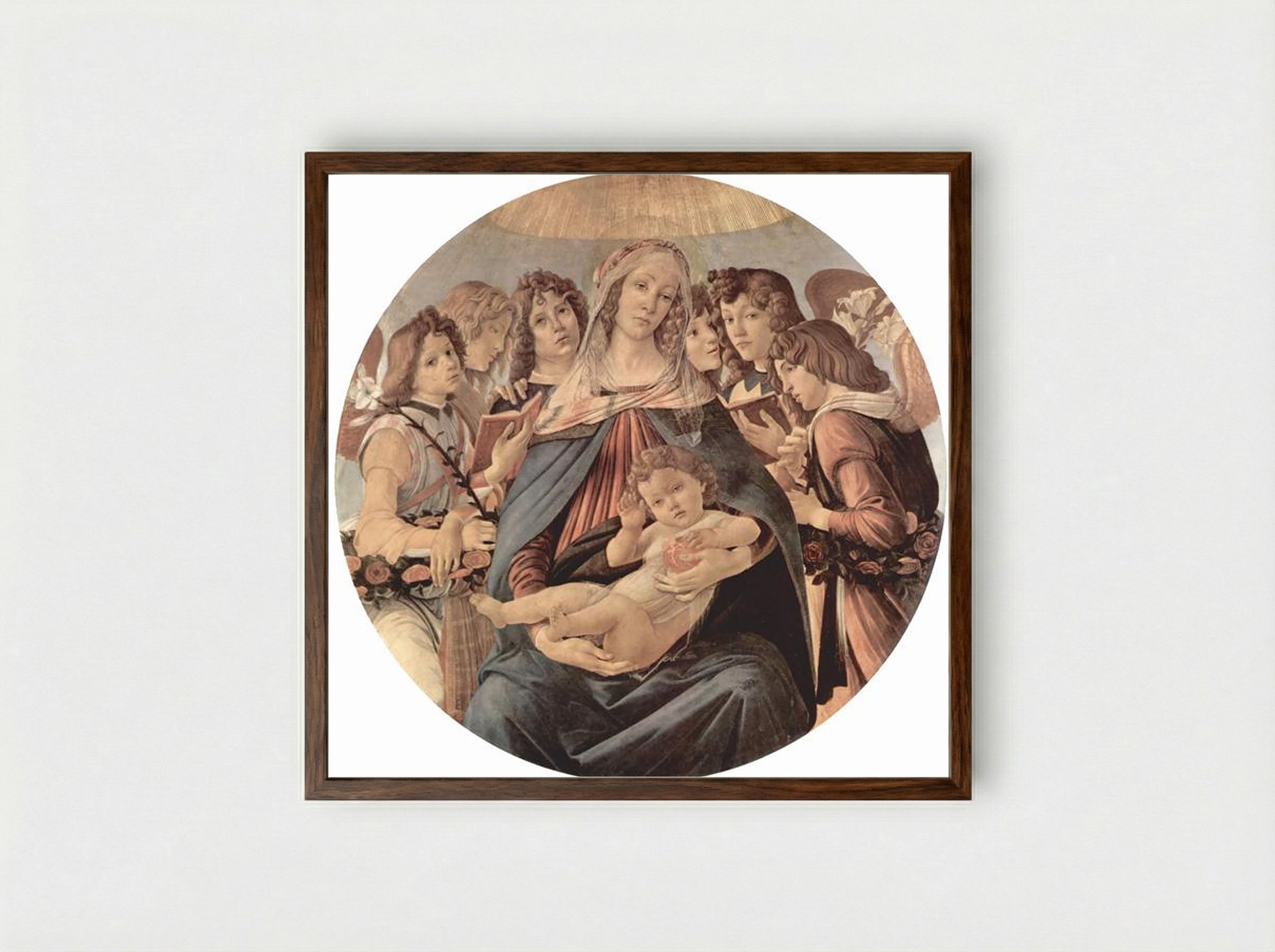
The Virgin Adoring the Child - Sandro Botticelli
Archival giclée
Ready to hang
Secure checkout
Made to order
Description
Sandro Botticelli's 'The Virgin Adoring the Child' is a Renaissance masterpiece, showcasing the artist's delicate lines and serene colour palette in a harmonious tondo composition. This religious painting captures a moment of quiet reverence and tender affection.
Sandro Botticelli, an Italian painter of the Early Renaissance, is known for his graceful figures and refined style. This painting, titled 'The Virgin Adoring the Child', exemplifies Botticelli's characteristic approach to religious subjects. The composition is arranged in a tondo, or circular format, a popular choice during the Renaissance, which lends a sense of harmony and balance to the scene. The Virgin Mary is depicted at the centre, gazing down at the Christ Child whom she holds in her arms. She is surrounded by a group of angels, some of whom are holding books, possibly alluding to the scriptures. The figures are rendered with delicate lines and soft modelling, typical of Botticelli's style. The colour palette is restrained, with muted blues, reds, and golds creating a serene and contemplative atmosphere. The overall effect is one of quiet reverence and tender affection.
Return policy
Because every print is made to order, we don't offer change-of-mind returns, refunds or exchanges. If your order arrives faulty, damaged or incorrect, we'll replace it free of charge — just contact us within 48 hours of delivery. EU customers have a 14-day cooling-off right. See our refunds page for full details.
Shipping
We ship worldwide, printing at the production hub nearest to your delivery address. Delivery times and costs vary by destination — you'll see the options available to you at checkout.
Manufacturing
Each print is produced to order using 12-colour giclée printing on FSC-certified archival paper. Designed in Britain and printed at your nearest production hub to reduce waste and speed up delivery.
The Virgin Adoring the Child - Sandro Botticelli
Our Features
Designed for Lasting Impact
Specific Features
Every Solis piece is made to order with archival, gallery-quality materials built to last.
- Museum-grade giclée printing for rich, fade-resistant colour
- Archival matte fine-art paper, FSC-certified
- Choose poster, framed print, canvas or framed canvas
- Frames in black, natural wood, dark wood or white
- Framed prints arrive ready to hang
Care & Cleaning
To keep your artwork looking its best:
- Dust gently with a soft, dry cloth
- Avoid prolonged direct sunlight
- Never use liquid cleaners on the print or canvas surface
- Keep in a dry, room-temperature space
- Handle prints with clean, dry hands
Materials & Sizing
Museum-grade giclée on FSC-certified archival matte paper, with framed and canvas options.
- Paper sizes: A4, A3, A2, A1, A0 and B2 (50×70 cm)
- Canvas: XS (20×30 cm) to Large (60×90 cm)
- Frames: black, natural wood, dark wood or white
Why Choose Us ?
100% Satisfaction Guarantee
Fast Shipping
Museum-Quality Materials

Artist Biography
Sandro Botticelli
He worked in Florence under the patronage of the Medici family during the period art historians call the Early Renaissance. The Birth of Venus and Primavera, both painted in the 1480s, are his best-known works and among the most reproduced images in Western art. They are strange paintings. Venus stands on a shell, blown to shore by the wind, her body curved in a way that owes nothing to anatomical reality and everything to Gothic line. Primavera fills a dark orange grove with mythological figures whose feet barely touch the ground.
The paintings are technically tempera on canvas and panel, executed with a fineness of line that reflects his goldsmith training. The outlines are visible. The surfaces are flat compared to the oil-based modelling that Leonardo and other contemporaries were developing. Botticelli was not interested in three-dimensional illusion. He was interested in contour, pattern, and the way a line can describe both a body and an emotion simultaneously.
His later career was affected by the rise of the Dominican friar Girolamo Savonarola, who preached against secular art and luxury. Botticelli may have burned some of his own paintings in the Bonfire of the Vanities in 1497. Whether this represents genuine religious conversion or political self-preservation is unclear. His output declined. He died in 1510, largely forgotten, and was not rediscovered until the Pre-Raphaelites championed him in the nineteenth century.
You May Also Like