

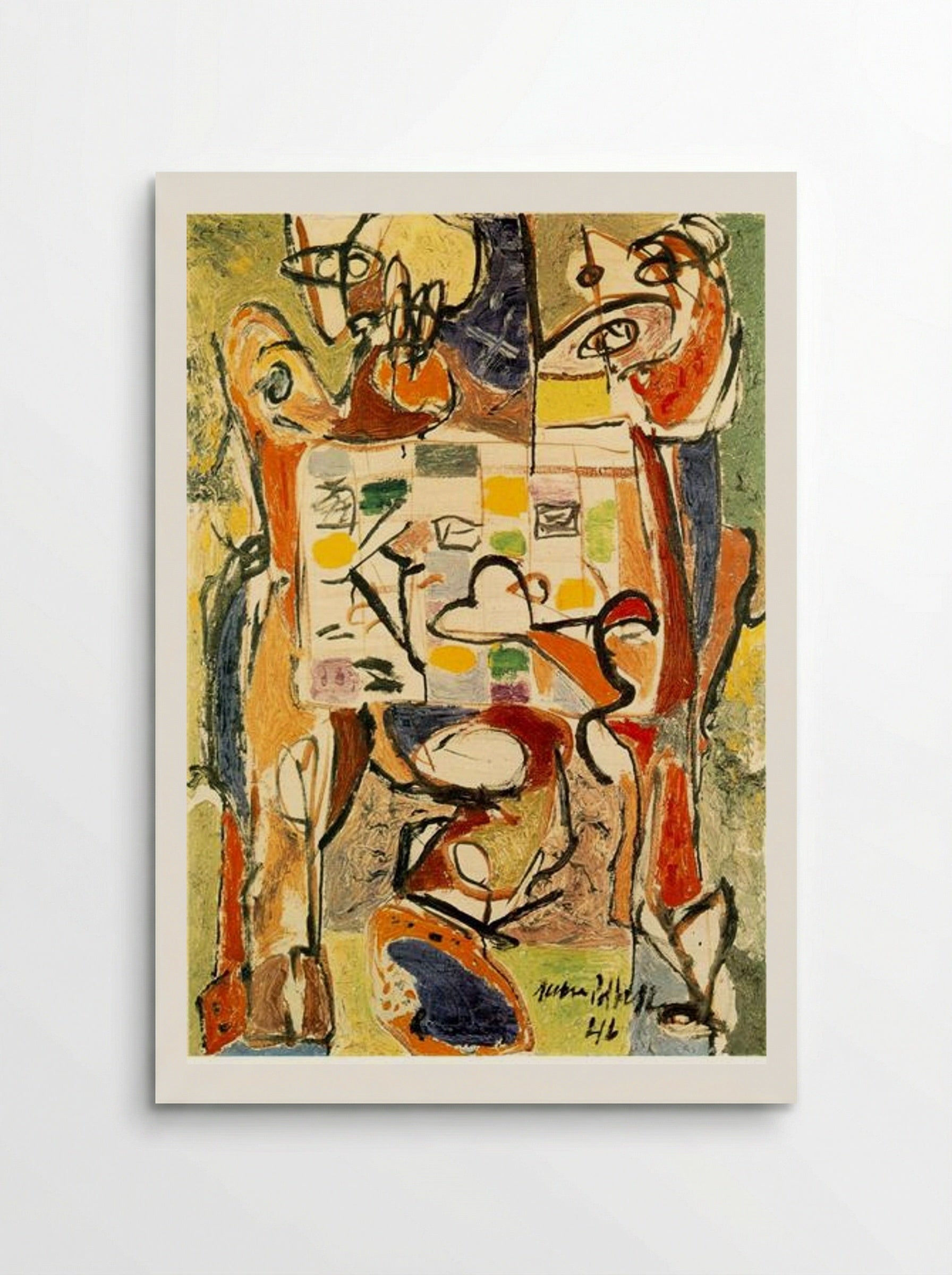
The Tea Cup - Jackson Pollock
Archival giclée
Frames arrive ready to hang
Secure checkout
Made to order
Description
A 1946 oil painting by Jackson Pollock, featuring a complex arrangement of biomorphic forms and gestural lines that bridge Surrealism and Abstract Expressionism.
The Tea Cup, painted by Jackson Pollock in 1946, represents a period of transition in the artist's career. Before he adopted his signature drip technique, Pollock worked in a style that combined elements of Surrealism with the influence of Picasso and Miró. This work displays a complex arrangement of biomorphic shapes and calligraphic lines that suggest a domestic scene, though the subject remains obscured by the artist's gestural approach. The composition is divided by a central grid-like structure, which acts as a anchor for the surrounding chaotic forms. Pollock uses a palette of earthy tones, including ochre, burnt orange, and muted greens, punctuated by stark black outlines. These lines do not merely define the shapes but exist as independent marks that traverse the surface of the canvas. The paint application is thick and tactile, revealing the physical energy of the artist's hand. While the title refers to a mundane object, the painting avoids literal representation. Instead, it functions as a record of the artist's internal state and his engagement with the materials. The grid provides a sense of order against the fluid, organic forms that populate the rest of the frame. This tension between structure and spontaneity is a recurring theme in Pollock's early work. By 1946, he was moving away from traditional figurative painting, opting for a more direct expression of emotion through line and colour. The Tea Cup offers a view into this experimental phase, where the artist was actively dismantling the boundaries between the object and the act of painting itself. It remains a significant example of the stylistic shifts occurring in American art during the mid-twentieth century.
Return policy
Because every print is made to order, we don't offer change-of-mind returns, refunds or exchanges. If your order arrives faulty, damaged or incorrect, we'll replace it free of charge — just contact us within 48 hours of delivery. See our refunds page for full details.
Shipping
We ship worldwide, printing at the production hub nearest to your delivery address. Delivery times and costs vary by destination — you'll see the options available to you at checkout.
Manufacturing
Each print is produced to order using 12-colour giclée printing on FSC-certified archival paper. Designed in Britain and printed at your nearest production hub to reduce waste and speed up delivery.
Care and materials
Specific Features
Every Solis piece is made to order with archival, gallery-quality materials built to last.
- Museum-grade giclée printing for rich, fade-resistant colour
- Archival matte fine-art paper, FSC-certified
- Multiple sizes and framing options available
- Frames in black, natural wood, dark wood or white
- Framed prints arrive ready to hang
Care & Cleaning
To keep your artwork looking its best:
- Dust gently with a soft, dry cloth
- Avoid prolonged direct sunlight
- Never use liquid cleaners on the print or canvas surface
- Keep in a dry, room-temperature space
- Handle prints with clean, dry hands
Materials & Sizing
Museum-grade giclée on FSC-certified archival matte paper, with framed and canvas options.
- Paper sizes: A4, A3, A2, A1, A0 and B2 (50×70 cm)
- Canvas: XS (20×30 cm) to Large (60×90 cm)
- Frames: black, natural wood, dark wood or white
The Tea Cup - Jackson Pollock

Artist Biography
Jackson Pollock
He drank heavily from his teens onwards. He was in and out of psychiatric treatment, tried Jungian analysis, and spent time working for the WPA Federal Art Project during the Depression. The early paintings are dark, tangled, influenced by Picasso and by the Mexican muralists Orozco and Siqueiros, whose experimental techniques (including pouring paint) Pollock encountered in a workshop.
The drip paintings started in 1947. He laid canvas on the floor of his barn in Springs, Long Island, and poured household enamel paint from tins, flicking and dripping it with sticks, trowels, and hardened brushes. He moved around the canvas, working from all four sides. No easel, no brushes touching surface, no predetermined composition. 'I am nature,' he told an interviewer, which sounds grandiose but describes the method accurately: the paintings record physical movement through space.
The drip period lasted roughly four years. By 1951 he had largely stopped, returning to figurative work that nobody wanted. His marriage to the painter Lee Krasner deteriorated alongside the drinking. He died in a car crash in 1956, at forty-four, drunk at the wheel. Krasner spent the next three decades managing his legacy and making her own paintings, which were excellent and consistently overlooked.
Why Choose Us ?
Damage-free delivery guarantee
Fast Shipping
Museum-Quality Materials
You May Also Like