

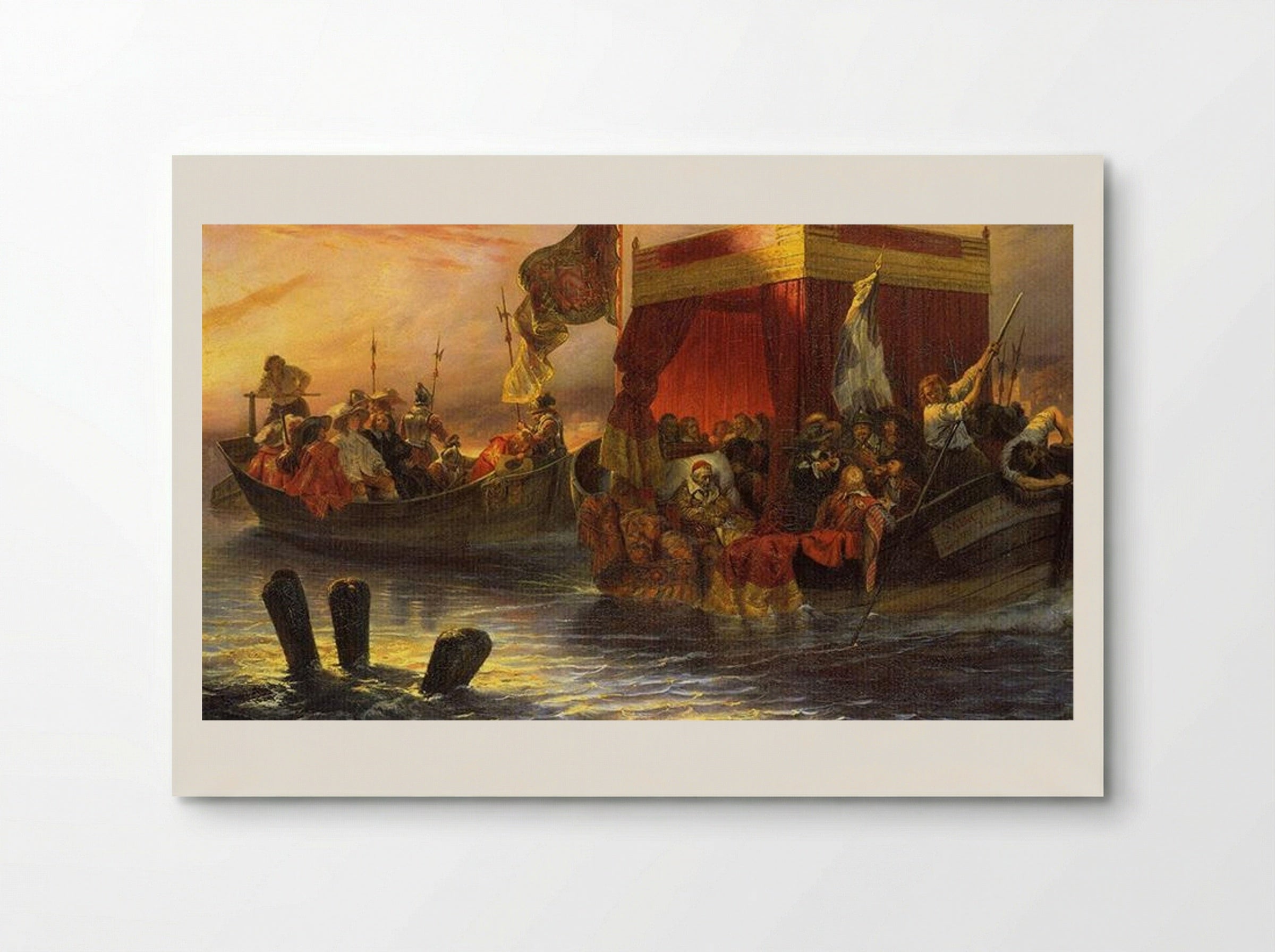
The State Barge of Cardinal Richelieu on the Rhone - Paul Delaroche
Archival giclée
Frames arrive ready to hang
Secure checkout
Made to order
Description
A detailed historical scene by Paul Delaroche, capturing Cardinal Richelieu on a barge during a sunset journey along the Rhone.
Paul Delaroche, a central figure in the French Academic tradition, produced this work in 1829. It depicts Cardinal Richelieu, the powerful minister to Louis XIII, travelling along the Rhone. The composition focuses on the contrast between the ornate, heavy barge carrying the Cardinal and the smaller, more utilitarian boat accompanying him. Delaroche employs a dramatic lighting scheme, with the setting sun casting a golden glow across the water and reflecting off the fabric of the barge's canopy. The painting demonstrates the artist's technical precision and his interest in historical narrative. Delaroche was known for his ability to render historical figures with a sense of psychological realism, moving away from the idealised forms favoured by his predecessors. The figures on the barge are captured in a moment of quiet transit, their expressions and postures suggesting the weight of their political responsibilities. The water is rendered with careful attention to the movement of the current and the play of light on its surface, grounding the scene in a tangible environment. This work reflects the mid-nineteenth-century fascination with French history, a subject Delaroche explored throughout his career. By choosing a specific, atmospheric moment rather than a grand battle or coronation, he creates a more intimate connection with the viewer. The attention to costume detail, from the Cardinal's robes to the military attire of the guards, provides a window into the visual culture of the seventeenth century as interpreted by a nineteenth-century painter. The work remains a fine example of the narrative clarity and technical discipline that defined the French school during this period.
Return policy
Because every print is made to order, we don't offer change-of-mind returns, refunds or exchanges. If your order arrives faulty, damaged or incorrect, we'll replace it free of charge — just contact us within 48 hours of delivery. See our refunds page for full details.
Shipping
We ship worldwide, printing at the production hub nearest to your delivery address. Delivery times and costs vary by destination — you'll see the options available to you at checkout.
Manufacturing
Each print is produced to order using 12-colour giclée printing on FSC-certified archival paper. Designed in Britain and printed at your nearest production hub to reduce waste and speed up delivery.
The State Barge of Cardinal Richelieu on the Rhone - Paul Delaroche
Our Features
Designed for Lasting Impact
Specific Features
Every Solis piece is made to order with archival, gallery-quality materials built to last.
- Museum-grade giclée printing for rich, fade-resistant colour
- Archival matte fine-art paper, FSC-certified
- Multiple sizes and framing options available
- Frames in black, natural wood, dark wood or white
- Framed prints arrive ready to hang
Care & Cleaning
To keep your artwork looking its best:
- Dust gently with a soft, dry cloth
- Avoid prolonged direct sunlight
- Never use liquid cleaners on the print or canvas surface
- Keep in a dry, room-temperature space
- Handle prints with clean, dry hands
Materials & Sizing
Museum-grade giclée on FSC-certified archival matte paper, with framed and canvas options.
- Paper sizes: A4, A3, A2, A1, A0 and B2 (50×70 cm)
- Canvas: XS (20×30 cm) to Large (60×90 cm)
- Frames: black, natural wood, dark wood or white
Why Choose Us ?
Damage-free delivery guarantee
Fast Shipping
Museum-Quality Materials

Artist Biography
Paul Delaroche
He was born in 1797 in Paris and specialised in English and French history scenes because they sold well. In his own lifetime, his commercial success often exceeded both Ingres and Delacroix. Upon first seeing the daguerreotype in 1839, he reportedly declared: from today, painting is dead.
He married Louise Vernet, daughter of the painter Horace Vernet, in 1835. She was the absorbing passion of his life. She died in 1845, aged thirty-one. He sketched her on her deathbed; the drawing survives at the Walters Art Museum in Baltimore. He never recovered from the loss. His later work turned exclusively to religious subjects. He died in 1856.
You May Also Like