

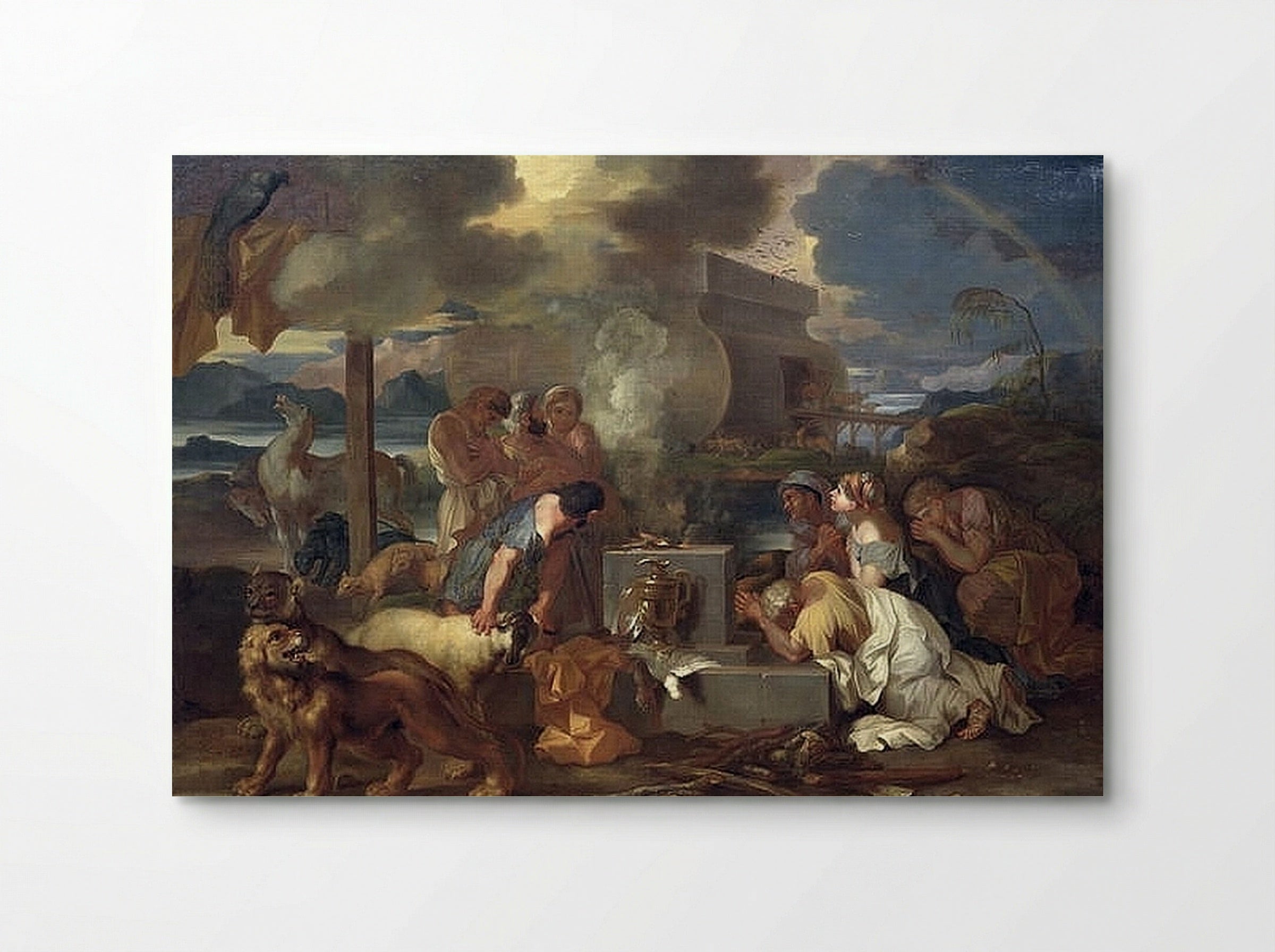
The Sacrifice of Noah - Sebastien Bourdon
Archival giclée
Frames arrive ready to hang
Secure checkout
Made to order
Description
A classic seventeenth-century French Baroque painting depicting the biblical scene of Noah offering a sacrifice after the Great Flood.
Sebastien Bourdon, a French painter active during the seventeenth century, produced this work during a period when he was heavily influenced by the Roman school and the works of Nicolas Poussin. The composition depicts the biblical narrative of Noah offering a sacrifice after the Great Flood. The ark is visible in the background, serving as a reminder of the preceding events, while a rainbow arcs across the sky, symbolising the covenant between God and humanity. Bourdon employs a balanced, theatrical arrangement of figures gathered around a stone altar. The smoke from the sacrifice rises towards the centre, creating a vertical axis that draws the eye upward. The palette is composed of muted earth tones, ochres, and deep blues, which reflect the sombre and reflective nature of the scene. The animals in the foreground, including a lion and a horse, are rendered with careful attention to their forms, grounding the scene in a tangible reality. The lighting is dramatic, typical of the Baroque period, with light sources that define the contours of the figures and the texture of their garments. This painting demonstrates Bourdon's ability to synthesise classical structure with the emotional weight of religious subjects. His approach to the human form and the organisation of space shows a clear debt to the academic traditions of the time. The work remains a representative example of French classicism, where order and clarity are maintained even within a complex narrative setting. The inclusion of the rainbow provides a subtle yet effective conclusion to the visual story, linking the terrestrial act of sacrifice to the divine promise above. The painting is currently held in the collection of the Musée du Louvre in Paris, where it is studied for its technical precision and its contribution to the development of the French Baroque style.
Return policy
Because every print is made to order, we don't offer change-of-mind returns, refunds or exchanges. If your order arrives faulty, damaged or incorrect, we'll replace it free of charge — just contact us within 48 hours of delivery. See our refunds page for full details.
Shipping
We ship worldwide, printing at the production hub nearest to your delivery address. Delivery times and costs vary by destination — you'll see the options available to you at checkout.
Manufacturing
Each print is produced to order using 12-colour giclée printing on FSC-certified archival paper. Designed in Britain and printed at your nearest production hub to reduce waste and speed up delivery.
The Sacrifice of Noah - Sebastien Bourdon

Artist Biography
Sebastien Bourdon
He was born in Montpellier in 1616, the son of a Protestant glass painter. Back in Paris after the Roman flight, he became a co-founder of the French Royal Academy in 1648, later serving as professor and rector. In 1652, Queen Christina of Sweden appointed him first court painter, though the posting lasted only two years. His versatility was unusual: landscapes, religious compositions, mythological scenes and strikingly lifelike portraits all came from the same hand with equal competence.
His Calvinist background gave him access to Protestant networks across Europe while limiting his access to Catholic commissions in France. He died in Paris in 1671, at fifty-five.
His Calvinist background gave him access to Protestant networks across northern Europe while restricting his ability to secure the most lucrative Catholic commissions in France. The tension between faith and profession forced him into a peripatetic career that, paradoxically, gave his art a cosmopolitan range that more settled painters lacked.
Our Features
Designed for Lasting Impact
Specific Features
Every Solis piece is made to order with archival, gallery-quality materials built to last.
- Museum-grade giclée printing for rich, fade-resistant colour
- Archival matte fine-art paper, FSC-certified
- Multiple sizes and framing options available
- Frames in black, natural wood, dark wood or white
- Framed prints arrive ready to hang
Care & Cleaning
To keep your artwork looking its best:
- Dust gently with a soft, dry cloth
- Avoid prolonged direct sunlight
- Never use liquid cleaners on the print or canvas surface
- Keep in a dry, room-temperature space
- Handle prints with clean, dry hands
Materials & Sizing
Museum-grade giclée on FSC-certified archival matte paper, with framed and canvas options.
- Paper sizes: A4, A3, A2, A1, A0 and B2 (50×70 cm)
- Canvas: XS (20×30 cm) to Large (60×90 cm)
- Frames: black, natural wood, dark wood or white
Why Choose Us ?
Damage-free delivery guarantee
Fast Shipping
Museum-Quality Materials
Artist Biography
Sebastien Bourdon
He was born in Montpellier in 1616, the son of a Protestant glass painter. Back in Paris after the Roman flight, he became a co-founder of the French Royal Academy in 1648, later serving as professor and rector. In 1652, Queen Christina of Sweden appointed him first court painter, though the posting lasted only two years. His versatility was unusual: landscapes, religious compositions, mythological scenes and strikingly lifelike portraits all came from the same hand with equal competence.
His Calvinist background gave him access to Protestant networks across Europe while limiting his access to Catholic commissions in France. He died in Paris in 1671, at fifty-five.
His Calvinist background gave him access to Protestant networks across northern Europe while restricting his ability to secure the most lucrative Catholic commissions in France. The tension between faith and profession forced him into a peripatetic career that, paradoxically, gave his art a cosmopolitan range that more settled painters lacked.
You May Also Like