

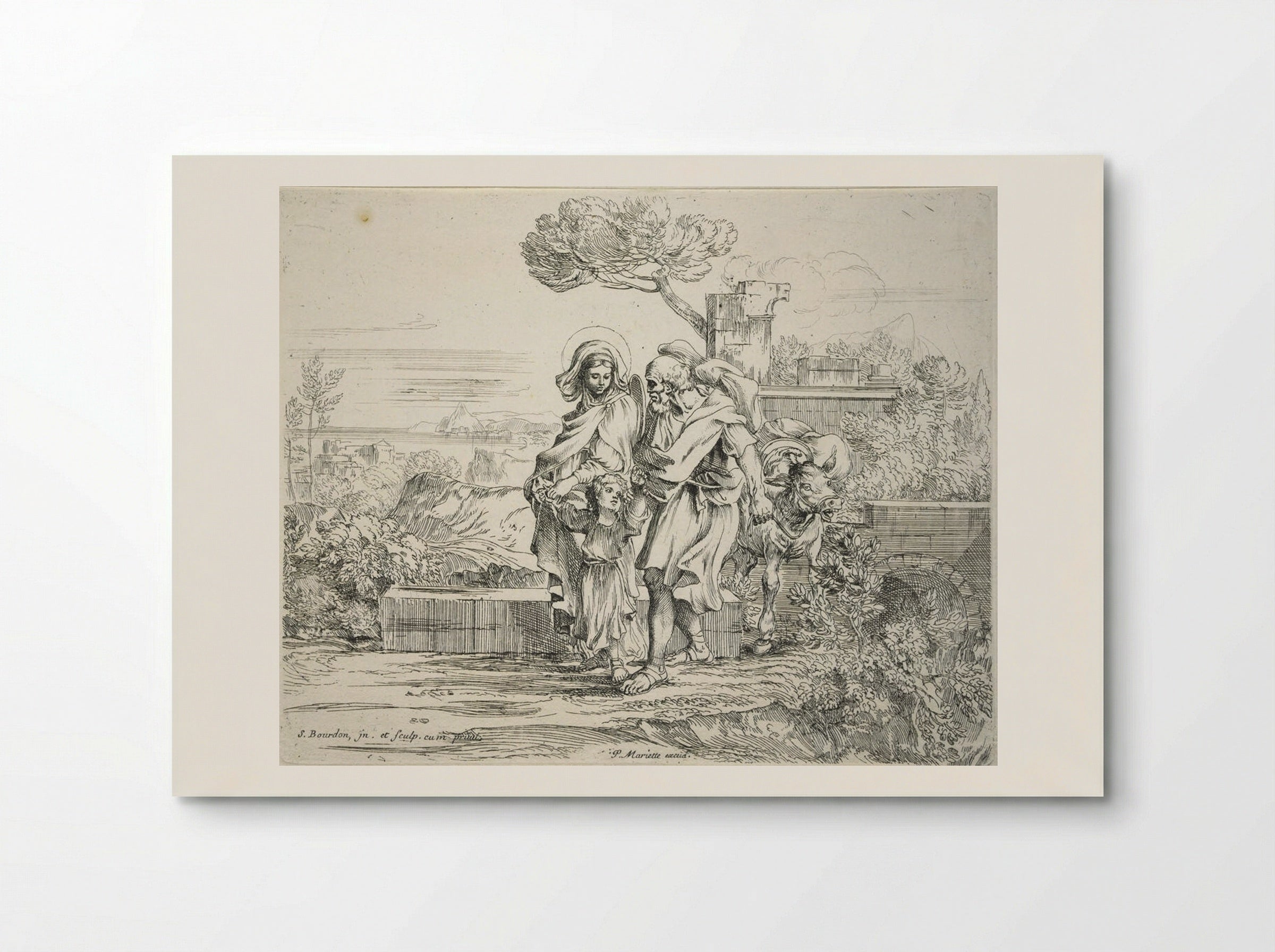
The Return from Egypt - Sébastien Bourdon
Archival giclée
Frames arrive ready to hang
Secure checkout
Made to order
Description
This etching by Sébastien Bourdon depicts the biblical scene of the Holy Family's return from Egypt. The artwork features detailed line work and a classical composition.
Sébastien Bourdon (1616-1671) was a French painter and printmaker, known for his classical style and versatility across various genres, including portraiture, historical subjects, and landscapes. He spent time in Italy early in his career, absorbing influences from the Italian masters, which shaped his artistic approach. Bourdon also co-founded the Académie Royale de Peinture et de Sculpture in 1648. His work displays a blend of French and Italian artistic traditions. 'The Return from Egypt' depicts the biblical story of the Holy Family's return from their exile in Egypt, where they sought refuge from Herod's persecution. The etching shows Mary, Joseph, and the young Jesus travelling, accompanied by an animal. The composition includes a background with architectural ruins and a distant landscape, rendered with fine lines. Bourdon's skill as a draughtsman is evident in the detailed rendering of figures and the atmospheric perspective of the background. The print captures a sense of serenity and the protective journey of the Holy Family.
Return policy
Because every print is made to order, we don't offer change-of-mind returns, refunds or exchanges. If your order arrives faulty, damaged or incorrect, we'll replace it free of charge — just contact us within 48 hours of delivery. See our refunds page for full details.
Shipping
We ship worldwide, printing at the production hub nearest to your delivery address. Delivery times and costs vary by destination — you'll see the options available to you at checkout.
Manufacturing
Each print is produced to order using 12-colour giclée printing on FSC-certified archival paper. Designed in Britain and printed at your nearest production hub to reduce waste and speed up delivery.
The Return from Egypt - Sébastien Bourdon

Artist Biography
Sebastien Bourdon
He was born in Montpellier in 1616, the son of a Protestant glass painter. Back in Paris after the Roman flight, he became a co-founder of the French Royal Academy in 1648, later serving as professor and rector. In 1652, Queen Christina of Sweden appointed him first court painter, though the posting lasted only two years. His versatility was unusual: landscapes, religious compositions, mythological scenes and strikingly lifelike portraits all came from the same hand with equal competence.
His Calvinist background gave him access to Protestant networks across Europe while limiting his access to Catholic commissions in France. He died in Paris in 1671, at fifty-five.
His Calvinist background gave him access to Protestant networks across northern Europe while restricting his ability to secure the most lucrative Catholic commissions in France. The tension between faith and profession forced him into a peripatetic career that, paradoxically, gave his art a cosmopolitan range that more settled painters lacked.
Our Features
Designed for Lasting Impact
Specific Features
Every Solis piece is made to order with archival, gallery-quality materials built to last.
- Museum-grade giclée printing for rich, fade-resistant colour
- Archival matte fine-art paper, FSC-certified
- Multiple sizes and framing options available
- Frames in black, natural wood, dark wood or white
- Framed prints arrive ready to hang
Care & Cleaning
To keep your artwork looking its best:
- Dust gently with a soft, dry cloth
- Avoid prolonged direct sunlight
- Never use liquid cleaners on the print or canvas surface
- Keep in a dry, room-temperature space
- Handle prints with clean, dry hands
Materials & Sizing
Museum-grade giclée on FSC-certified archival matte paper, with framed and canvas options.
- Paper sizes: A4, A3, A2, A1, A0 and B2 (50×70 cm)
- Canvas: XS (20×30 cm) to Large (60×90 cm)
- Frames: black, natural wood, dark wood or white
Why Choose Us ?
Damage-free delivery guarantee
Fast Shipping
Museum-Quality Materials
Artist Biography
Sébastien Bourdon
He was born in Montpellier in 1616, the son of a Protestant glass painter. Back in Paris after the Roman flight, he became a co-founder of the French Royal Academy in 1648, later serving as professor and rector. In 1652, Queen Christina of Sweden appointed him first court painter, though the posting lasted only two years. His versatility was unusual: landscapes, religious compositions, mythological scenes and strikingly lifelike portraits all came from the same hand with equal competence.
His Calvinist background gave him access to Protestant networks across Europe while limiting his access to Catholic commissions in France. He died in Paris in 1671, at fifty-five.
His Calvinist background gave him access to Protestant networks across northern Europe while restricting his ability to secure the most lucrative Catholic commissions in France. The tension between faith and profession forced him into a peripatetic career that, paradoxically, gave his art a cosmopolitan range that more settled painters lacked.
You May Also Like