

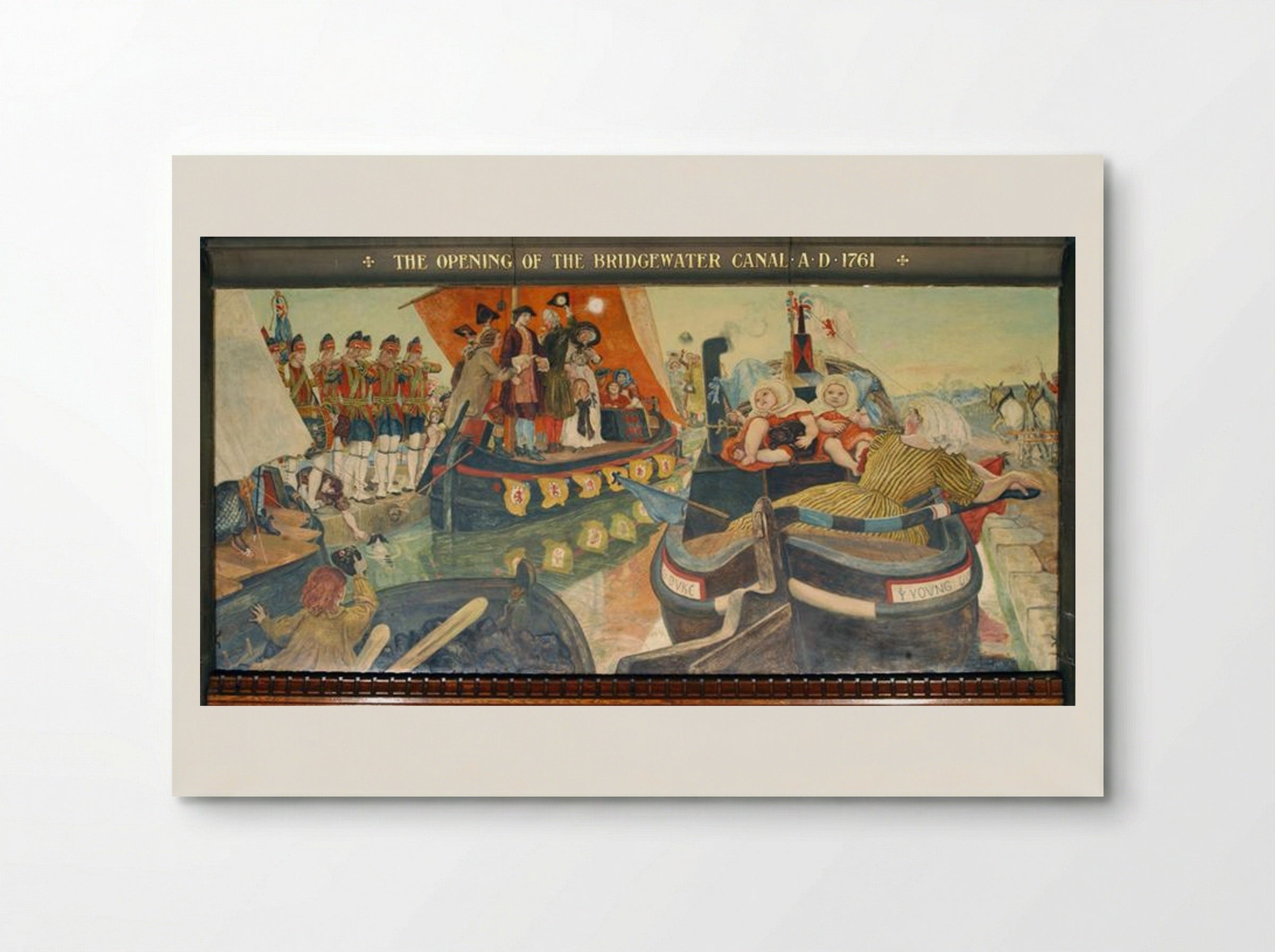
The Opening of the Bridgewater Canal, A.D. 1761 - Ford Madox Brown
Archival giclée
Frames arrive ready to hang
Secure checkout
Made to order
Description
A detailed historical scene by Ford Madox Brown depicting the 1761 opening of the Bridgewater Canal. This work is part of the famous Manchester Murals series.
Ford Madox Brown produced this work as part of the Manchester Murals series for Manchester Town Hall. The series consists of twelve paintings depicting the history of the city from Roman times to the nineteenth century. This specific panel illustrates the inaugural journey on the Bridgewater Canal in 1761. The canal was a major engineering project that connected Worsley to Manchester. It facilitated the transport of coal during the early Industrial Revolution and lowered the price of fuel for local factories. The composition features the Duke of Bridgewater standing on a decorated barge. He is accompanied by his engineer, James Brindley, and the Earl of Gower. Brown used a crowded, multi-figure arrangement to convey the activity of the event. In the foreground, a woman in a striped dress leans over the side of a boat. Two small children sit nearby in a smaller vessel named the Young Duke. To the left, a line of soldiers stands at attention on the bank, their red uniforms providing a contrast to the water. Brown employed the spirit fresco technique for this commission. This involved using a medium of wax and resin mixed with oil colours. The method allowed for a matte finish similar to traditional Italian frescoes but was better suited to the damp British climate. The palette consists of earthy ochres, terracotta reds, and muted blues. Brown focused on historical accuracy in the costumes and the mechanical details of the canal boats. The work avoids idealised figures. Instead, it features the sturdy, realistic physical types characteristic of Brown's later style. The artist spent several years researching the history of Manchester to ensure the accuracy of the scenes. This print captures the specific textures and flat colour fields of the original mural.
Return policy
Because every print is made to order, we don't offer change-of-mind returns, refunds or exchanges. If your order arrives faulty, damaged or incorrect, we'll replace it free of charge — just contact us within 48 hours of delivery. See our refunds page for full details.
Shipping
We ship worldwide, printing at the production hub nearest to your delivery address. Delivery times and costs vary by destination — you'll see the options available to you at checkout.
Manufacturing
Each print is produced to order using 12-colour giclée printing on FSC-certified archival paper. Designed in Britain and printed at your nearest production hub to reduce waste and speed up delivery.
The Opening of the Bridgewater Canal, A.D. 1761 - Ford Madox Brown

Artist Biography
Ford Madox Brown
He was born in Calais in 1821, trained across Europe, and settled in London. Though never an official member of the Pre-Raphaelite Brotherhood, he was their most important older ally and the teacher who most shaped their ambitions. His insistence on painting outdoors in natural light, often to the point of physical discomfort, and his dense, moralising compositions made him a bridge between the Nazarenes he had studied with in Rome and the young English radicals who followed.
He also designed stained glass and furniture for Morris and Co. He died in 1893, at seventy-two.
Our Features
Designed for Lasting Impact
Specific Features
Every Solis piece is made to order with archival, gallery-quality materials built to last.
- Museum-grade giclée printing for rich, fade-resistant colour
- Archival matte fine-art paper, FSC-certified
- Multiple sizes and framing options available
- Frames in black, natural wood, dark wood or white
- Framed prints arrive ready to hang
Care & Cleaning
To keep your artwork looking its best:
- Dust gently with a soft, dry cloth
- Avoid prolonged direct sunlight
- Never use liquid cleaners on the print or canvas surface
- Keep in a dry, room-temperature space
- Handle prints with clean, dry hands
Materials & Sizing
Museum-grade giclée on FSC-certified archival matte paper, with framed and canvas options.
- Paper sizes: A4, A3, A2, A1, A0 and B2 (50×70 cm)
- Canvas: XS (20×30 cm) to Large (60×90 cm)
- Frames: black, natural wood, dark wood or white
Why Choose Us ?
Damage-free delivery guarantee
Fast Shipping
Museum-Quality Materials
Artist Biography
Ford Madox Brown
He was born in Calais in 1821, trained across Europe, and settled in London. Though never an official member of the Pre-Raphaelite Brotherhood, he was their most important older ally and the teacher who most shaped their ambitions. His insistence on painting outdoors in natural light, often to the point of physical discomfort, and his dense, moralising compositions made him a bridge between the Nazarenes he had studied with in Rome and the young English radicals who followed.
He also designed stained glass and furniture for Morris and Co. He died in 1893, at seventy-two.
You May Also Like