

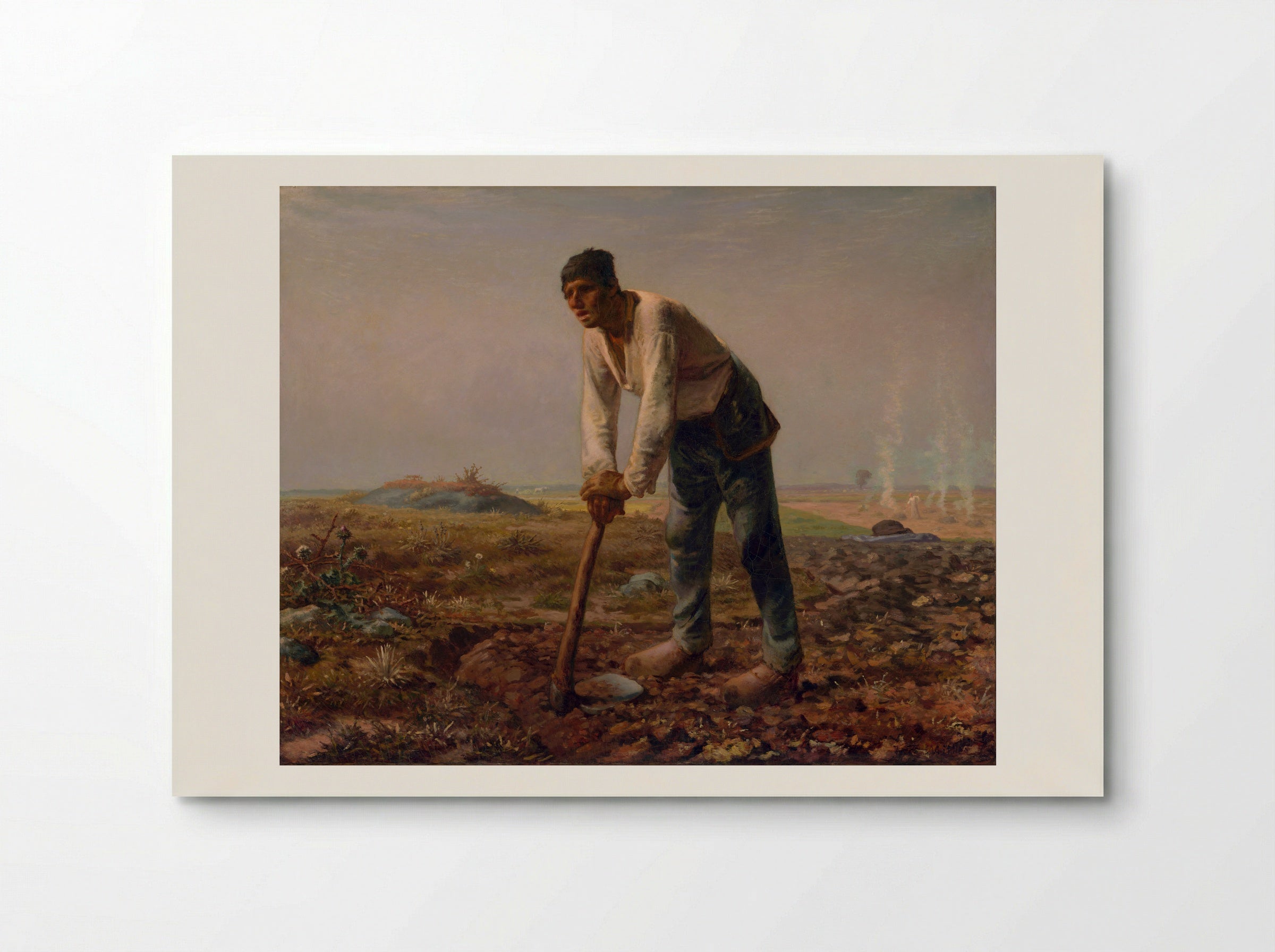
The Man with the Hoe - Jean-François Millet
Archival giclée
Frames arrive ready to hang
Secure checkout
Made to order
Description
A poignant depiction of a weary peasant labourer, capturing the physical toll of agricultural life through the lens of nineteenth-century French Realism.
Jean-François Millet painted The Man with the Hoe between 1860 and 1862. It depicts a weary peasant labourer pausing in his work, leaning heavily upon his tool. The figure occupies the centre of the composition, his posture conveying the physical toll of agricultural life. Millet utilised a muted palette of earth tones, browns, and greys to reflect the harsh environment of the French countryside. The painting belongs to the Realist movement, which sought to represent subjects from everyday life with honesty. Millet focused on the dignity and the struggle of the rural working class. Unlike the idealised depictions of pastoral life common in earlier academic art, this work presents the labourer as a figure of exhaustion. The background shows a barren, rocky field, further emphasising the difficulty of the task. The man's facial expression is one of vacancy and fatigue, suggesting a life defined by repetitive, back-breaking toil. This piece generated significant debate upon its exhibition. Some critics viewed it as a critique of the social conditions of the time, while others saw it as a commentary on the dehumanising effects of manual labour. Millet did not intend to create a political manifesto, but rather to capture the reality of the peasant experience as he observed it in Barbizon. The composition is stark, with the figure silhouetted against a pale, overcast sky. This choice directs the viewer's attention to the physical presence of the man and the weight of his burden. The work remains a significant example of nineteenth-century French painting, documenting the lives of those who worked the land during a period of rapid social change.
Return policy
Because every print is made to order, we don't offer change-of-mind returns, refunds or exchanges. If your order arrives faulty, damaged or incorrect, we'll replace it free of charge — just contact us within 48 hours of delivery. See our refunds page for full details.
Shipping
We ship worldwide, printing at the production hub nearest to your delivery address. Delivery times and costs vary by destination — you'll see the options available to you at checkout.
Manufacturing
Each print is produced to order using 12-colour giclée printing on FSC-certified archival paper. Designed in Britain and printed at your nearest production hub to reduce waste and speed up delivery.
The Man with the Hoe - Jean-François Millet

Artist Biography
Jean Francois Millet
Two village priests educated him in Latin and literature before he was pulled back to farm work. He eventually reached Paris, where he lived in poverty for a period, painting in a damp cellar. His first wife died of tuberculosis three years after their 1841 marriage. He later had nine children with Catherine Lemaire.
The Gleaners (1857) and The Angelus (1857-59) made him famous and controversial. Both depict peasants at work with a dignity that unnerved the bourgeoisie, who saw political radicalism in the simple act of painting agricultural labourers as worthy subjects. The Angelus became one of the most widely reproduced images in the world.
Van Gogh was obsessed with him. While in the asylum at Saint-Remy in late 1889 and early 1890, Van Gogh made twenty-one copies of Millet's paintings over three months, translating them into his own colour and brushwork. Millet died in 1875, co-founder of the Barbizon school and the painter who gave peasant life a permanent place in art.
Our Features
Designed for Lasting Impact
Specific Features
Every Solis piece is made to order with archival, gallery-quality materials built to last.
- Museum-grade giclée printing for rich, fade-resistant colour
- Archival matte fine-art paper, FSC-certified
- Multiple sizes and framing options available
- Frames in black, natural wood, dark wood or white
- Framed prints arrive ready to hang
Care & Cleaning
To keep your artwork looking its best:
- Dust gently with a soft, dry cloth
- Avoid prolonged direct sunlight
- Never use liquid cleaners on the print or canvas surface
- Keep in a dry, room-temperature space
- Handle prints with clean, dry hands
Materials & Sizing
Museum-grade giclée on FSC-certified archival matte paper, with framed and canvas options.
- Paper sizes: A4, A3, A2, A1, A0 and B2 (50×70 cm)
- Canvas: XS (20×30 cm) to Large (60×90 cm)
- Frames: black, natural wood, dark wood or white
Why Choose Us ?
Damage-free delivery guarantee
Fast Shipping
Museum-Quality Materials
Artist Biography
Jean-François Millet
Two village priests educated him in Latin and literature before he was pulled back to farm work. He eventually reached Paris, where he lived in poverty for a period, painting in a damp cellar. His first wife died of tuberculosis three years after their 1841 marriage. He later had nine children with Catherine Lemaire.
The Gleaners (1857) and The Angelus (1857-59) made him famous and controversial. Both depict peasants at work with a dignity that unnerved the bourgeoisie, who saw political radicalism in the simple act of painting agricultural labourers as worthy subjects. The Angelus became one of the most widely reproduced images in the world.
Van Gogh was obsessed with him. While in the asylum at Saint-Remy in late 1889 and early 1890, Van Gogh made twenty-one copies of Millet's paintings over three months, translating them into his own colour and brushwork. Millet died in 1875, co-founder of the Barbizon school and the painter who gave peasant life a permanent place in art.
You May Also Like