

Fine Art Poster
From £37
A giclée print on 200gsm matte fine art paper, using a twelve-colour process for accurate, fade-resistant colour. Supplied unframed, delivered flat or rolled.



Archival giclée
Frames arrive ready to hang
Secure checkout
Made to order
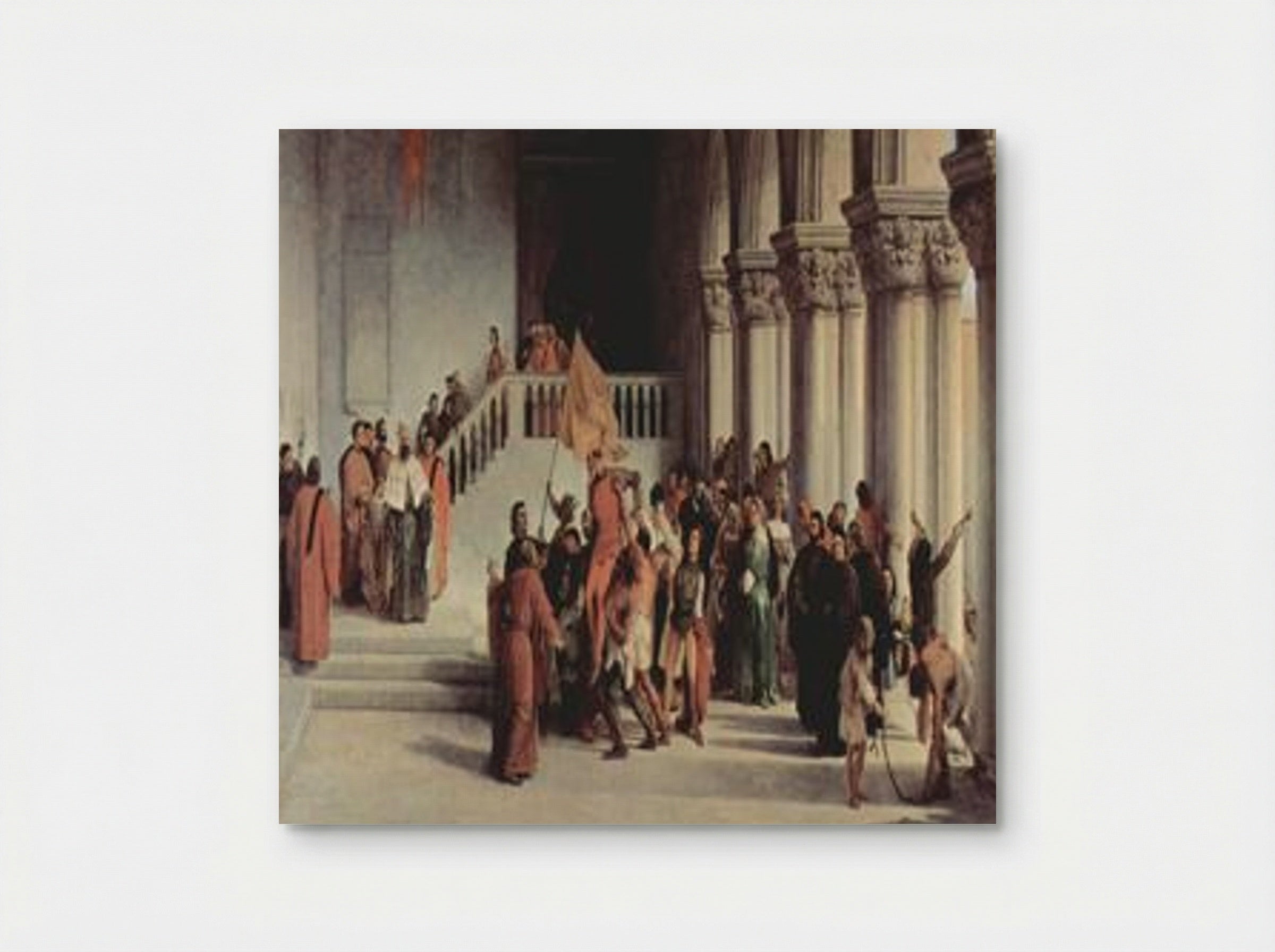
A dramatic historical scene by Francesco Hayez depicting the liberation of the Venetian admiral Vettor Pisani by a jubilant crowd.
Francesco Hayez, a central figure of Italian Romanticism, completed this work in 1840. The painting depicts a specific episode from the fourteenth-century conflict between Venice and Genoa. Vettor Pisani, a Venetian admiral, was imprisoned following a military defeat, yet the public demanded his release to lead the defence of the city. Hayez captures the moment of his liberation, showing the admiral being carried aloft by the populace. The composition is structured around the architectural elements of a Venetian loggia, with classical columns providing a rhythmic backdrop to the surging crowd. Hayez employs a theatrical arrangement, placing the central figure of Pisani at the apex of the human mass. The light enters from the left, illuminating the figures and creating a sense of movement within the scene. The artist focuses on the emotional response of the crowd, using varied gestures and expressions to convey the collective fervour of the Venetian citizens. Technically, the painting demonstrates the artist's mastery of historical narrative. Hayez balances the architectural rigour of the setting with the fluid, dynamic movement of the figures. The palette remains grounded in earthy tones, with accents of colour used to draw the eye toward the central action. This work reflects the nineteenth-century interest in historical subjects that mirrored contemporary political aspirations for Italian unification. By choosing a moment of civic unity and military necessity, Hayez connects the past to the nationalistic sentiments of his own time. The attention to period-appropriate costume and the architectural details of the Venetian setting provides a sense of authenticity to the historical reconstruction.
Because every print is made to order, we don't offer change-of-mind returns, refunds or exchanges. If your order arrives faulty, damaged or incorrect, we'll replace it free of charge — just contact us within 48 hours of delivery. See our refunds page for full details.
We ship worldwide, printing at the production hub nearest to your delivery address. Delivery times and costs vary by destination — you'll see the options available to you at checkout.
Each print is produced to order using 12-colour giclée printing on FSC-certified archival paper. Designed in Britain and printed at your nearest production hub to reduce waste and speed up delivery.

Artist Biography
Our Features
Designed for Lasting Impact
Every Solis piece is made to order with archival, gallery-quality materials built to last.
To keep your artwork looking its best:
Museum-grade giclée on FSC-certified archival matte paper, with framed and canvas options.
Made to order
Every piece is printed to order. These are the five finishes, and what makes each one different.
From £37
A giclée print on 200gsm matte fine art paper, using a twelve-colour process for accurate, fade-resistant colour. Supplied unframed, delivered flat or rolled.

From £59
The same fine art print in a solid wood frame with UV-protective acrylic glaze and rigid backing. Five frame colours. Arrives ready to hang.

From £95
A deeper solid wood frame: 33mm deep with a 20mm face and Perspex glaze. The print sits unmounted for a clean gallery presentation. Black, white or natural.

From £30
Hand-stretched canvas with neat gallery-wrapped edges, giving the artwork surface texture and depth. Arrives ready to hang.

From £135
Stretched canvas set in a floating wood frame, our most substantial finish. Arrives ready to hang.
Why Choose Us ?
Damage-free delivery guarantee
Fast Shipping
Museum-Quality Materials
Artist Biography
Francesco Hayez
You May Also Like
Cookies show us which prints people love, so we hang the right art. Help us fill it?
Essential cookies only if you prefer · Privacy Policy