

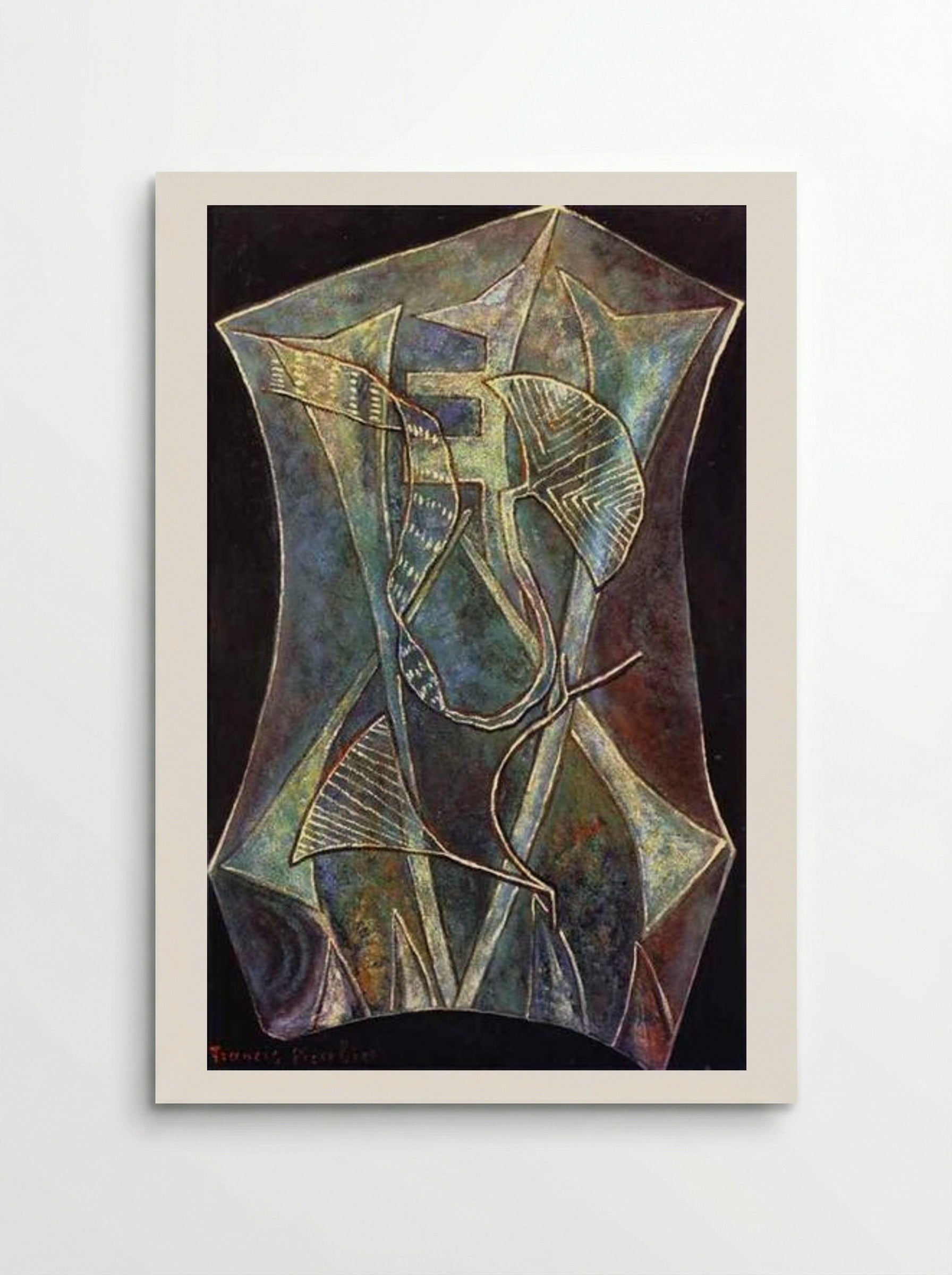
The Joy in Blindness - Francis Picabia
Archival giclée
Frames arrive ready to hang
Secure checkout
Made to order
Description
A 1929 abstract oil painting by Francis Picabia, featuring layered, angular forms and a muted, atmospheric colour palette.
The Joy in Blindness, painted by Francis Picabia in 1929, represents a specific phase in the artist's career where he moved away from his earlier mechanical drawings toward a more enigmatic, layered style. This work features a series of overlapping, translucent forms that suggest a sense of depth without relying on traditional perspective. The composition is dominated by sharp, angular shapes that intersect with softer, organic lines, creating a visual tension that is characteristic of Picabia's approach to abstraction during this period. The colour palette is restrained, focusing on muted tones of blue, grey, and earthy ochre. These colours are applied with a texture that gives the surface a weathered, almost metallic quality. The forms themselves are difficult to categorise, appearing as a mixture of architectural elements and biological structures. This ambiguity is intentional, as Picabia often sought to subvert the viewer's expectation of finding a clear subject matter within his paintings. By the late 1920s, Picabia had distanced himself from the more aggressive tactics of the Dada movement, yet he retained a commitment to questioning the nature of representation. In this piece, the title provides a conceptual anchor, suggesting a state of perception that exists beyond the physical act of seeing. The interplay between the light, linear markings and the darker, atmospheric background creates a sense of movement, as if the shapes are suspended in a fluid medium. This work is an example of the artist's ability to balance technical control with a desire to disrupt conventional aesthetic categories, offering a visual experience that remains open to interpretation.
Return policy
Because every print is made to order, we don't offer change-of-mind returns, refunds or exchanges. If your order arrives faulty, damaged or incorrect, we'll replace it free of charge — just contact us within 48 hours of delivery. See our refunds page for full details.
Shipping
We ship worldwide, printing at the production hub nearest to your delivery address. Delivery times and costs vary by destination — you'll see the options available to you at checkout.
Manufacturing
Each print is produced to order using 12-colour giclée printing on FSC-certified archival paper. Designed in Britain and printed at your nearest production hub to reduce waste and speed up delivery.
The Joy in Blindness - Francis Picabia
Our Features
Designed for Lasting Impact
Specific Features
Every Solis piece is made to order with archival, gallery-quality materials built to last.
- Museum-grade giclée printing for rich, fade-resistant colour
- Archival matte fine-art paper, FSC-certified
- Multiple sizes and framing options available
- Frames in black, natural wood, dark wood or white
- Framed prints arrive ready to hang
Care & Cleaning
To keep your artwork looking its best:
- Dust gently with a soft, dry cloth
- Avoid prolonged direct sunlight
- Never use liquid cleaners on the print or canvas surface
- Keep in a dry, room-temperature space
- Handle prints with clean, dry hands
Materials & Sizing
Museum-grade giclée on FSC-certified archival matte paper, with framed and canvas options.
- Paper sizes: A4, A3, A2, A1, A0 and B2 (50×70 cm)
- Canvas: XS (20×30 cm) to Large (60×90 cm)
- Frames: black, natural wood, dark wood or white
Why Choose Us ?
Damage-free delivery guarantee
Fast Shipping
Museum-Quality Materials
Artist Biography
Francis Picabia
You May Also Like