

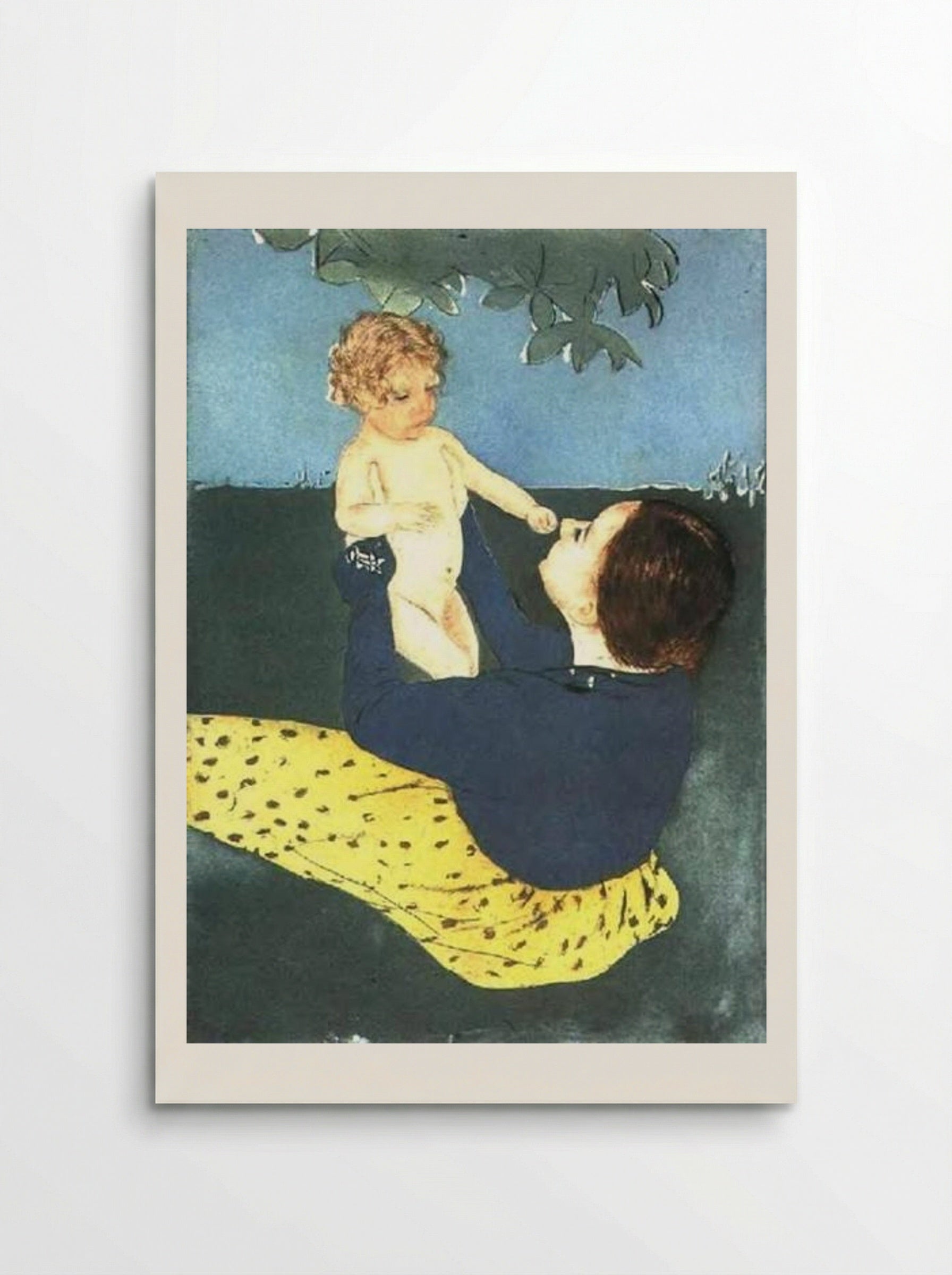
The Horse Chestnut - Mary Cassatt
Archival giclée
Frames arrive ready to hang
Secure checkout
Made to order
Description
A refined drypoint and aquatint print by Mary Cassatt, depicting a mother and child beneath a horse chestnut tree in a style influenced by Japanese art.
The Horse Chestnut is a notable example of Mary Cassatt's mastery of the printmaking medium. Produced during the 1890s, this work reflects the influence of Japanese ukiyo-e woodblock prints, which were then circulating in Paris. Cassatt adopted the flat planes of colour and the simplified, bold outlines characteristic of the style, applying them to her preferred subject matter: the domestic lives of women and children. In this composition, a mother sits on the ground, lifting her child towards the branches of a horse chestnut tree. The figures are rendered with minimal modelling, relying on the contrast between the dark, solid background and the lighter tones of the skin to create form. The mother wears a dark blue bodice paired with a yellow skirt patterned with dark spots, a choice that provides a clear visual anchor against the deep green ground. Above, the stylised leaves of the horse chestnut tree hang in the upper portion of the frame, providing a decorative element that frames the interaction between the two figures. Cassatt was a dedicated printmaker, often experimenting with combinations of drypoint and aquatint to achieve specific textures and tonal qualities. Her approach to this work demonstrates a departure from traditional Western perspective, favouring a more graphic, two-dimensional arrangement. The focus remains on the intimate connection between the mother and child, captured in a moment of quiet engagement. The print is part of a series of ten works that Cassatt exhibited in 1891, which helped establish her reputation as a significant figure within the Impressionist circle. Her ability to synthesise European subject matter with Eastern aesthetic principles remains a defining characteristic of her graphic work.
Return policy
Because every print is made to order, we don't offer change-of-mind returns, refunds or exchanges. If your order arrives faulty, damaged or incorrect, we'll replace it free of charge — just contact us within 48 hours of delivery. See our refunds page for full details.
Shipping
We ship worldwide, printing at the production hub nearest to your delivery address. Delivery times and costs vary by destination — you'll see the options available to you at checkout.
Manufacturing
Each print is produced to order using 12-colour giclée printing on FSC-certified archival paper. Designed in Britain and printed at your nearest production hub to reduce waste and speed up delivery.
The Horse Chestnut - Mary Cassatt

Artist Biography
Mary Cassatt
She grew up in Allegheny City, Pennsylvania (now part of Pittsburgh), in a prosperous family. She studied at the Pennsylvania Academy of the Fine Arts, where she found the instruction restrictive and the male students hostile. She moved to Paris in 1866, copied old masters in the Louvre, and studied privately with several painters before finding her direction with the Impressionists.
Her subject was women and children in domestic settings: mothers bathing infants, women reading, girls at the opera, women having tea. The subject matter sounds conventional. The treatment is not. She observed her subjects with the same unsentimental attention Degas brought to dancers. The compositions are cropped and angled, influenced by Japanese prints and by Degas's habit of painting people from unexpected viewpoints. Little Girl in a Blue Armchair (1878) shows a child sprawled across a chair with the boredom and physical abandon that adults rarely notice and painters rarely record.
She never married. She was wealthy enough not to need to sell her work. She used her position and her connections to persuade American collectors, particularly the Havemeyers, to buy Impressionist paintings. The Havemeyer collection, much of it acquired on Cassatt's advice, was donated to the Metropolitan Museum. She shaped the taste of American collectors more than any other single individual.
She developed cataracts and was nearly blind by 1914. She stopped painting. She died in 1926, at eighty-two.
Our Features
Designed for Lasting Impact
Specific Features
Every Solis piece is made to order with archival, gallery-quality materials built to last.
- Museum-grade giclée printing for rich, fade-resistant colour
- Archival matte fine-art paper, FSC-certified
- Multiple sizes and framing options available
- Frames in black, natural wood, dark wood or white
- Framed prints arrive ready to hang
Care & Cleaning
To keep your artwork looking its best:
- Dust gently with a soft, dry cloth
- Avoid prolonged direct sunlight
- Never use liquid cleaners on the print or canvas surface
- Keep in a dry, room-temperature space
- Handle prints with clean, dry hands
Materials & Sizing
Museum-grade giclée on FSC-certified archival matte paper, with framed and canvas options.
- Paper sizes: A4, A3, A2, A1, A0 and B2 (50×70 cm)
- Canvas: XS (20×30 cm) to Large (60×90 cm)
- Frames: black, natural wood, dark wood or white
Why Choose Us ?
Damage-free delivery guarantee
Fast Shipping
Museum-Quality Materials
Artist Biography
Mary Cassatt
She grew up in Allegheny City, Pennsylvania (now part of Pittsburgh), in a prosperous family. She studied at the Pennsylvania Academy of the Fine Arts, where she found the instruction restrictive and the male students hostile. She moved to Paris in 1866, copied old masters in the Louvre, and studied privately with several painters before finding her direction with the Impressionists.
Her subject was women and children in domestic settings: mothers bathing infants, women reading, girls at the opera, women having tea. The subject matter sounds conventional. The treatment is not. She observed her subjects with the same unsentimental attention Degas brought to dancers. The compositions are cropped and angled, influenced by Japanese prints and by Degas's habit of painting people from unexpected viewpoints. Little Girl in a Blue Armchair (1878) shows a child sprawled across a chair with the boredom and physical abandon that adults rarely notice and painters rarely record.
She never married. She was wealthy enough not to need to sell her work. She used her position and her connections to persuade American collectors, particularly the Havemeyers, to buy Impressionist paintings. The Havemeyer collection, much of it acquired on Cassatt's advice, was donated to the Metropolitan Museum. She shaped the taste of American collectors more than any other single individual.
She developed cataracts and was nearly blind by 1914. She stopped painting. She died in 1926, at eighty-two.
You May Also Like