

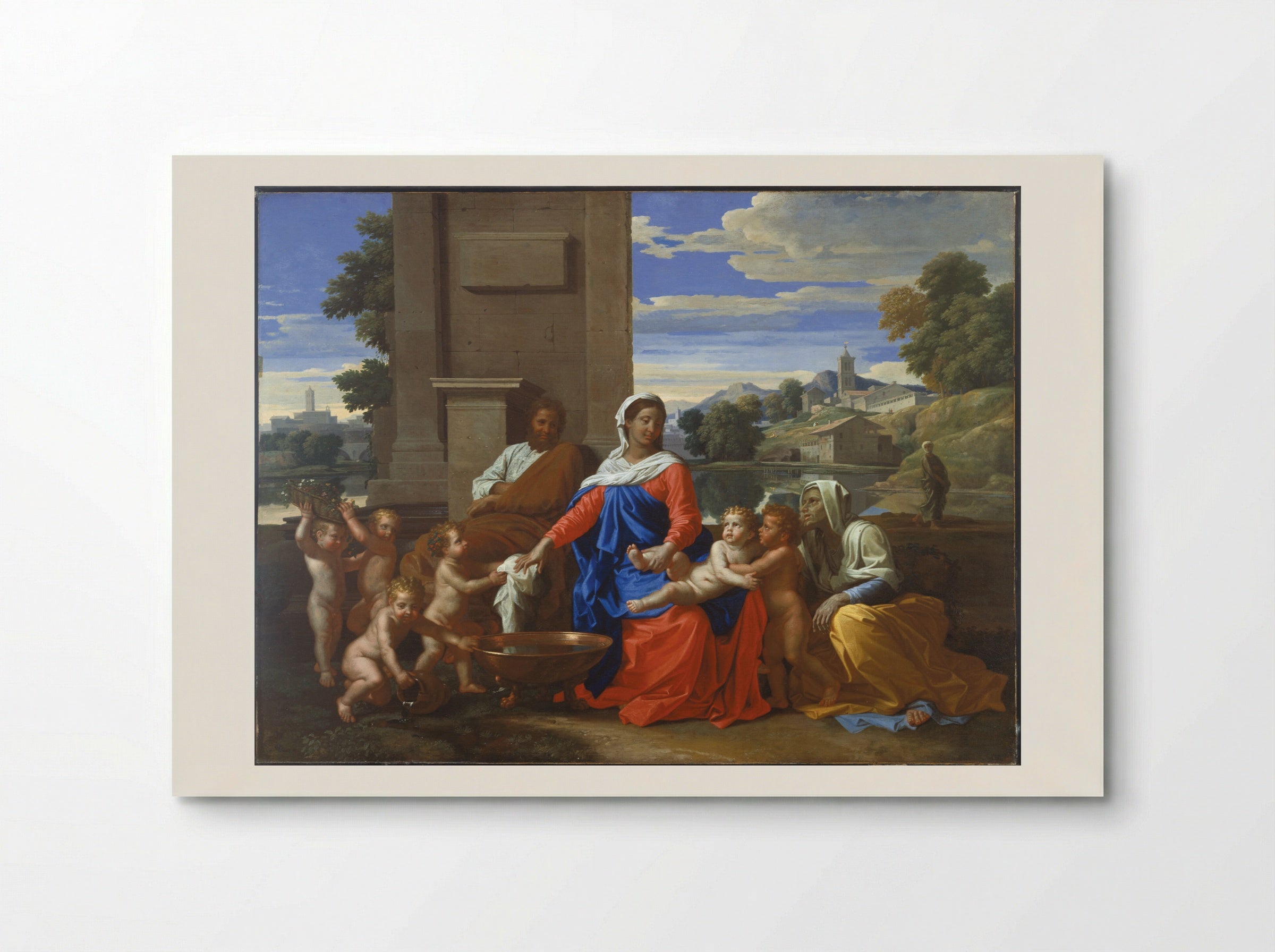
The Holy Family with the Infant Saint John the Baptist and Saint Elizabeth - Nicolas Poussin
Archival giclée
Frames arrive ready to hang
Secure checkout
Made to order
Description
A classic Baroque composition by Nicolas Poussin, depicting the Holy Family with Saint Elizabeth and the infant Saint John the Baptist in a serene, architectural setting.
Nicolas Poussin, a central figure of the French Baroque, painted this work around 1655. It depicts the Holy Family alongside Saint Elizabeth and the infant Saint John the Baptist. The composition is structured with geometric precision, reflecting the artist's preference for order and clarity. The figures are arranged in a frieze-like manner against a backdrop of classical architecture and a serene, distant townscape. The Virgin Mary sits at the centre, her red and blue garments providing a clear visual anchor. She reaches towards a basin, while the infant Christ is held by her and supported by the young Saint John. To the left, Joseph rests against a stone structure, observing the scene with a contemplative expression. Saint Elizabeth kneels to the right, her form draped in ochre and white, balancing the composition. Several putti are present, engaged in the domestic task of washing, which adds a humanising element to the sacred narrative. Poussin's mastery of light and shadow creates a sense of stillness. The palette is controlled, with primary colours used to define the main figures against the cooler tones of the sky and water. The architectural elements, including the heavy stone pillar, provide a sense of permanence and historical weight. The distant landscape, with its calm water and soft hills, draws the eye into the background, creating a sense of depth that contrasts with the foreground activity. This work demonstrates the artist's ability to combine theological subject matter with a rigorous approach to form and spatial organisation. The painting is currently held in the collection of the Fogg Museum at Harvard University.
Return policy
Because every print is made to order, we don't offer change-of-mind returns, refunds or exchanges. If your order arrives faulty, damaged or incorrect, we'll replace it free of charge — just contact us within 48 hours of delivery. See our refunds page for full details.
Shipping
We ship worldwide, printing at the production hub nearest to your delivery address. Delivery times and costs vary by destination — you'll see the options available to you at checkout.
Manufacturing
Each print is produced to order using 12-colour giclée printing on FSC-certified archival paper. Designed in Britain and printed at your nearest production hub to reduce waste and speed up delivery.
The Holy Family with the Infant Saint John the Baptist and Saint Elizabeth - Nicolas Poussin

Artist Biography
Nicolas Poussin
Poussin's artistic vision was rooted in order, reason, and harmony. Unlike the dramatic flair of the Baroque, Poussin sought clarity and balance in his paintings. His meticulously planned compositions, populated with figures inspired by ancient sculpture, evoke a sense of timelessness and moral virtue. Key works like "The Death of Germanicus" and "The Rape of the Sabine Women" exemplify his dedication to historical and mythological subjects, rendered with a controlled palette and precise draughtsmanship.
Although he spent a significant portion of his career in Rome, Poussin's influence on French art was profound. He became a touchstone for generations of artists seeking to emulate his intellectual approach and classical ideals. His legacy extends beyond individual paintings; it encompasses a philosophy of art that values intellect, order, and the pursuit of ideal beauty. Poussin died in Rome in 1665, leaving behind a body of work that continues to inspire awe and intellectual engagement.
Our Features
Designed for Lasting Impact
Specific Features
Every Solis piece is made to order with archival, gallery-quality materials built to last.
- Museum-grade giclée printing for rich, fade-resistant colour
- Archival matte fine-art paper, FSC-certified
- Multiple sizes and framing options available
- Frames in black, natural wood, dark wood or white
- Framed prints arrive ready to hang
Care & Cleaning
To keep your artwork looking its best:
- Dust gently with a soft, dry cloth
- Avoid prolonged direct sunlight
- Never use liquid cleaners on the print or canvas surface
- Keep in a dry, room-temperature space
- Handle prints with clean, dry hands
Materials & Sizing
Museum-grade giclée on FSC-certified archival matte paper, with framed and canvas options.
- Paper sizes: A4, A3, A2, A1, A0 and B2 (50×70 cm)
- Canvas: XS (20×30 cm) to Large (60×90 cm)
- Frames: black, natural wood, dark wood or white
Why Choose Us ?
Damage-free delivery guarantee
Fast Shipping
Museum-Quality Materials
Artist Biography
Nicolas Poussin
Poussin's artistic vision was rooted in order, reason, and harmony. Unlike the dramatic flair of the Baroque, Poussin sought clarity and balance in his paintings. His meticulously planned compositions, populated with figures inspired by ancient sculpture, evoke a sense of timelessness and moral virtue. Key works like "The Death of Germanicus" and "The Rape of the Sabine Women" exemplify his dedication to historical and mythological subjects, rendered with a controlled palette and precise draughtsmanship.
Although he spent a significant portion of his career in Rome, Poussin's influence on French art was profound. He became a touchstone for generations of artists seeking to emulate his intellectual approach and classical ideals. His legacy extends beyond individual paintings; it encompasses a philosophy of art that values intellect, order, and the pursuit of ideal beauty. Poussin died in Rome in 1665, leaving behind a body of work that continues to inspire awe and intellectual engagement.
You May Also Like