

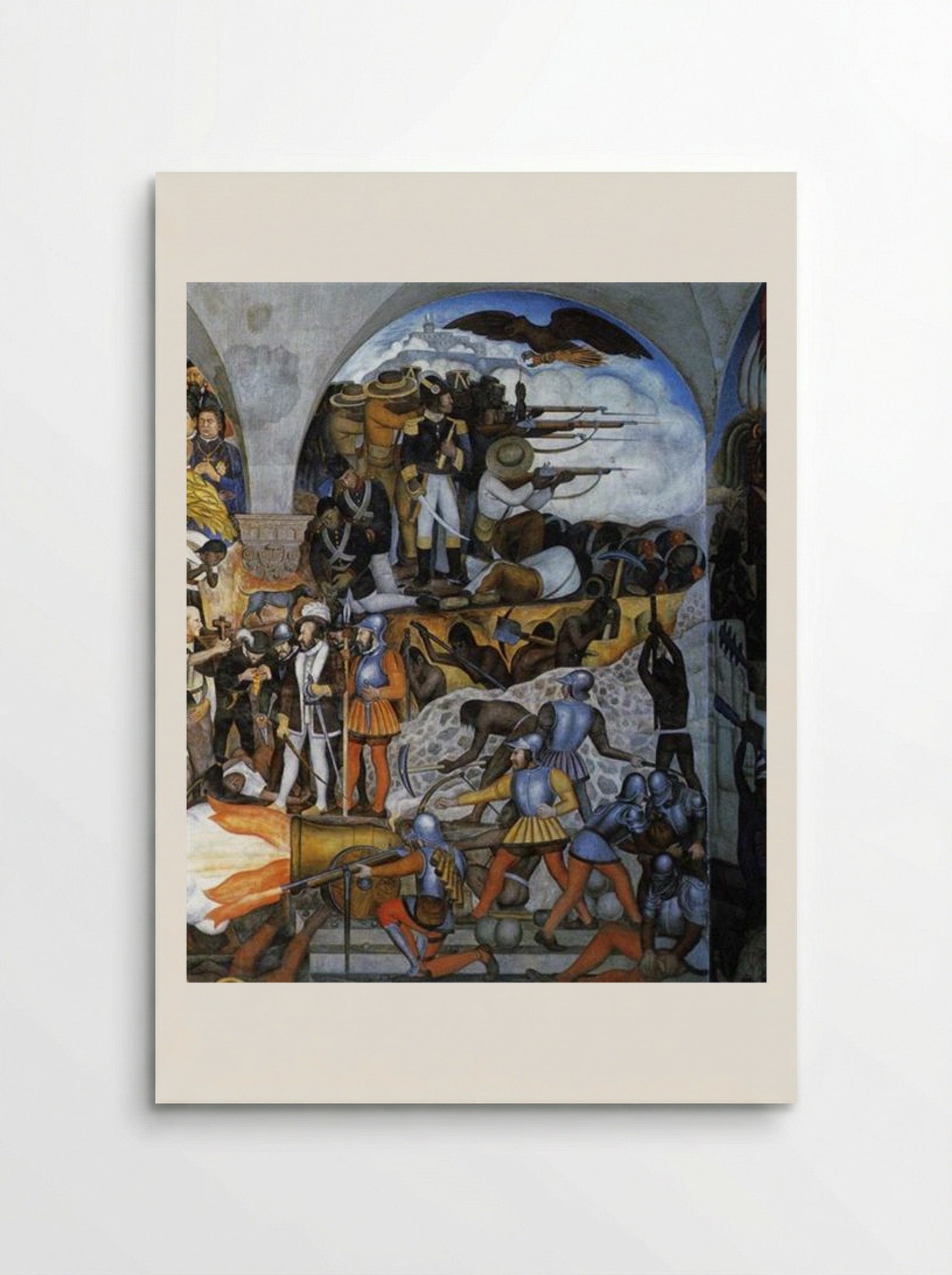

The History of Mexico - Diego Rivera
Archival giclée
Frames arrive ready to hang
Secure checkout
Made to order
Description
Diego Rivera's fresco, "The History of Mexico", is a dynamic depiction of Mexican history, from pre-Columbian times through the Revolution, reflecting the struggles and triumphs of the Mexican people.
Diego Rivera's "The History of Mexico" is a fresco that presents a sweeping narrative of Mexican history, from pre-Columbian times through the Mexican Revolution. Rivera was a central figure in the Mexican Muralism movement, which sought to create public art that would educate and inspire the masses. This work is a complex composition filled with figures representing various historical periods and social classes. The mural depicts scenes of conflict, oppression, and resistance. Indigenous peoples are shown alongside Spanish conquistadors, highlighting the clash of cultures and the exploitation of the native population. The Mexican Revolution is also represented, with images of revolutionaries fighting for social justice. The overall effect is one of dynamism and movement, as the figures seem to surge across the surface of the wall. Rivera's use of colour and form creates a powerful visual statement about the struggles and triumphs of the Mexican people. The mural is not just a historical record; it is also a call for social change and a celebration of Mexican identity.
Return policy
Because every print is made to order, we don't offer change-of-mind returns, refunds or exchanges. If your order arrives faulty, damaged or incorrect, we'll replace it free of charge — just contact us within 48 hours of delivery. See our refunds page for full details.
Shipping
We ship worldwide, printing at the production hub nearest to your delivery address. Delivery times and costs vary by destination — you'll see the options available to you at checkout.
Manufacturing
Each print is produced to order using 12-colour giclée printing on FSC-certified archival paper. Designed in Britain and printed at your nearest production hub to reduce waste and speed up delivery.
Care and materials
Specific Features
Every Solis piece is made to order with archival, gallery-quality materials built to last.
- Museum-grade giclée printing for rich, fade-resistant colour
- Archival matte fine-art paper, FSC-certified
- Multiple sizes and framing options available
- Frames in black, natural wood, dark wood or white
- Framed prints arrive ready to hang
Care & Cleaning
To keep your artwork looking its best:
- Dust gently with a soft, dry cloth
- Avoid prolonged direct sunlight
- Never use liquid cleaners on the print or canvas surface
- Keep in a dry, room-temperature space
- Handle prints with clean, dry hands
Materials & Sizing
Museum-grade giclée on FSC-certified archival matte paper, with framed and canvas options.
- Paper sizes: A4, A3, A2, A1, A0 and B2 (50×70 cm)
- Canvas: XS (20×30 cm) to Large (60×90 cm)
- Frames: black, natural wood, dark wood or white
The History of Mexico - Diego Rivera

Artist Biography
Diego Rivera
He studied at the Academy of San Carlos in Mexico City and spent fourteen years in Europe (1907-1921), absorbing Cubism in Paris and working alongside Picasso, Modigliani, and Mondrian. He returned to Mexico and found his subject: the history, labour, and people of his country, painted in a style that combined Renaissance fresco technique with pre-Columbian imagery and Marxist ideology.
The Detroit Industry Murals at the Detroit Institute of Arts (1932-33) are twenty-seven panels depicting the Ford Motor Company's River Rouge plant. The workers are heroic. The machinery is beautiful. Henry Ford's son Edsel commissioned them. The business community wanted them destroyed. They survived.
He married Frida Kahlo in 1929. They divorced in 1939. They remarried in 1940. The relationship was mutually unfaithful, politically intense, and artistically productive for both of them. Rivera said Kahlo was the better painter. Whether he believed this or was performing generosity is an open question.
He accepted a commission from Nelson Rockefeller for a mural in Rockefeller Center in 1933 and included a portrait of Lenin. Rockefeller asked him to remove it. Rivera refused. The mural was destroyed. Rivera repainted it in Mexico City. He died in 1957, at seventy.
Why Choose Us ?
Damage-free delivery guarantee
Fast Shipping
Museum-Quality Materials
You May Also Like