

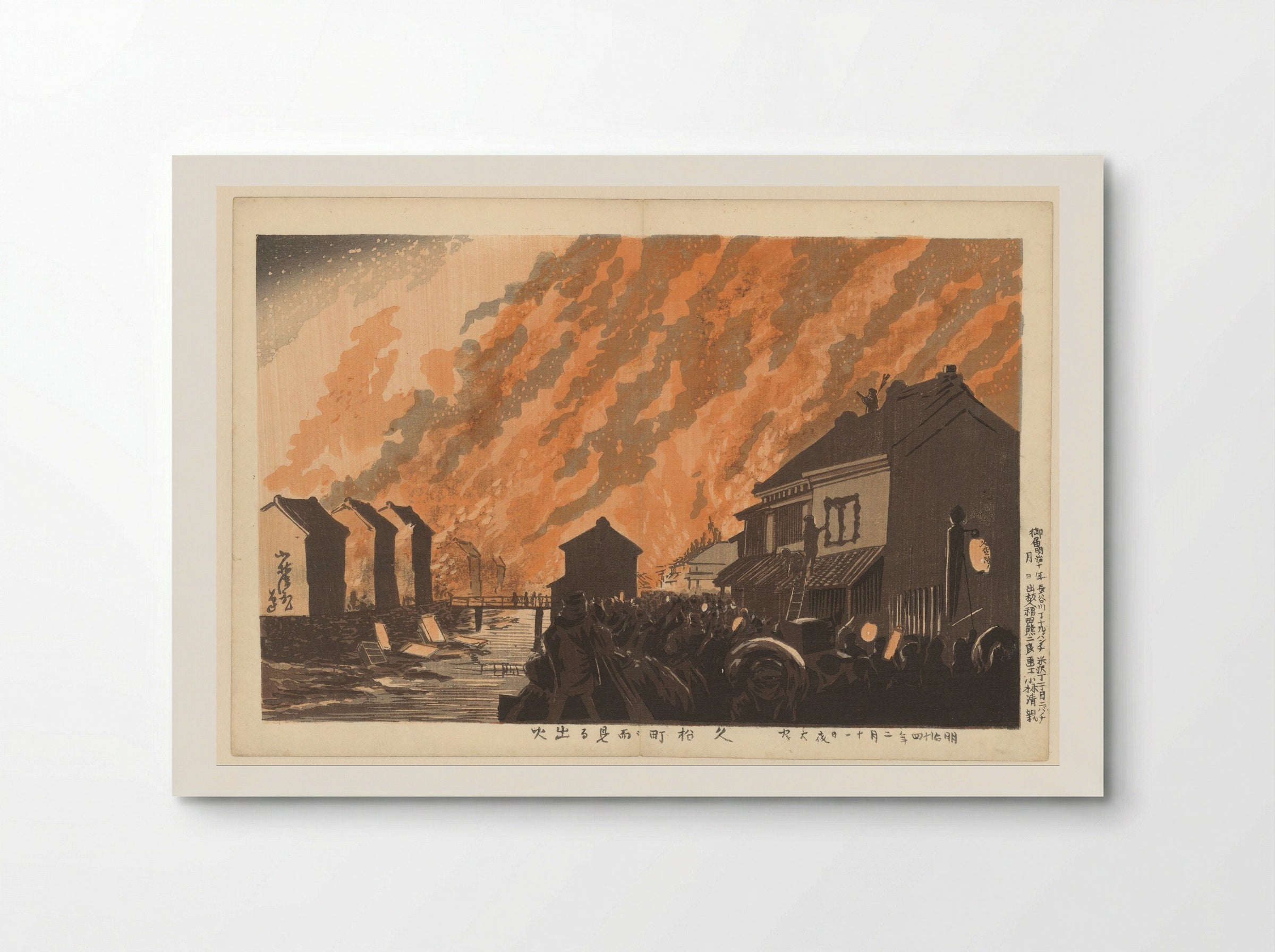
The Great Fire Seen from Hisamatsu-cho - Fine Art Print
Archival giclée
Frames arrive ready to hang
Secure checkout
Made to order
Description
A dramatic Meiji-era woodblock print depicting the intensity of a major fire in Tokyo, captured with traditional graphic techniques.
This woodblock print depicts the chaos and intensity of a major urban conflagration in Meiji-era Tokyo. The scene captures the fire as viewed from the Hisamatsu-cho district, a location known for its proximity to the theatre quarter. The composition is dominated by the massive, stylised plumes of orange and red smoke that fill the upper portion of the frame, contrasting with the dark, silhouetted architecture of the city below. In the foreground, the artist records the frantic activity of the local population. Figures are shown attempting to protect their properties, with one individual positioned on a roof and others gathered near the street level. The use of traditional woodblock techniques allows for the layering of colour, particularly in the depiction of the fire, which is rendered with a graphic, almost flat quality that emphasises the scale of the disaster. The inclusion of lanterns and the specific architectural details of the buildings provides a sense of place and time, documenting the frequent fires that plagued the wooden structures of nineteenth-century Japanese cities. This work belongs to the genre of news prints, or 'kaika-e', which emerged during the early Meiji period to inform the public about current events. These prints served as a visual record of the rapid changes and occasional catastrophes occurring in the capital. The print maintains a balance between the documentary nature of the subject and the aesthetic conventions of the Ukiyo-e tradition. The stark contrast between the dark, muted tones of the street and the bright, saturated hues of the fire creates a sense of urgency. It remains a compelling example of how traditional printmaking adapted to record the modernising, yet often volatile, environment of late nineteenth-century Japan.
Return policy
Because every print is made to order, we don't offer change-of-mind returns, refunds or exchanges. If your order arrives faulty, damaged or incorrect, we'll replace it free of charge — just contact us within 48 hours of delivery. See our refunds page for full details.
Shipping
We ship worldwide, printing at the production hub nearest to your delivery address. Delivery times and costs vary by destination — you'll see the options available to you at checkout.
Manufacturing
Each print is produced to order using 12-colour giclée printing on FSC-certified archival paper. Designed in Britain and printed at your nearest production hub to reduce waste and speed up delivery.
The Great Fire Seen from Hisamatsu-cho - Fine Art Print
Artist Biography
Unknown Artist
The artistic approach of the Unknown Artist varies between the formal composition of the carte-de-visite and the narrative style of the war prints. In the Moroccan portraits, the focus rests on the subject's posture and attire against a neutral studio backdrop. The Japanese prints use bold lines and flat colours to depict military movements and naval victories. Despite the lack of a specific attribution, these works demonstrate a high level of technical skill in both lithography and woodblock carving.
Modern collectors often value anonymous works for their mystery and focus on the image itself. These prints provide a direct connection to history without the distraction of a famous name. They function as windows into the 19th-century world, from the quiet dignity of a young girl in a studio to the chaos of a distant conflict. These pieces offer a sense of discovery for those who appreciate the aesthetic qualities of vintage photography and historical illustration.
Our Features
Designed for Lasting Impact
Specific Features
Every Solis piece is made to order with archival, gallery-quality materials built to last.
- Museum-grade giclée printing for rich, fade-resistant colour
- Archival matte fine-art paper, FSC-certified
- Multiple sizes and framing options available
- Frames in black, natural wood, dark wood or white
- Framed prints arrive ready to hang
Care & Cleaning
To keep your artwork looking its best:
- Dust gently with a soft, dry cloth
- Avoid prolonged direct sunlight
- Never use liquid cleaners on the print or canvas surface
- Keep in a dry, room-temperature space
- Handle prints with clean, dry hands
Materials & Sizing
Museum-grade giclée on FSC-certified archival matte paper, with framed and canvas options.
- Paper sizes: A4, A3, A2, A1, A0 and B2 (50×70 cm)
- Canvas: XS (20×30 cm) to Large (60×90 cm)
- Frames: black, natural wood, dark wood or white
Why Choose Us ?
Damage-free delivery guarantee
Fast Shipping
Museum-Quality Materials
Artist Biography
Unknown Artist
The artistic approach of the Unknown Artist varies between the formal composition of the carte-de-visite and the narrative style of the war prints. In the Moroccan portraits, the focus rests on the subject's posture and attire against a neutral studio backdrop. The Japanese prints use bold lines and flat colours to depict military movements and naval victories. Despite the lack of a specific attribution, these works demonstrate a high level of technical skill in both lithography and woodblock carving.
Modern collectors often value anonymous works for their mystery and focus on the image itself. These prints provide a direct connection to history without the distraction of a famous name. They function as windows into the 19th-century world, from the quiet dignity of a young girl in a studio to the chaos of a distant conflict. These pieces offer a sense of discovery for those who appreciate the aesthetic qualities of vintage photography and historical illustration.
You May Also Like