

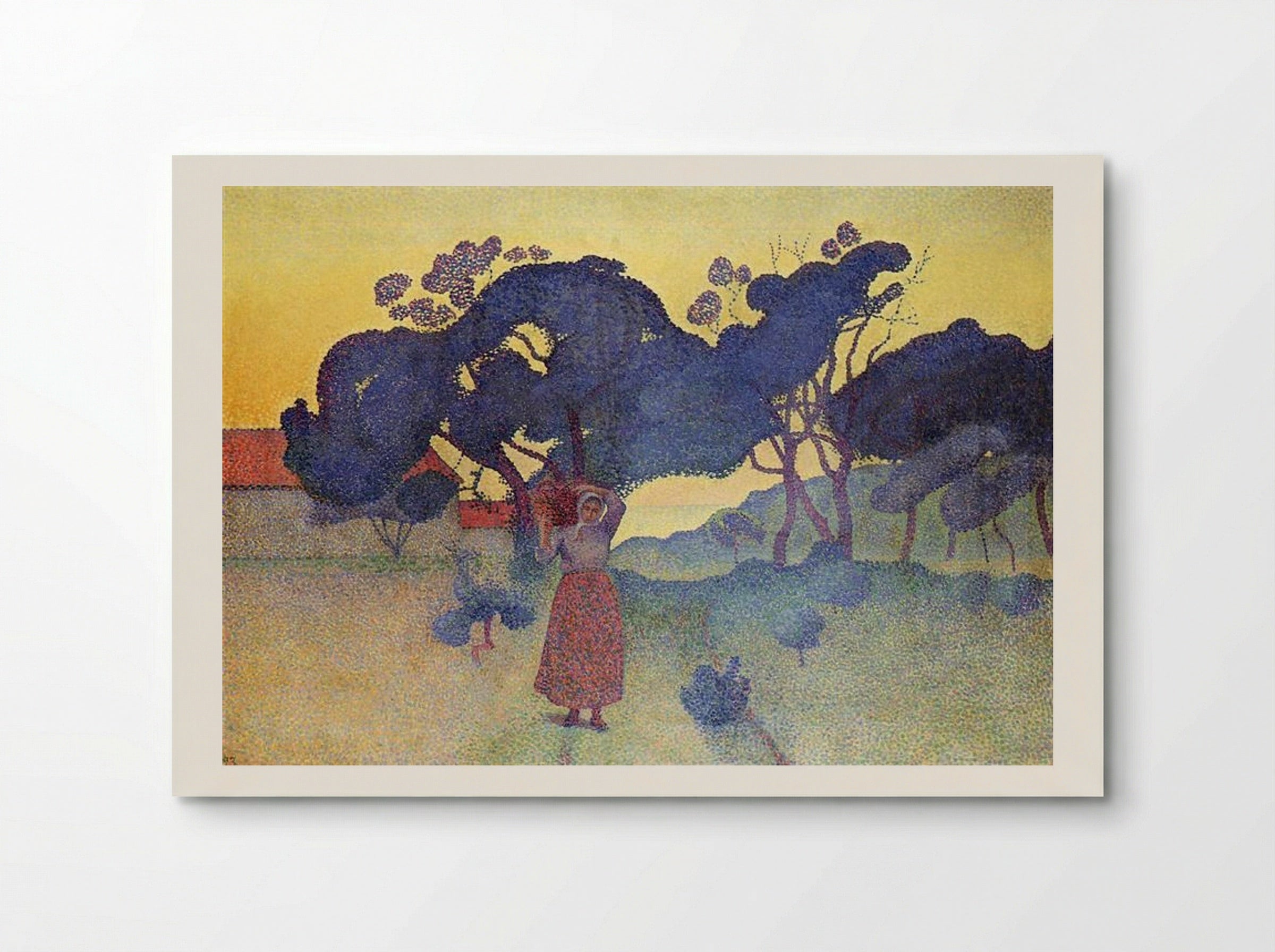
The Farm, Evening - Henri-Edmond Cross
Archival giclée
Frames arrive ready to hang
Secure checkout
Made to order
Description
Henri-Edmond Cross's 'The Farm, Evening' captures a tranquil rural scene in the warm light of dusk, showcasing his mastery of colour and light within the Neo-Impressionist style.
Henri-Edmond Cross, a French painter born in 1856, is known for his contributions to the Neo-Impressionist movement. He, along with artists like Seurat and Signac, explored the science of colour and optics, applying small, distinct dots of pure colour to the canvas, allowing the viewer's eye to blend them at a distance. This technique, known as Pointillism, aimed to achieve a greater luminosity and colour intensity than traditional mixing methods. Cross's later works, including 'The Farm, Evening', moved away from strict Pointillism, using broader, more expressive brushstrokes. In 'The Farm, Evening', Cross depicts a rural scene bathed in the warm light of dusk. The composition features a woman in the foreground, possibly a farmer, set against a backdrop of trees and a distant farmhouse. The sky is rendered in soft yellows, suggesting the setting sun. The trees, rendered in shades of blue and purple, create a contrast with the warm tones of the sky and ground. The overall effect is one of tranquility and harmony, capturing the serene atmosphere of the countryside at twilight. The painting demonstrates Cross's mastery of colour and light, and his ability to evoke a sense of place and mood.
Return policy
Because every print is made to order, we don't offer change-of-mind returns, refunds or exchanges. If your order arrives faulty, damaged or incorrect, we'll replace it free of charge — just contact us within 48 hours of delivery. See our refunds page for full details.
Shipping
We ship worldwide, printing at the production hub nearest to your delivery address. Delivery times and costs vary by destination — you'll see the options available to you at checkout.
Manufacturing
Each print is produced to order using 12-colour giclée printing on FSC-certified archival paper. Designed in Britain and printed at your nearest production hub to reduce waste and speed up delivery.
Care and materials
Specific Features
Every Solis piece is made to order with archival, gallery-quality materials built to last.
- Museum-grade giclée printing for rich, fade-resistant colour
- Archival matte fine-art paper, FSC-certified
- Multiple sizes and framing options available
- Frames in black, natural wood, dark wood or white
- Framed prints arrive ready to hang
Care & Cleaning
To keep your artwork looking its best:
- Dust gently with a soft, dry cloth
- Avoid prolonged direct sunlight
- Never use liquid cleaners on the print or canvas surface
- Keep in a dry, room-temperature space
- Handle prints with clean, dry hands
Materials & Sizing
Museum-grade giclée on FSC-certified archival matte paper, with framed and canvas options.
- Paper sizes: A4, A3, A2, A1, A0 and B2 (50×70 cm)
- Canvas: XS (20×30 cm) to Large (60×90 cm)
- Frames: black, natural wood, dark wood or white
The Farm, Evening - Henri-Edmond Cross

Artist Biography
Henri Edmond Cross
He trained conventionally, painting in the dark realist manner of Bastien-Lepage and Manet. The conversion to Neo-Impressionism came slowly: he did not adopt the pointillist technique until 1891, years after Seurat and Signac had established the method. Once he committed, he moved south. Diagnosed with rheumatism, he left Paris and settled in Saint-Clair on the Mediterranean coast, where the climate was gentler and the light was entirely different.
The move changed his painting. Working alongside Signac, who had also moved south, Cross developed a second phase of Neo-Impressionism: broader, looser brushstrokes than the granular dots of Parisian pointillism, in colours heated by Mediterranean light. The palette shifted from grey and blue to orange, violet and turquoise. The brushstrokes grew from points to mosaic-like blocks of colour.
The late paintings influenced Matisse directly. When Matisse visited Saint-Tropez in 1904, he saw Cross's work and recognised something he could use: the liberation of colour from description. Fauvism, which Matisse would lead the following year, grew partly from what Cross and Signac were doing on the Mediterranean coast.
Cross died in 1910, aged fifty-three. He spent the last nineteen years of his life painting the same coastline in colours that got more intense with each passing year.
Why Choose Us ?
Damage-free delivery guarantee
Fast Shipping
Museum-Quality Materials
You May Also Like